






India’s ₹75,000 crore paint industry is witnessing an intense shakeup as Birla Opus, backed by ₹10,000 crore in investments, challenges the dominance of Asian Paints and other long-standing leaders. With simultaneous plant rollouts, backward integration, and a bold distribution strategy, Birla is taking on decades of entrenched dealer relationships and brand loyalty. This article dives deep into the industry structure, business models, capex races, stock market impact, and whether Birla can truly disrupt one of India’s most stable consumer sectors.
Overview of the Indian Paint Industry
India’s paint industry is booming. As of 2024, it’s estimated to be worth over ₹75,000 crore and is expected to grow at a CAGR of 11-13% over the next five years. Despite rapid urbanization, infrastructure development, and rising disposable incomes, India still lags behind in per capita paint consumption, using just around 4.5 kg per person annually. In contrast, China consumes over 15 kg and developed markets like the US and Europe exceed 20 kg. This low base offers tremendous headroom for growth.
The industry is broadly divided into two segments:
- Decorative Paints (75-80%): This includes products like emulsions, distempers, enamels, and wood finishes used in homes, offices, and buildings.
- Industrial Paints (20-25%): Used in sectors such as automotive, marine, and protective coatings.
A strong monsoon, government housing schemes (like PMAY), and urban real estate construction are key drivers. The repainting cycle—typically 3-5 years in India—adds stability to demand.
How Paint is Made and Supplied
Paint production is a high-precision, batch-based industrial process involving chemical engineering and supply chain coordination. The process begins with key raw materials:
- Pigments like titanium dioxide (for whiteness and opacity)
- Resins and binders to form the paint film
- Solvents to ensure flow and spreadability
- Additives to improve performance (UV resistance, anti-fungal, etc.)
The paint is manufactured in controlled environments and undergoes multiple rounds of quality testing. Once produced, paints are packed and shipped to regional stockists and over 150,000 dealers across India.
Also Read: Asian Paints Slips After Profit Shock: Market Reacts to Q4 FY25 Earnings
Distribution is King in This Business
Distribution is king in this business. Paint companies rely heavily on strong dealer relationships, extensive credit facilities, and frequent training to ensure product knowledge and brand loyalty at the point of sale. Logistics challenges, especially in rural India, make scale a key competitive advantage.
Asian Paints was the first to fully leverage this model by building a 75,000-strong dealer network across metros, Tier 2/3 towns, and rural markets. These dealers receive regular stock replenishments every 48–72 hours, enabling high inventory turnover and excellent cash flow visibility.
In return, Asian Paints offers exclusive products, personalized dealer schemes, color consultancy tools, and co-funded retail branding. This creates a sticky ecosystem that makes dealer churn extremely low.
Berger, Nerolac, and AkzoNobel follow similar, though regionally limited, approaches. Indigo Paints uses a more targeted model—focusing on emerging towns with higher incentive structures.
Birla Opus is aiming to recreate this strength from scratch. The company is rolling out a hub-and-spoke logistics model with regional fulfillment centers, integrated ERP-backed inventory systems, and express delivery fleet partners. It is offering dealers:
- Higher upfront margins
- Faster onboarding
- Digital POS tools
- Access to branded retail formats
The challenge? Breaking the incumbents’ decades-old emotional and financial bonds with dealers.
If Birla succeeds, it could redefine what a 21st-century distribution network in India’s paint sector looks like.
The Market Leaders: Dominance and Differentiation
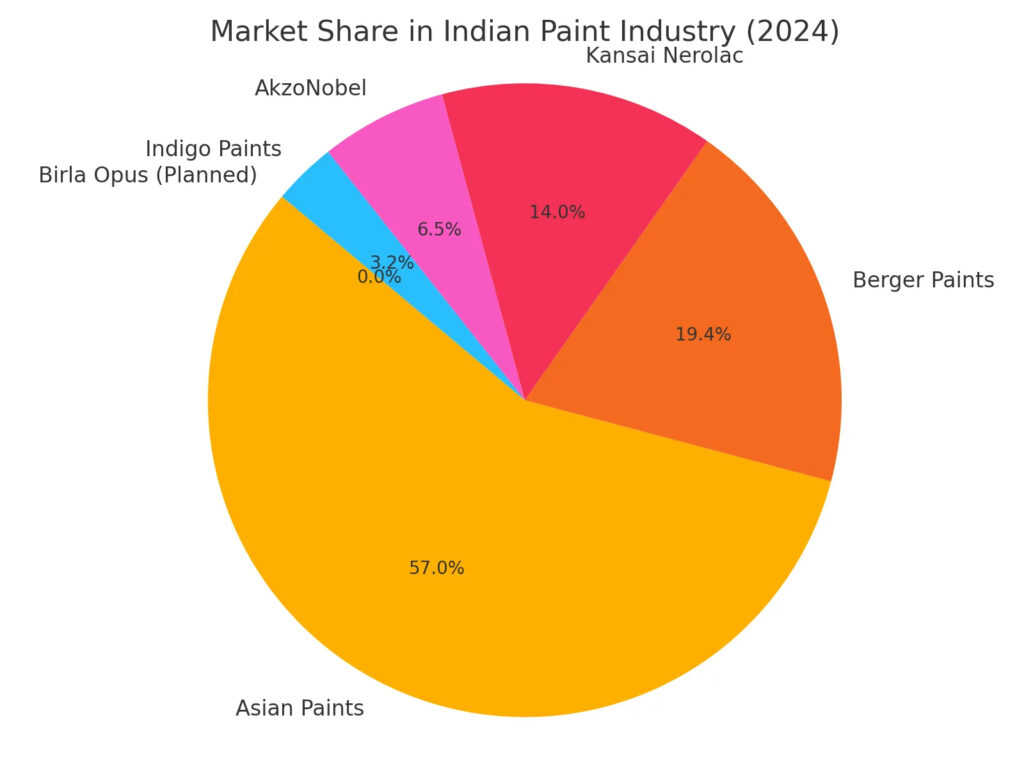
The Indian paint industry is an oligopoly dominated by five players:
- Asian Paints (53%): The undisputed leader, with a legacy of over 80 years. Known for its extensive dealer network (~75,000 dealers), aggressive branding (“Har Ghar Kuch Kehta Hai”), and strong supply chain. It also provides services like home painting.
- Berger Paints (18%): Known for its value-for-money offerings and faster drying paints. Strong presence in Eastern India.
- Kansai Nerolac (13%): Leader in industrial paints, especially automotive. Key client: Maruti Suzuki.
- AkzoNobel (6%): Global parent of Dulux. Strong premium presence but limited penetration.
- Indigo Paints (3%): New-age player with a strong focus on Tier 2/3 towns and product innovation.

Asian Paints’ edge comes from vertical integration—it controls everything from raw materials to final delivery. Its ability to deliver to dealers in less than 48 hours is unmatched.
The New Challenger: Birla Opus’ Entry
Birla Opus, the Aditya Birla Group’s ambitious venture into paints, is more than just a new player—it’s a declaration of war on the incumbents. With ₹10,000 crore earmarked for investments, the move is positioned to disrupt the paint oligopoly that has existed for decades.
The strategy is based on three foundational pillars:
- Massive Manufacturing Capacity: Birla Opus is setting up six greenfield plants in Tamil Nadu, Maharashtra, West Bengal, Andhra Pradesh, Madhya Pradesh, and Odisha. The total production capacity is pegged at over 1.3 million kilolitres annually—comparable to Asian Paints.
- Backward Integration: The company is leveraging Grasim and Aditya Birla Chemicals to build in-house capabilities for emulsions, resins, and other key inputs. This will help reduce dependency on volatile global raw material markets and ensure cost efficiency from day one.
- Premium Branding and Technology: Birla Opus aims to enter the market with premium emulsions and textures, focusing on modern homes and contractors. A digital-first approach will be key, targeting millennials and urban families through influencer marketing, e-commerce, and high-tech color visualization tools
| Company | Annual Capacity (KL) | No. of Plants | Rollout Type |
| Asian Paints | ~1.3 million KL | 26+ | Phased |
| Berger Paints | ~700,000 KL | 15+ | Regional-focused |
| Birla Opus | 1.3 million KL (planned) | 6 | Simultaneous |
In terms of logistics, Birla Opus is investing in its own fleet and warehouses, trying to replicate Asian Paints’ 48-hour delivery model. Their stated goal is to onboard 10,000 dealers by 2026—a goal seen as both ambitious and aggressive.
Business Model Comparison: Expansion, Pricing, and Distribution
The paint industry thrives on last-mile control. While product quality matters, the ability to reach a local shop in a Tier 3 town within 48 hours makes or breaks a brand.
- Asian Paints has built its empire by becoming a logistics powerhouse. Every dealer gets regular support, sales analytics, and is locked in through exclusive product offerings. Their Home Solution program and colour consultancy services provide end-to-end consumer engagement.
- Berger and Kansai Nerolac operate on a regional strength model—Berger is strong in East India, while Kansai is preferred in industrial and automotive sectors.
- Birla Opus is using its capex muscle to jumpstart a fresh network. It’s aggressively offering dealers better margins (5–10% higher), easy credit, rapid onboarding, and data tools for customer targeting. It is even offering co-branded paint studios to build premium experience stores.
- Pricing Strategy: Asian Paints and Berger operate at a premium to mid-premium level. Birla Opus is expected to enter both premium and economy categories simultaneously, using a disruptive pricing model in lower-tier markets while holding margins in metros.
| Company | Dealer Network | Distribution Strength | Pricing Strategy | Credit Support | Brand Recall |
| Asian Paints | 75,000+ | 2-day direct delivery | Premium | Moderate | Very High |
| Berger Paints | 30,000+ | Strong East presence | Mid-premium | Flexible | Medium |
| Kansai Nerolac | 20,000+ | OEM/Auto partnerships | Industrial & retail | Niche | Moderate |
| Birla Opus | Target 10,000 | New fleet + warehousing | Dual (Aggressive B2C) | Very Flexible | Low (new) |
Exit of Reliance from Asian Paints
In 1999, Reliance Industries acquired a 5% stake in Asian Paints through a strategic investment. However, by 2007, it had exited completely. The reasons aren’t fully public, but analysts speculate that Reliance wanted to exit non-core businesses.
In hindsight, this exit has cost Reliance significant long-term gains. Asian Paints’ market capitalization has grown over 10x since then, making it one of India’s most valuable FMCG brands. It remains a case study in missed long-term investing opportunities.
Also Read: Paint Industry Disrupted: Birla Opus Challenges Asian Paints’ Dominance
Capex Wars: Where the Big Money Is Going
The last 24 months have witnessed a sudden spike in investment announcements across the industry. The playbook is simple: Build capacity today to dominate market share tomorrow.
- Asian Paints is spending ₹4,500 crore to expand capacity across Maharashtra, Vizag, and Karnataka. It’s also investing in backward integration plants for white cement and emulsions.
- Berger Paints is deploying ₹1,200 crore into its upcoming Sandila (UP) and Howrah (West Bengal) plants. It is also upgrading automation at existing facilities.
- Kansai Nerolac is allocating ₹1,000 crore, mostly into automotive-focused paint tech and sustainable coating systems.
- Birla Opus has committed ₹10,000 crore, the majority of which is already deployed in land acquisition, plant construction, and machinery import. Each plant is expected to create ~300 direct and 1,000 indirect jobs.

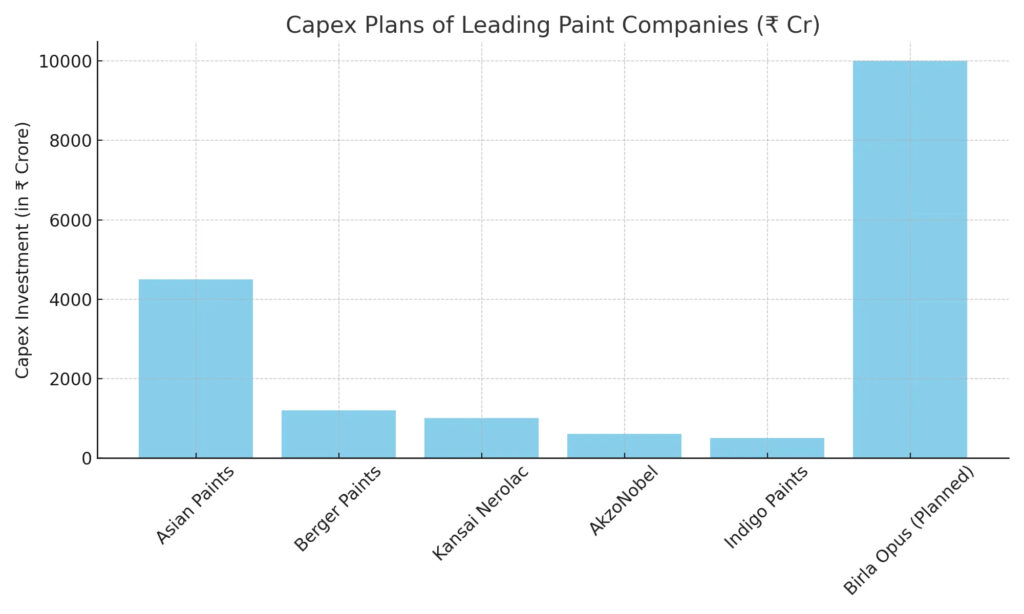
What’s unique about Birla’s investment is the parallel rollout. All six facilities are being built almost simultaneously, ensuring a pan-India launch rather than a phased one—something no incumbent has done before.
Stock Market Perspective
Investor sentiment in the paints sector has traditionally been bullish. With stable cash flows, low capex relative to revenue (until now), and high brand loyalty, paint stocks have enjoyed premium valuations.
- Asian Paints, the bellwether, has traded at a P/E ratio of over 65x consistently. Despite the threat from Birla, it remains a defensive pick in consumer discretionary.
- Berger Paints and Indigo Paints have also witnessed volatility, but analysts believe they could gain market share if Birla’s aggression dents Asian Paints.
- The entry of Birla Opus has triggered fears of price undercutting, which has led to temporary dips in all major paint stock prices.
| Company | Market Cap (₹ Cr) | P/E Ratio | 5-Year Return |
| Asian Paints | ~₹2.8 lakh Cr | ~66x | 150%+ |
| Berger Paints | ~₹60,000 Cr | ~72x | 130%+ |
| Indigo Paints | ~₹10,000 Cr | ~50x | 80%+ |
The Street is watching:
- Whether Birla Opus meets its launch timelines.
- Whether Asian Paints’ margins shrink.
- Whether dealer attrition becomes visible.
In the short term, volatility is expected. But long-term, the entry of a serious challenger could expand the total market and lift all boats.
What Lies Ahead: Can Birla Opus Disrupt the Paint Oligopoly?
Breaking an oligopoly takes more than money—it requires reshaping habits. Dealers are creatures of habit, and switching costs include risk of return, customer dissatisfaction, and lack of after-sales support.
Birla Opus will have to:
- Build trust at the dealer level through consistent delivery and field support.
- Create high-impact brand campaigns to gain top-of-mind recall.
- Sustain pricing advantage without sacrificing product quality.
- Use analytics and digitization to offer differentiated value to modern homeowners.
At the same time, Asian Paints is unlikely to take things lightly. It has already increased its dealer engagement budget, launched new service arms (Asian Paints Beautiful Homes), and is rumored to be scouting for tech acquisitions in home décor and automation.
If Birla succeeds, this will be one of the most impressive B2B-to-B2C transformations in India’s consumer history. If not, it might go the way of several past disruptors who couldn’t break the Asian Paints moat.
When the Paint Dries…
India’s paint industry is no longer a sleepy sector. With a massive ₹10,000 crore gamble, Birla Opus is set to challenge an entrenched oligopoly. Whether this leads to price wars, improved services, or just stronger competition, one thing is clear: the battle has only just begun. Consumers will benefit, dealers will gain choices, and investors will watch closely as the paint dries on India’s most colorful corporate rivalry yet.
READ MORE ON