






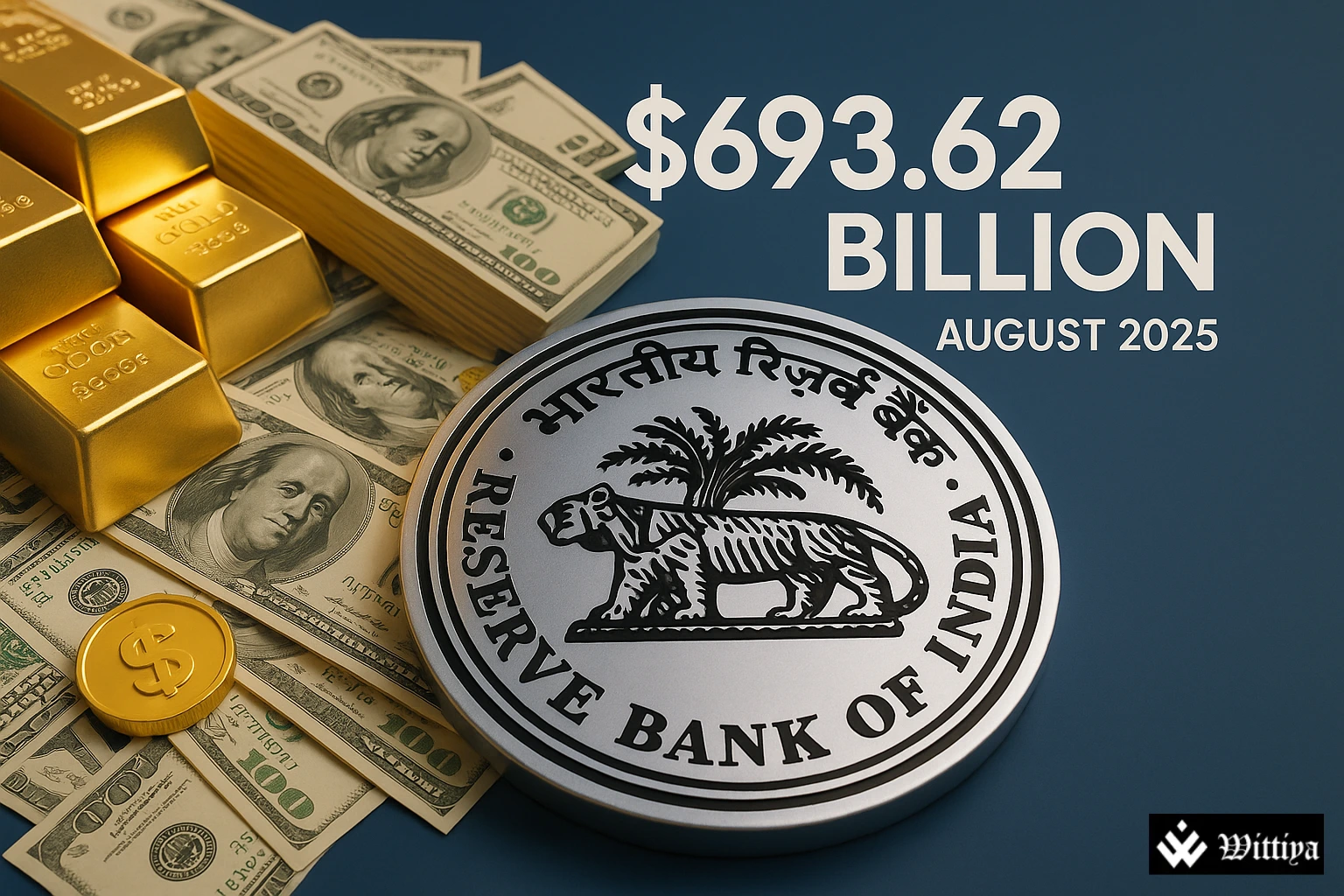
India’s foreign exchange reserves rose by $4.74 billion to reach $693.62 billion as of August 8, 2025, according to the Reserve Bank of India (RBI). The increase, largely driven by higher gold and Special Drawing Rights (SDR) holdings, comes as a positive signal for the rupee, externa
The Reserve Bank of India (RBI), headquartered in Mumbai, is responsible for managing the nation’s monetary policy, banking regulation, and foreign exchange stability. The central bank’s forex reserve data, released weekly, is closely tracked by policymakers, investors, and international agencies as a key measure of economic resilience.
For the week ending August 8, 2025, India’s forex reserves increased to $693.62 billion, recovering strongly from the previous week’s fall when the reserves stood at $688.87 billion. The $4.74 billion rise highlights renewed confidence in India’s external account and reinforces the country’s financial buffers.
A breakdown of the reserves shows that gold holdings surged by $2.16 billion, taking the tally to $86.16 billion, reflecting both valuation gains and additions by the RBI. Meanwhile, Special Drawing Rights (SDR) rose by $169 million to $18.74 billion, while the IMF reserve position climbed by $45 million to $4.73 billion.
India’s forex reserves had earlier touched a record high of $704.88 billion in September 2024, but fluctuated since then due to global capital flows, commodity price swings, and currency market movements. The current rebound suggests stronger inflows and effective liquidity management by the central bank.
Also Read: RBI’s $7 billion rupee rescue sparks fears of economic instability
Why Rising Reserves Matter
Forex reserves play a critical role in shielding the economy from external shocks. For India, higher reserves help:
- Stabilize the rupee: The RBI can intervene in currency markets to check volatility.
- Support imports: With reserves covering more than 10 months of imports, India has a strong cushion against trade disruptions.
- Boost investor confidence: A high reserve base signals financial stability, encouraging foreign direct investment (FDI) and portfolio flows.
- Mitigate global risks: Adequate reserves provide protection during global crises, oil price surges, or sudden capital outflows.
Sectoral Impact
- Rupee and Currency Market: The reserves give the RBI greater flexibility to manage the exchange rate, reducing speculative pressure on the rupee.
- Trade and Imports: Rising reserves ensure smoother financing of essential imports such as crude oil and technology goods.
- Capital Markets: Strong forex buffers improve investor sentiment, potentially attracting more foreign institutional investments into Indian equities and bonds.
- Banking Sector: With higher reserves, banks can expect more stability in currency markets, reducing risks of sudden shocks in cross-border trade financing.
Also Read: India’s Central Bank Celebrates a Spectacular Financial Leap in FY25
RBI’s Strategy
The RBI has maintained that it does not target any specific exchange rate but focuses on maintaining orderly market conditions. Its interventions—primarily through dollar sales or liquidity injections—are meant to curb excess volatility and ensure confidence in the financial system.
Looking ahead, analysts expect reserves to remain resilient, supported by steady FDI inflows, strong remittances, and an anticipated pick-up in exports as global trade stabilizes.
READ MORE ON