






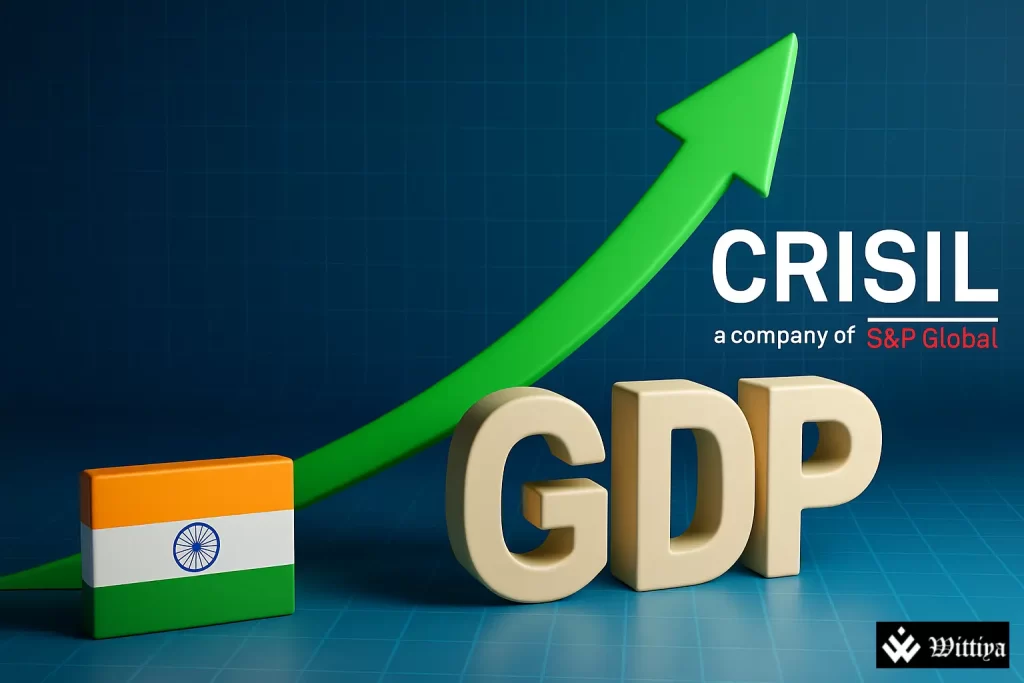
The India GDP forecast by Crisil remains unchanged at 6.5% for FY 2025-26. It stated that, as expected, private consumption would continue to be the mainstay of the country’s economic development. The forecast is still strong despite various risks such as U.S. trade barriers and a weak global economy.
Crisil Retains India GDP Forecast FY26 at 6.5%
Crisil is Mumbai-based Indian company that provides global analytics, ratings, and research. The company mainly functions in the financial services sector providing the market with risk analysis, credit ratings, industry research, and policy insights. Being a subsidiary of S&P Global, Crisil, through its regular forecasts and sectoral studies, plays an instrumental role in India’s macroeconomic outlook.
India’s GDP Growth Expectation for FY26
In its earlier forecast, Crisil envisaged India’s GDP growth at 6.5% for FY26, which it has now confirmed. Despite the external headwinds, the forecast comes with the resilience of domestic consumption bolstered by the fiscal measures and the easing of monetary policy.
India’s economy was able to expand by 6.5% in FY25. The official data shows 7.8% real GDP growth for the April–June 2025 quarter, which is much higher than the 6.5% growth recorded in the same period last year. In that quarter, nominal GDP grew by 8.8%, thus indicating the vigor of domestic demand.
Downside Risks from U.S. Tariffs
The major sources of the Indian economy’s downgrading to negative impacts are the 50% tariffs that the U.S. has placed on Indian exports, going into effect on August 27, 2025, is the most significant negative impact of the Indian economy. It is expected that the tariffs would focus on the sectors that are dependent on labor such as textiles, leather, and some types of manufactured products.
Crisil is warning that the slower pace of export growth may become one of the factors that pull down total GDP growth in the next few quarters. The reduction in global trade activities combined with the protectionist policies of the U.S. could result in lower external competitiveness of India. Based on S&P Global data, worldwide GDP growth is estimated to fall from 3.3% in 2024 to 2.9% in 2025, which further decreases international demand.
Private Consumption: The Key Driver
Private consumption is likely to be the mainstay of India’s GDP growth despite the existing trade disputes. The expectation can be raised by a multitude of supportive factors:
- Healthy Monsoon & Agriculture Output
The good monsoon season is likely to raise agrarian production substantially, which in turn will lead to higher rural incomes and the stability of the food supply.
- Monetary Policy Support
RBI has signed off on a cut to the key repo rate by 1 straightforward percentage point in 2025. Cheap credit for households and businesses will be conveniently available thanks to this move. In addition, money flows from October to January are expected to be more than usual because of the gradual reduction in the CRR.
- Fiscal Measures & Tax Relief
To be specific, the Union Government will reduce the burden of taxes by giving relief to taxpayers, allocate more funds to various rural development schemes, and create demand in semi-urban and rural markets as a whole.
- GST Reform on the Horizon
During his Independence Day speech, Prime Minister Narendra Modi declared that by Diwali 2025, a more advanced Goods and Services Tax (GST) reform shall be introduced. The forthcoming GST Council gathering lined up for September 3–4 in Delhi is believed to seal the structural tax alterations that possibly mean a cut in the tax rates for certain consumer segments and a rise in consumption.
Sectoral Impact of GDP Outlook
- Consumer Goods & Retail: More available money and lower GST rates can create a larger customer base for both the FMCG and retail markets.
- Agriculture & Rural Economy: Besides a robust monsoon and policy support, purchasing power will also rise in rural India thus making consumption-led growth possible.
- Manufacturing & Exports: Uncertainty concerning tariffs might cause the decrease of the output of export-oriented industries. The effect will be more profound in sectors that are labor-intensive.
- Banking & Financial Services: Reduced interest rates and increased liquidity can push the growth of credit in retail loans, housing, and small business sectors.
Also Read: India Shrimp Exports Face 65% Tariffs
Comparison with Government Forecast
According to Crisil, the growth for the Indian economy will be approximately 6.5% for the financial year 2025-2026. While the Government of India also forecasts that growth will be in the range of 6.3%-6.8%. Both projections suggest that despite various economic challenges, the domestic consumption story holds strong.
The near agreement of the models signals that India is the strongest among the emerging countries whose growth is structurally based on consumer spending, policy reforms, and a populous working age group.
Looking Ahead
The way in which India’s economy grows in the financial year 2025-2026 will be dependent on how effectively domestic demand balances against any downturn in the external market. India’s GDP growth can go beyond projections if for example, global growth recovers sooner than expected or the adverse impacts of U.S. tariffs become more manageable. On the other hand, an extended period of weak exports coupled with global instability will impose a difficult situation on the consumption-driven growth model for it to survive.
Crisil’s 6.5% GDP growth for FY26 remains a strong sign of stability that in turn provides support to India’s domestic markets, the favorable policy environment, and structural reforms.
Key Highlights
- Crisil has retained the forecast for India’s GDP growth for FY26 at 6.5%.
- The major growth driver will be private consumption.
- Still, there are risks in the form of U.S. tariffs and the slowing of international trade.
- Positive agricultural production, Reserve Bank cutting the interest rates and tax relief are anticipated to boost the demand for the domestic market.
- The government’s prediction of GDP is between 6.3% and 6.8% for FY26.
FAQ’s
Q1. What is the forecast of India’s GDP for FY26 according to Crisil?
The expected GDP growth for India in FY26 by Crisil is 6.5%. The projection has not changed from the last one.
Q2. What are the main factors expected to provide momentum to India’s GDP growth in FY26?
RBI rate cuts, fiscal measures, and the great performance of the agriculture sector will fuel private consumption which will be the mainstay of the economy.
Q3. What are the risks that could lead to a low of India’s GDP growth in FY26?
The main threats are U.S. tariffs imposed on Indian exports and a global slowdown that causes fewer trades.
READ MORE ON