







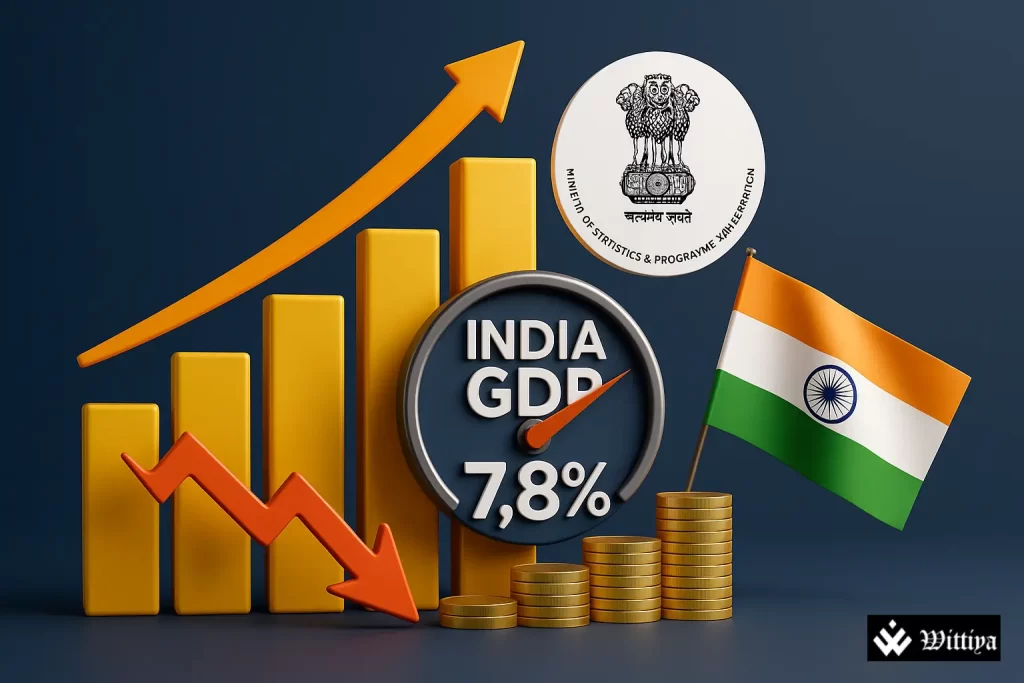
India’s economy expanded 7.8% in April–June 2025, the fastest pace in five quarters, led by manufacturing and services. Despite headline growth surpassing the official forecast, the high US tariffs on Indian exports and weaker nominal growth cast a shadow on the near-term fiscal and external outlook.
Ministry of Statistics and Programme Implementation (MoSPI) — Location: New Delhi, India — Sector: Government statistical agency — Basic services: collection, compilation, and publication of the national statistics including GDP, inflation, employment, and sectoral output. MoSPI releases the quarterly national accounts that form the base of macroeconomic monitoring and policy formulation.
India GDP Growth — Q1 FY26 Details and Implications
India’s first quarter of fiscal 2025–26 (April–June 2025) saw a much higher than expected growth of 7.8% year-on-year (YoY), thus reaching the best level in five quarters. Besides good results in manufacturing and services, the growth also came after a rise in public capital spending especially in the infrastructure area.
What the numbers show
- Real GDP (growth): 7.8% in Q1 FY26 (April–June 2025).
- Nominal GDP: went up by 8.8%, which was below the full-year nominal forecast of the government, primarily due to a steep reduction in the GDP deflator.
- GDP deflator: dropped to around 1.0% in Q1 from around 3.4% in Q4 FY25, which reflected that inflation had a less strong impact on both wholesale and retail during the quarter.
Sectoral drivers
- Services: Grew impressively at about 9.3% (the highest level of the last eight quarters), while public administration, defense, financial, and professional services were essentially the leading contributors to the growth. Trade, hotels, transport, and communication also recorded good progress.
- Manufacturing: Was back on the upward trajectory to approximately 7.7%, the best performance over the last four quarters, and this was accompanied by the easing of the input cost pressure.
- Agriculture: The output has gone up to 3.7%, with the harvest of rabi (winter crops) and sowing of kharif (monsoon crops) both being above the average.
- Construction: The decline in growth to 7.6% was because of a temporary softer activity of the labor-intensive project.
Also Read: India Q1 FY26 GDP Growth at 6.7% Matches RBI Projection
Demand side dynamics
- Private consumption: Speeded up to approximately 7%, which was mainly rural demand and better-than-usual household cash flows that drove the consumption.
- Government spending: Rose by a large margin, while government final consumption and capital expenditure were the two main contributors to aggregate demand.
- Investment (GFCF): The gross fixed capital formation went up by 7.8%, pointing to the positive trend of capex, especially public capital projects and infrastructure.
External sector and trade
In Q1 net exports became negative again as imports increased by around 10.9%, thus outpacing exports that grew only by about 6.3% (merchandise and services combined). The import surge is due to strong domestic activity and continuous resource demands for industry and infrastructure.
Why the headline outperformance matters
The robust Q1 figure gives a short-term endorsement of India’s cyclical recovery: production is up at companies, consumer expenditure is also increasing, and government investing projects are in full swing. For capital markets, quicker real GDP growth reinforces corporate earnings projections and is a support to the overall market confidence in cyclical sectors such as manufacturing, infrastructure, and financial services.
Also Read: Trump’s Tariff Surge Could Shave 0.4% Off India’s FY26 GDP
On the other hand, the weaker nominal growth and the reduction in the GDP deflator make fiscal calculations more complicated. Lower price increases pull down the nominal base that government revenues and debt ratios depend on, therefore, this may make fiscal targets more difficult to achieve unless collections or growth pick up later in the year.
Policy vectors and macro risks
- Fiscal and monetary context
A somewhat lower GDP deflator and slower nominal growth could potentially limit the space for fiscal manoeuvre. At the same time, there is a strong positive domestic policy framework: less income tax and an easy monetary stance have resulted in more disposable income and credit flow. Besides, the Reserve Bank of India (RBI) is still monitoring inflation and liquidity conditions while the Ministry of Finance is keeping a close eye on fiscal metrics.
(Reserve Bank of India | Ministry of Finance)
- External shock: tariffs on exports
A great risk to the rest of FY26 is the situation of a U.S. trading partner that rolls out a plan to impose a 50% tariff on Indian exports to them. That kind of action affects not only directly export-oriented sectors but also the micro, small and medium enterprise (MSME) ecosystem, which accounts for most of the shipments of goods. It is estimated that the sustained external tariffs at a higher level could reduce India’s growth rate by several tenths of a percentage point and thus lower private investment in industries that are exposed to the external environment.
- Labour and supply constraints
Despite the fact that headline growth is strong, construction as well as certain services sectors are sensitive to shortages of labor, demand for specific events, and localized supply problems. The rising global uncertainties may cast a shadow on capital expenditure decisions in export-linked segments.
Structural strengths supporting growth
India’s positive GDP story is supported by a number of structural factors, which also provide the country with the capacity to withstand shocks that are part of the economic cycle:
- Policy reform momentum: The process of structural reforms keeps being implemented and the promotion of formalization are two factors that ensure the productivity of the medium term.
- Infrastructure investment: The government elevated capital expenditure feeds into the construction, transport and domestic demand are the three main sectors that benefit from this investment.
- Services export base: The continued output of higher value-added products such as finance, IT and professional services is one reason why the country is able to recover from the export composition shifts.
Also Read: India’s GDP Could Dip Due to US Tariffs—Here’s the Full Picture
- Agricultural rebound: The strong rabi output and the trajectory of the monsoon coming in favour of rural incomes and consumption are the factors that explain the agricultural revival.
Market and corporate implications
The high single-digit real GDP print normally has a positive impact on corporate revenue prospects, makes bank credit growth more sustainable and increases investor sentiment. From the point of view of the stock market, the fact that inflation is manageable and growth is picking up is good news for the cyclical sectors of the economy — manufacturing, capital goods, financials and consumer discretionary.
However, it should be noted that companies whose operations are heavily dependent on the US market and whose supply chains are sensitive to pricing will be the ones most affected by the tariff measures. As a result, their earnings and valuations will need to be re-evaluated by firms and investors when the tariff impacts and global demand dynamics get to be analyzed.
Takeaways for the rest of FY26
- Growth trajectory: The remarkable performance of Q1 makes it possible that the path to a ~6.5% full-year growth rate target can still be maintained, only if the external shock does not worsen and domestic demand keeps its strength.
- Nominal growth watch: The deceleration of nominal GDP will make it harder to meet fiscal targets and it will be closely observed by budget planners.
- Export vulnerability: The first thing that those sectors that are dependent on the affected export markets should do is to adjust their prices, secondly, explore new markets and lastly, speed up productivity measures.
- Policy space: The continuation of fiscal measures aimed at capex along with a well-calibrated monetary stance will be the main factors to keep up the momentum through Q2 and H2.
India GDP Growth
The India GDP growth surprise for Q1 FY26 highlights the domestic economy’s capacity to outperform near-term forecasts. India GDP growth of 7.8% in Q1 establishes a strong base, but policymakers and businesses must account for tariff headwinds and nominal-growth dynamics in planning for the rest of FY26.
FAQ’s
Q1: What factors contributed to India’s 7.8% GDP growth in Q1 FY26?
The growth in India was mainly driven by manufacturing and services, which were well supported by a rising public capital spending and improved private consumption.
Q2: What is the reason for concern about weaker nominal GDP?
Lower nominal growth slows down the tax bases and may cause the government to have problems in achieving fiscal-deficit and debt ratio targets unless there is a considerable increase in revenue or a decrease in expenditure.
Q3: What is the impact of a 50% export tariff on the economy?
A high and long-lasting tariff on the main products for export raises the risk of the export-dependent sectors and MSMEs falling, and therefore the total GDP may be decreased by a few tenths of a percentage if the situation is not alleviated.
READ MORE ON