






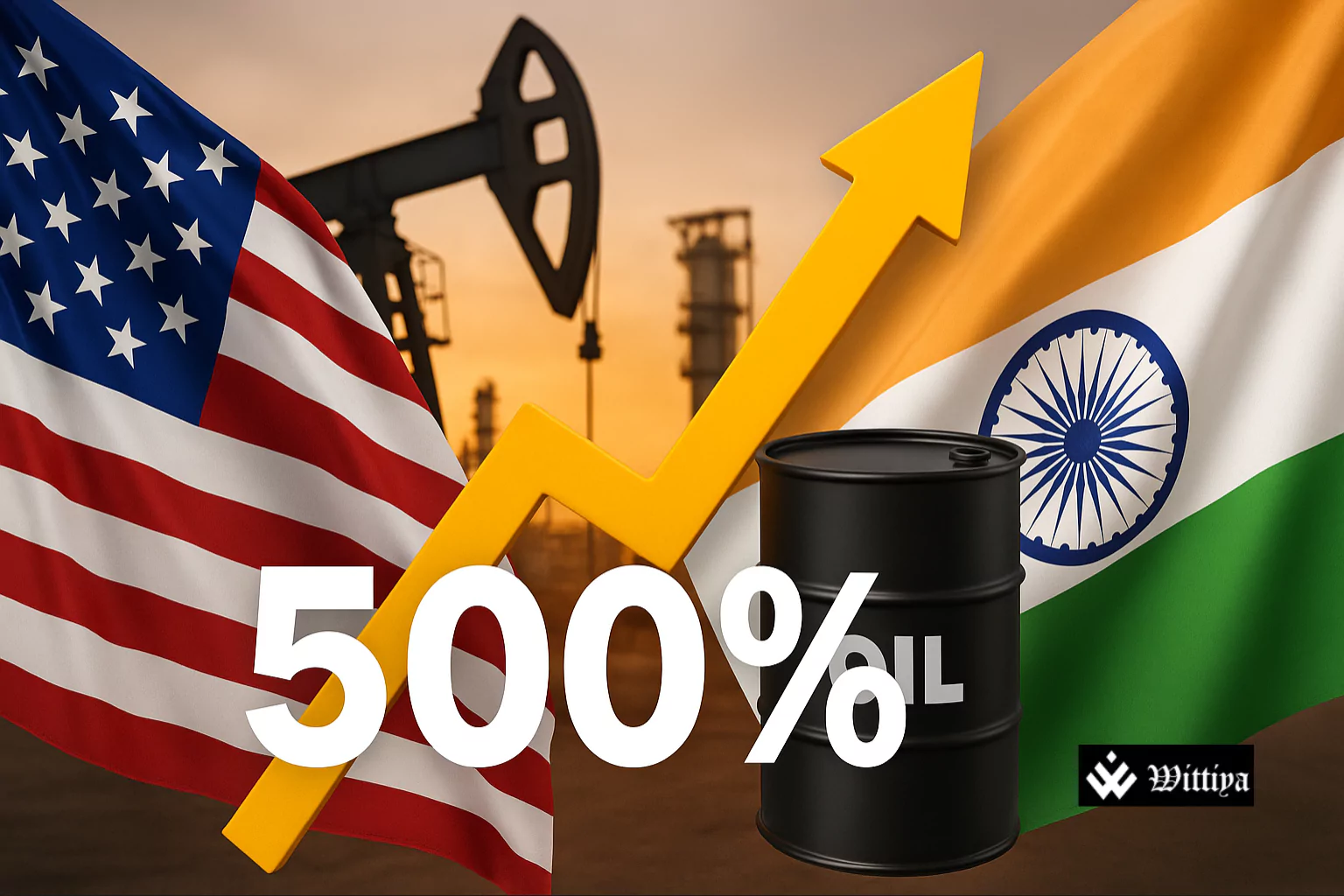
India’s continued import of discounted Russian oil could trigger a 500% tariff on its exports to the United States under a new U.S. Senate bill targeting countries supporting Moscow. The move, led by U.S. Senator Lindsey Graham and backed by former President Donald Trump, puts India and China directly in Washington’s spotlight.
India’s growing reliance on discounted oil imports from Russia has triggered concerns in Washington, with the United States Senate now considering a bill that could impose a staggering 500% tariff on goods from countries that continue energy trade with Moscow.
The proposed measure, led by Senator Lindsey Graham, seeks to punish nations purchasing Russian oil while withholding support for Ukraine amid the ongoing conflict. Graham said, “India and China are fueling Russia’s war machine by buying its oil. It’s time to hold them accountable.”
India has emerged as one of Russia’s top oil buyers since the start of the Russia-Ukraine war, even surpassing its traditional imports from the Gulf. This shift in trade has alarmed U.S. lawmakers who aim to intensify economic pressure on Russia through indirect sanctions.
The bill reportedly has the support of former U.S. President Donald Trump, who could potentially return to office depending on the outcome of the upcoming elections. His endorsement gives the bill significant political momentum. However, the final decision on enforcement, implementation, or exemptions rests with the executive branch.
Officials in New Delhi are yet to officially comment on the tariff threat, but diplomatic sources suggest that back-channel negotiations are ongoing. A bilateral trade agreement between India and the United States is being discussed, which could potentially provide relief from the harsh tariff proposal if finalized soon.
If the bill is passed and implemented without exceptions, several Indian industries—particularly textiles, pharmaceuticals, and automotive parts—could be severely affected by the 500% duty.
Meanwhile, U.S. lawmakers have clarified that the aim is not to alienate India, a strategic partner in the Indo-Pacific, but to pressure global oil customers to reconsider their stance toward the Russia-Ukraine conflict. The proposed tariffs are designed to apply uniformly to all non-cooperating countries, including China.
As geopolitical tensions escalate, India’s balancing act between economic interests and global diplomatic pressures may soon face its toughest test in recent years.