






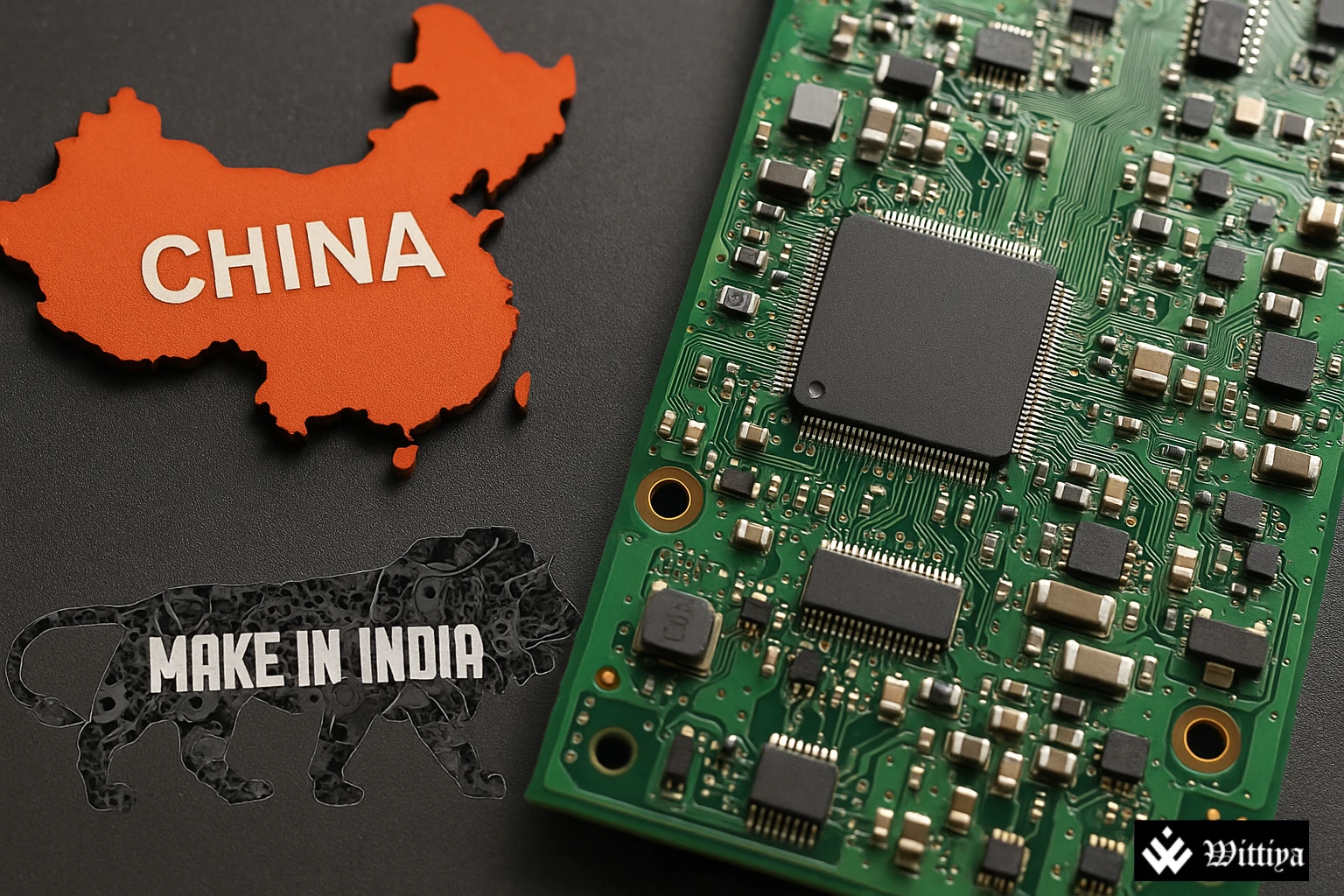
Despite India’s ambitious Make in India and Production-Linked Incentive (PLI) schemes, the country’s manufacturing ecosystem remains significantly dependent on Chinese imports, especially in key sectors like electronics, semiconductors, and pharmaceuticals. While localized wins like toy manufacturing show promise, the broader picture reflects a continued reliance on China.
While India’s Make in India initiative and the Production-Linked Incentive (PLI) schemes were launched with the aim to transform the country into a self-reliant manufacturing hub, the ground reality paints a more nuanced picture. Despite bold policy ambitions, a deep-rooted dependence on Chinese components remains a key structural bottleneck.
The government’s drive toward manufacturing localization has achieved progress in selective areas. For example, India’s toy industry has seen a measurable turnaround. Policy enforcement, development of domestic manufacturing clusters, and standard-setting have helped the country transition from being an import-heavy market to exporting toys to over 150 countries. Yet, even this success story has its caveats—India’s toy exports dipped marginally in FY2024, indicating that long-term competitiveness remains a challenge.
However, the broader ecosystem still reflects significant reliance on Chinese supply chains, especially in high-tech sectors.
Data shows that China accounts for:
- 96.8% of India’s silicon wafer imports
- 86% of flat panel display imports
- 66.8% of computer monitor imports
- 40.5% of memory chips
- 37% of printed circuit boards
- A major share of microprocessor imports
This level of dependence is particularly concerning in the electronics and semiconductor sectors—both critical pillars of modern manufacturing. Even with the PLI incentives targeting these sectors, India faces structural challenges such as limited domestic capacity, lack of technological depth, and capital-intensive barriers to entry.
Also Read: Govt Disburses ₹21,534 Cr Under PLI; Pharma, Food, Textiles Lead Growth
Industry experts caution that while Make in India and PLI schemes are directionally positive, their execution needs to be coupled with broader systemic reforms. These include enhancing R&D ecosystems, incentivizing component-level manufacturing, and fostering stronger public-private partnerships to develop foundational supply chain infrastructure.
Furthermore, India’s dependence on Chinese imports extends beyond electronics. Pharmaceuticals, renewable energy components, and key industrial inputs still largely originate from China. Until India successfully builds local alternatives at scale, the country’s economic sovereignty in manufacturing will remain constrained.
In summary, while India’s manufacturing ambitions are backed by strong policy intent, the persistent shadow of China in critical input markets continues to hinder self-reliance. A multipronged, long-term strategy is essential to overcome structural dependencies and realize India’s vision of becoming a global manufacturing powerhouse.
READ MORE ON