






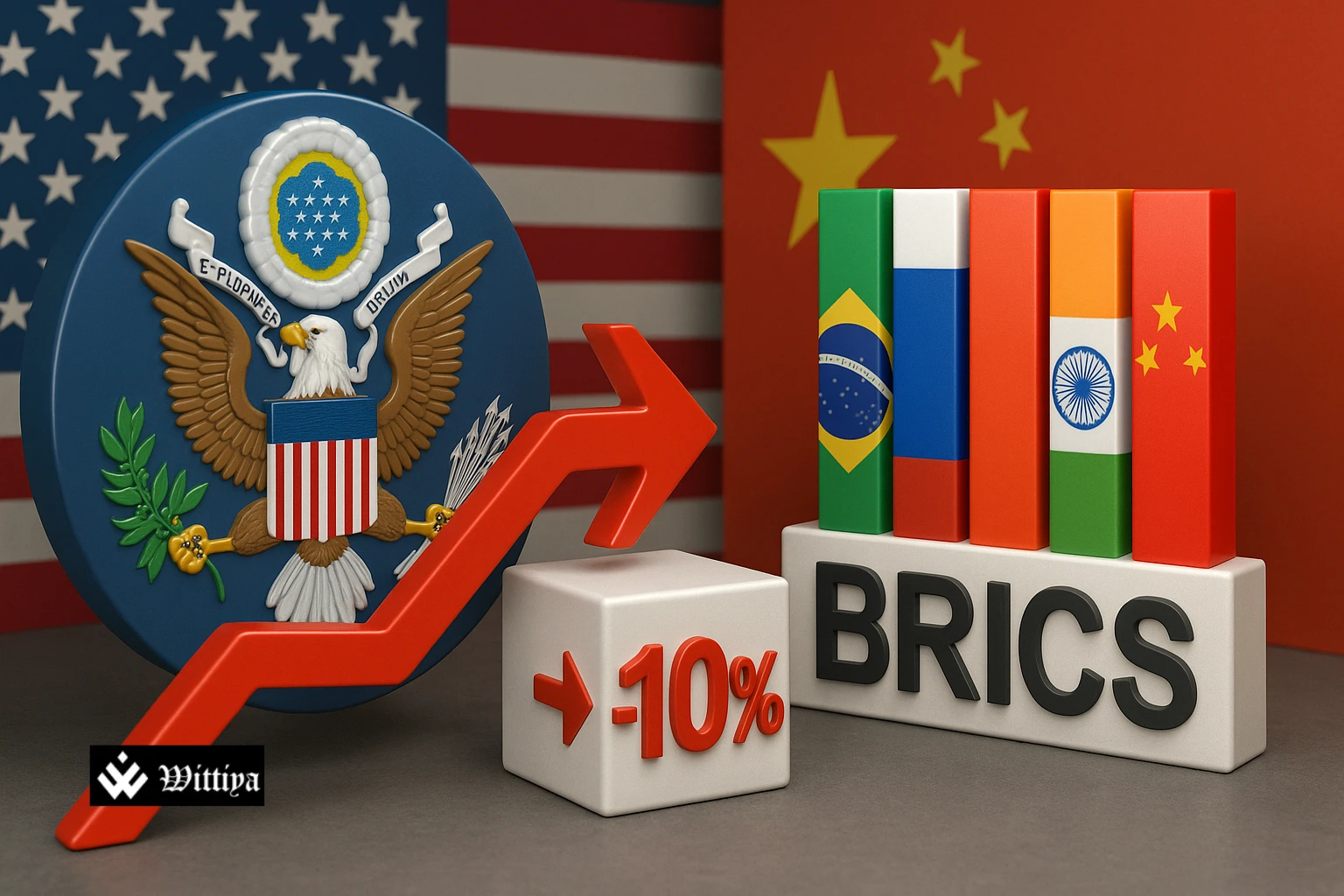
U.S. President Donald Trump has threatened a 10% tariff on countries aligning with BRICS policies, accusing the group of adopting “anti-American” stances. The announcement coincided with the ongoing BRICS Summit in Rio de Janeiro, Brazil, and follows the bloc’s veiled criticism of U.S. trade actions. The situation underscores escalating global trade tensions and a growing divide between Western-led and Global South economic governance.
U.S. President Donald Trump announced a new 10% tariff on countries aligning themselves with what he called the “Anti-American policies of BRICS,” escalating already strained global trade relations. The statement came as the BRICS summit convened in Rio de Janeiro, Brazil, drawing attention to the growing political divide between the United States and the expanded coalition of emerging economies.
The BRICS grouping—comprising Brazil, Russia, India, China, South Africa, Saudi Arabia, Egypt, United Arab Emirates, Ethiopia, Indonesia, and Iran—has evolved into a major geopolitical bloc seeking alternatives to Western-dominated institutions. The organization defines itself as “a political and diplomatic coordination forum for countries from the Global South” and aims to amplify the voice of developing nations in global governance.
Trump’s message, posted on Truth Social on July 6, followed a BRICS leaders’ statement criticizing “unjustified unilateral protectionist measures,” interpreted as a direct rebuke to U.S. tariff actions. Although the BRICS communique did not name the U.S., it condemned the rise of unilateral trade policies that “distort trade and are inconsistent with WTO rules.”
“Any country aligning themselves with the Anti-American policies of BRICS will be charged an ADDITIONAL 10% Tariff. There will be no exceptions to this policy,” Trump declared online.
According to Stephen Olson, former U.S. trade negotiator and a visiting senior fellow at the ISEAS–Yusof Ishak Institute, Trump may be referring to BRICS’s ambition to reduce dependence on U.S.-led financial institutions and replace the dominance of the U.S. dollar in global transactions.
Meanwhile, this year’s summit also included symbolic support for BRICS member Iran, as the bloc condemned recent military actions on its territory without naming Israel or the United States.
China, a key voice in BRICS, was represented by Premier Li Qiang in place of President Xi Jinping, while Russian President Vladimir Putin, under an ICC arrest warrant, attended virtually.
Trump also confirmed the U.S. Treasury would begin issuing country-specific tariff notices from July 8, aligning with Treasury Secretary Scott Bessent’s recent statements. The earlier-announced tariff pause expires on July 10, and new rates are set to take effect on August 1, unless bilateral agreements are reached.
As BRICS continues its push to restructure the global economic order, Trump’s aggressive stance signals a renewed phase of trade nationalism from the U.S., placing pressure on developing economies caught between superpower rivalries.