






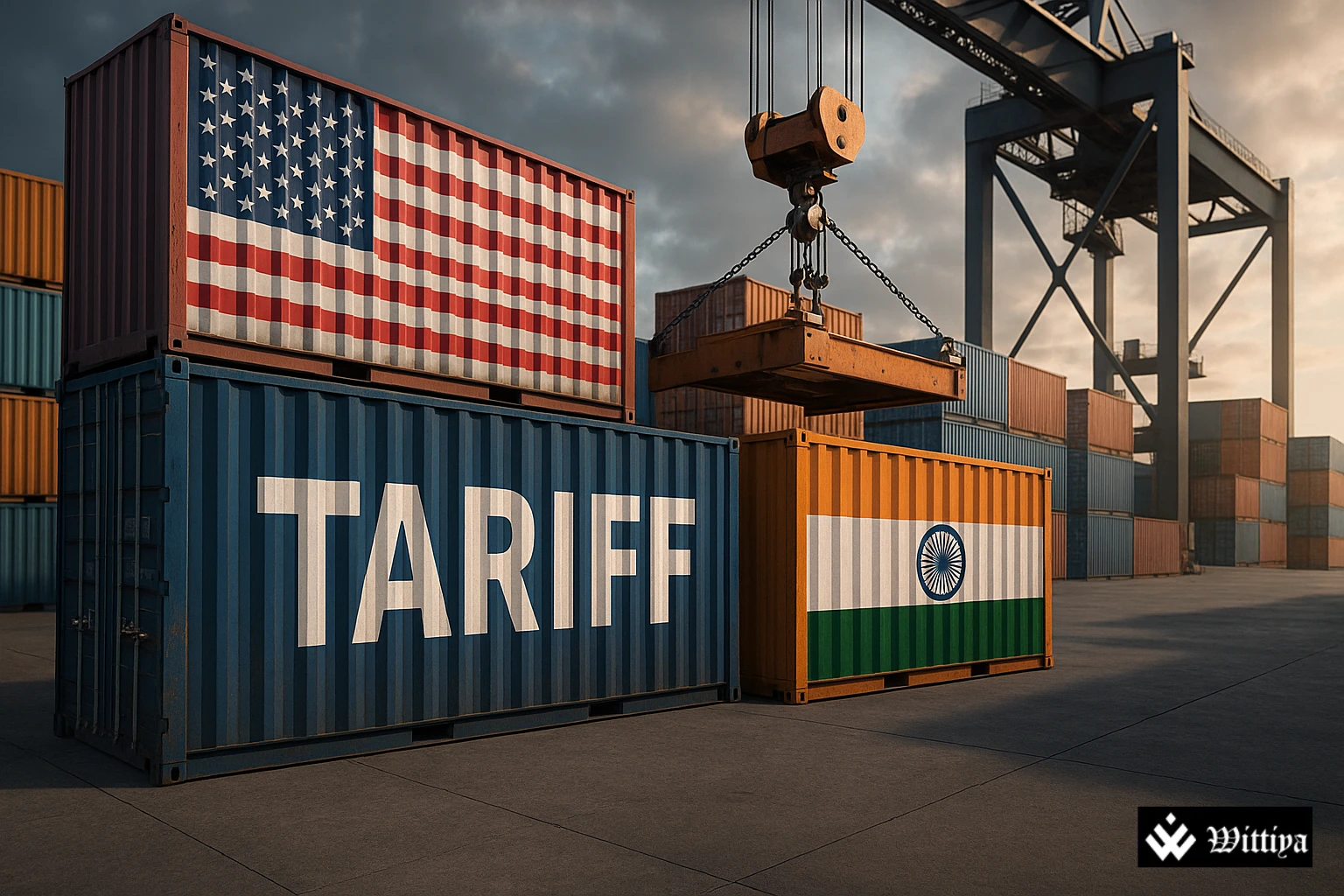
The United States has imposed an additional 25% tariff on Indian imports, raising the total duty to 50%, in response to India’s continued oil trade with Russia. Economists warn this move could reduce India’s FY26 GDP growth by up to 0.4%, with major implications for export-driven sectors and MSMEs.
The United States has sharply escalated trade tensions with India by announcing an additional 25% tariff on Indian imports, taking the total duty to 50%. The decision, driven by geopolitical concerns over India’s continued oil imports from Russia, has raised alarms across India’s export sector. Economists and industry leaders caution that the move could significantly dent India’s GDP growth in FY26 and place thousands of exporters—particularly MSMEs—at a competitive disadvantage in the U.S. market.
U.S. Tariff Hike on Indian Goods May Cut FY26 GDP by 0.4%
The United States has imposed an additional 25% tariff on goods imported from India, bringing the total tariff rate on Indian exports to 50%. This significant increase is expected to weigh heavily on India’s export sector and could reduce the country’s GDP growth in FY26 by up to 0.4%, according to economists.
Impact on Economic Growth
India’s economic growth forecast for FY26 may face downward pressure due to the imposition of an additional 25% tariff by the United States on certain imports. This move comes on top of the earlier 25–26% tariff, compounding the potential economic strain.
The cumulative tariff burden could reduce India’s GDP growth by an estimated 0.2% to 0.4%, depending on the trajectory of trade negotiations in the coming weeks. The new tariff is scheduled to take effect after a 21-day notification period, which may provide an opportunity for both nations to engage in constructive dialogue and potentially mitigate the trade impact.
Also Read: Why Trump Imposed 25% Tariffs on Indian Goods Explained
Failure to arrive at a resolution within this window, however, may place India’s FY26 GDP growth projection of 6.4%–6.6% at risk, as sustained tariff pressures could adversely affect export competitiveness, sectoral output, and overall economic momentum.
Sector-Wise Implications
Several key export-oriented sectors are likely to be directly impacted by the increased tariffs, including:
| Sector | Potential Impact |
| Textiles & Garments | Higher costs may reduce U.S. orders |
| Gems & Jewellery | Competitive disadvantage in premium markets |
| Electronics | Lower cost-effectiveness for U.S. buyers |
| Pharmaceuticals | Margin pressure on low-cost generic exports |
| Auto Components | Strained supply chain linkages |
| MSMEs | Risk of order cancellations, client loss |
MSMEs, which play a significant role in India’s export base, are expected to be the hardest hit, as they lack the financial strength to absorb such a steep cost increase.
Political Context Behind the Tariff
The move was announced through an executive order signed by U.S. President Donald Trump, citing India’s continued import of crude oil from Russia as the reason.
I find that the Government of India is currently directly or indirectly importing Russian Federation oil. Accordingly… articles of India imported into the customs territory of the United States shall be subject to an additional ad valorem rate of duty of 25 percent.”
Donald Trump, U.S. President
This measure is being viewed as a political response rather than a trade correction, triggering concerns in diplomatic and trade circles.
Industry and Expert Reactions
Industry leaders and trade analysts have expressed deep concern over the development.
A tariff rate of 50% is expected to severely disrupt trade flows, rendering many export transactions commercially unviable. Even at the previous 25% rate, exporters were already facing margin pressures and a strained trade environment. The escalation in duties may lead to a collapse in trade volumes across several sectors.
Also Read: Trump’s Double Standards: Tariffs for India, Tariff Cuts for Pakistan?
With shipments for the upcoming holiday season already dispatched, Indian exporters—particularly in the textile segment—could face immediate financial setbacks. A potential disruption in approximately $1 billion worth of textile exports may have a significant employment impact, potentially affecting close to 100,000 workers directly engaged in the sector. The ripple effects of such trade disruptions could further extend to allied industries and logistics networks.
Agneshwar Sen, Trade Policy Leader at EY India, called the tariff “an unnecessary escalation” and emphasized the importance of resolving political disagreements through bilateral dialogue. He urged the Indian government to pursue a balanced and constructive resolution with the United States.
Trade Body Raises Red Flag
The Federation of Indian Export Organisations (FIEO) has also voiced serious concern. According to its President, S.C. Ralhan, nearly 55% of India’s total shipments to the U.S. market are now impacted by the tariff increase.
This puts Indian exporters at a competitive disadvantage of 30–35%. Several buyers are delaying or cancelling their orders due to the high landed costs,”
S.C. Ralhan, President of Federation of Indian Export Organisations (FIEO)
He warned that MSMEs, in particular, are not in a position to absorb such cost shocks and may end up losing long-term buyers in the U.S. market.
Exceptions and Strategic Response
While the majority of Indian goods now face a 50% tariff in the U.S., the executive order does allow for certain exemptions. Under Annex II of Executive Order 14257, the following product categories are excluded:
- Certain mineral substances
- Metallurgical ores
- Fuels
- Industrial chemicals
- Pharmaceutical precursors
Also Read: Trump Confirms Ongoing Negotiations With India Despite Tariff Announcement
These exemptions may offer limited relief to specific exporters but do not significantly offset the broad impact on India’s trade.
In response, the Indian government has reiterated its commitment to making strategic energy decisions in the country’s best interests. It has clarified that oil imports will continue based on national energy security and economic priorities.
Outlook
The imposition of the additional tariff by the U.S. marks a new phase in India–U.S. trade relations. With economic and geopolitical stakes running high, the next few weeks will be critical. Negotiations between the two governments will likely determine whether a resolution can be achieved to avoid deeper economic fallout.
READ MORE ON