






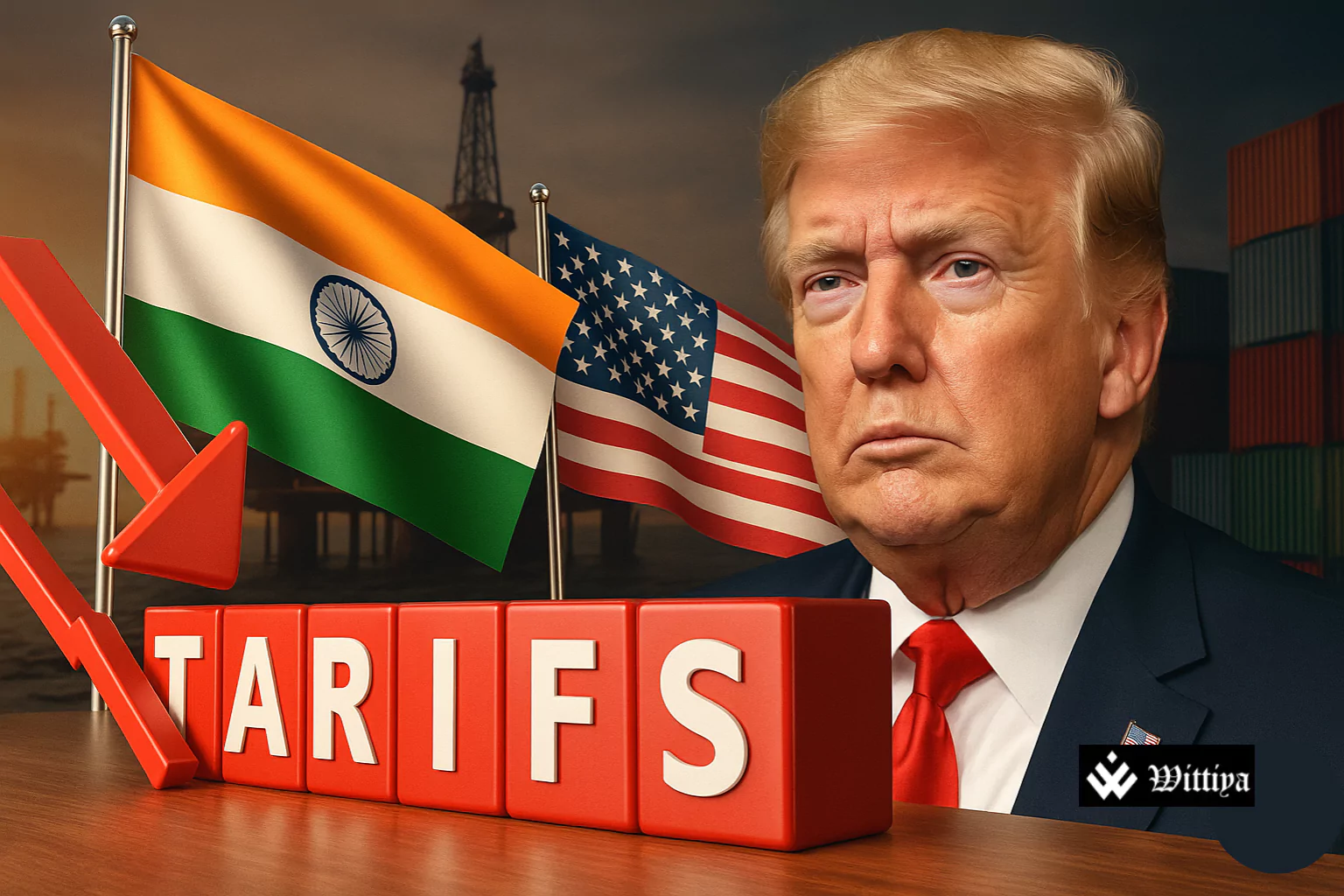
India has strongly criticized US President Donald Trump’s tariff threats over Russian oil purchases, calling them unjustified. With nearly 20% of its exports dependent on the US market, India is now navigating an increasingly coercive trade environment that ties economic policies with geopolitical strategy. Financial experts warn the US’s hegemonic use of sanctions could have long-term consequences on global trade, prompting India to rethink its global alignments.
India has strongly objected to the latest tariff threats issued by US President Donald Trump, who warned of imposing additional duties on Indian goods over the country’s continued purchase of Russian oil. With the US accounting for nearly 20% of India’s total exports, New Delhi’s trade position has come under new pressure as Washington wields economic tools for strategic goals.
In a sharp rebuttal, Indian officials labeled the targeting as “unjustified and unreasonable”, vowing to take “all necessary measures” to protect national interests and economic security.
The move signals a deepening of the US’s evolving sanctions doctrine, where trade and financial penalties are used to push foreign policy objectives. Analysts now see this as a pivotal moment in India-US economic relations, questioning whether traditional partnerships can endure in an increasingly unilateral global order.
While India’s Ministry of External Affairs maintains that energy security requires diversified sourcing — including oil from Russia — the tariff pressure from the US has already caused exporters to scramble for alternative arrangements to maintain their US market access.
Tariffs as a Geopolitical Weapon
Trump’s decision to align trade measures with geopolitical posturing is not new but marks a significant escalation in using tariffs as a mechanism to enforce foreign policy. India is being asked to reduce its energy trade with Russia or face penalties — a clear example of how trade tools are being adapted for non-trade objectives.
India’s strategic oil purchases are made under sovereign policy choices aimed at affordability, not political alignment. The targeting of Indian exports under these circumstances sets a new precedent, one where sovereignty in trade decisions risks direct financial penalty.
Also Read: Russia Slams US ‘Neocolonial Agenda’ After Trump Targets India
Financial Risks for India and Emerging Economies
Trade experts argue that India’s situation reflects broader vulnerabilities faced by emerging economies in a world where US financial dominance is often used as leverage. A recent paper by a former central banker described the US as a “hegemonic sanctioner”, citing that over 35% of global sanctions since 1949 have originated from Washington.
With the US maintaining control over the global financial system — particularly through its dominant currency and settlement networks — developing nations face limited channels for evading the economic fallout from sanctions or secondary sanctions. These actions, while not acts of war, can be just as disruptive for national economies.
In India’s case, public-sector oil companies are already facing blocked dividend flows — reportedly close to $900 million — due to payment channel restrictions related to ongoing sanctions. Such disruptions not only affect corporate earnings but also the government’s fiscal projections.
Long-Term Implications on Bilateral Ties
Indian trade negotiators have reportedly been struggling to convince the US to discuss sector-specific reliefs, particularly in the steel and auto sectors. Exports worth nearly $5 billion have been affected by existing US tariffs, and new measures could deepen the impact.
Financial commentators caution that Washington’s policy risks alienating New Delhi at a time when global alignments are undergoing seismic shifts. The growing economic influence of non-Western institutions such as BRICS and the Asian Infrastructure Investment Bank (AIIB) offers alternative funding and trade partnerships — a direction India might be increasingly inclined to explore.
The consistent elevation of economic sanctions as a diplomatic tool also risks diminishing the effectiveness of such measures over time. As more countries diversify away from US-centric systems — both financially and politically — the long-term dominance of the dollar and related economic leverage could erode.
India’s Strategic Response
New Delhi has already begun recalibrating its trade and financial partnerships, deepening its engagement with non-Western institutions and exploring alternate payment mechanisms. The upcoming trade talks with the US are expected to be tense, with India’s position likely to harden if coercive measures continue.
While India’s commitment to maintaining strong bilateral ties remains unchanged, the expanding use of economic threats is pushing it to reassess its strategic alignments, possibly accelerating its pivot toward multipolar global structures.
The weeks ahead will determine whether this latest friction with the US is resolved diplomatically — or leads to long-term structural changes in India’s trade, currency, and financial strategies.
READ MORE ON