





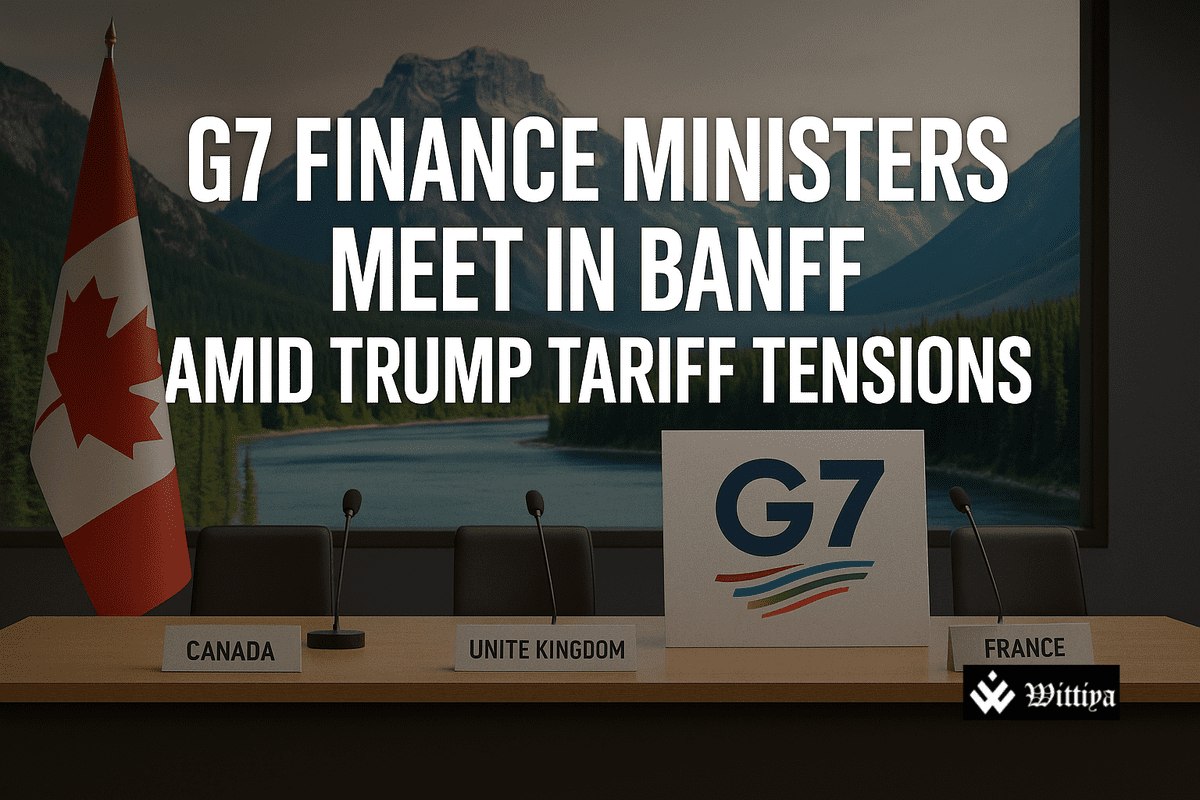
The G7 finance ministers’ summit in Banff, Canada, is set to be contentious amid President Trump’s new tariffs. With Canada and EU members facing steep duties and Russia sanctions under discussion, the gathering will test the unity of the world’s richest nations as they navigate rising trade tensions and shifting global alliances.
The world’s leading economic powers are facing one of their most divisive moments in recent years as G7 finance ministers gather in the scenic resort town of Banff, Canada, this week. What is traditionally a cooperative annual meeting has turned contentious due to sweeping new tariffs introduced by U.S. President Donald Trump.
Officials from Canada, the United Kingdom, Japan, France, Germany, and Italy — along with the United States — are meeting under the cloud of escalating trade tensions. Trump’s recent decision to impose steep tariffs on imports from several G7 nations has unsettled markets and strained diplomatic ties.
Tariffs Spark Friction Among Allies
President Trump’s tariffs include a 25% duty on Canadian exports such as autos and a 10% baseline tariff on European Union exports, which impacts France, Germany, and Italy. While the U.S. has reached a preliminary trade agreement with the U.K. and is in talks with Japan and the EU, Canada remains a primary target.
“This is a very difficult period for the relationships among the G7 countries,” said Eswar Prasad, an economist at Cornell University and former IMF official. “The tone will be far less congenial than in years past.”
Canada’s Finance Minister Francois-Philippe Champagne emphasized the importance of a fair, rules-based global trade system: “The message from colleagues is clear — a multilateral system benefits all.”
New U.S. Delegation, Familiar Tensions
This year marks the first full G7 meeting attended by U.S. Treasury Secretary Scott Bessent, who is viewed as a moderating voice in the Trump administration. Federal Reserve Chair Jerome Powell and central bank governors from other G7 countries are also present.
Though private meetings between officials are expected, no major trade breakthroughs are anticipated. Instead, ministers will aim to lay the groundwork for discussions at the G7 leaders’ summit in Kananaskis, Canada, next month.
Russia Sanctions and Global Trade Imbalances
Beyond tariffs, another key agenda item is Russia. The EU and U.K. recently imposed new sanctions on Russia’s shadow oil fleet, and proposals to lower the price cap on Russian oil exports from the current $60 are on the table.
While Trump’s administration has expressed support for stricter oil sanctions, it has yet to officially endorse the latest round of measures. Trump’s recent conversations with both Russian President Vladimir Putin and Ukrainian President Volodymyr Zelensky have further complicated the narrative.
Ukraine’s Finance Minister Sergii Marchenko is also attending the summit, representing the country’s interests despite Ukraine not being a G7 member.
The Dollar and Investor Confidence
Trump’s tariff announcements have triggered instability in financial markets. The U.S. dollar unexpectedly dropped last month, and rising Treasury yields suggest declining investor confidence in the U.S. economic outlook.
“In the hallways, they’re going to talk about nothing but tariffs and the dollar,” said Steven Kamin, a senior fellow at the American Enterprise Institute and former Fed economist.
Conclusion: A Pivotal Test of G7 Unity
Last year, the G7 issued a joint statement affirming their commitment to a free and fair global trading system. Whether a similar consensus can be reached this year remains uncertain.
As Daleep Singh, chief global economist at PGIM Fixed Income and a former Biden adviser, noted, “If you’re looking for something to engender a just and lasting peace, oil sanctions are the place to look.”
The outcomes of this summit could define the G7’s cohesion — or fragmentation — as global economic and political pressures mount.