


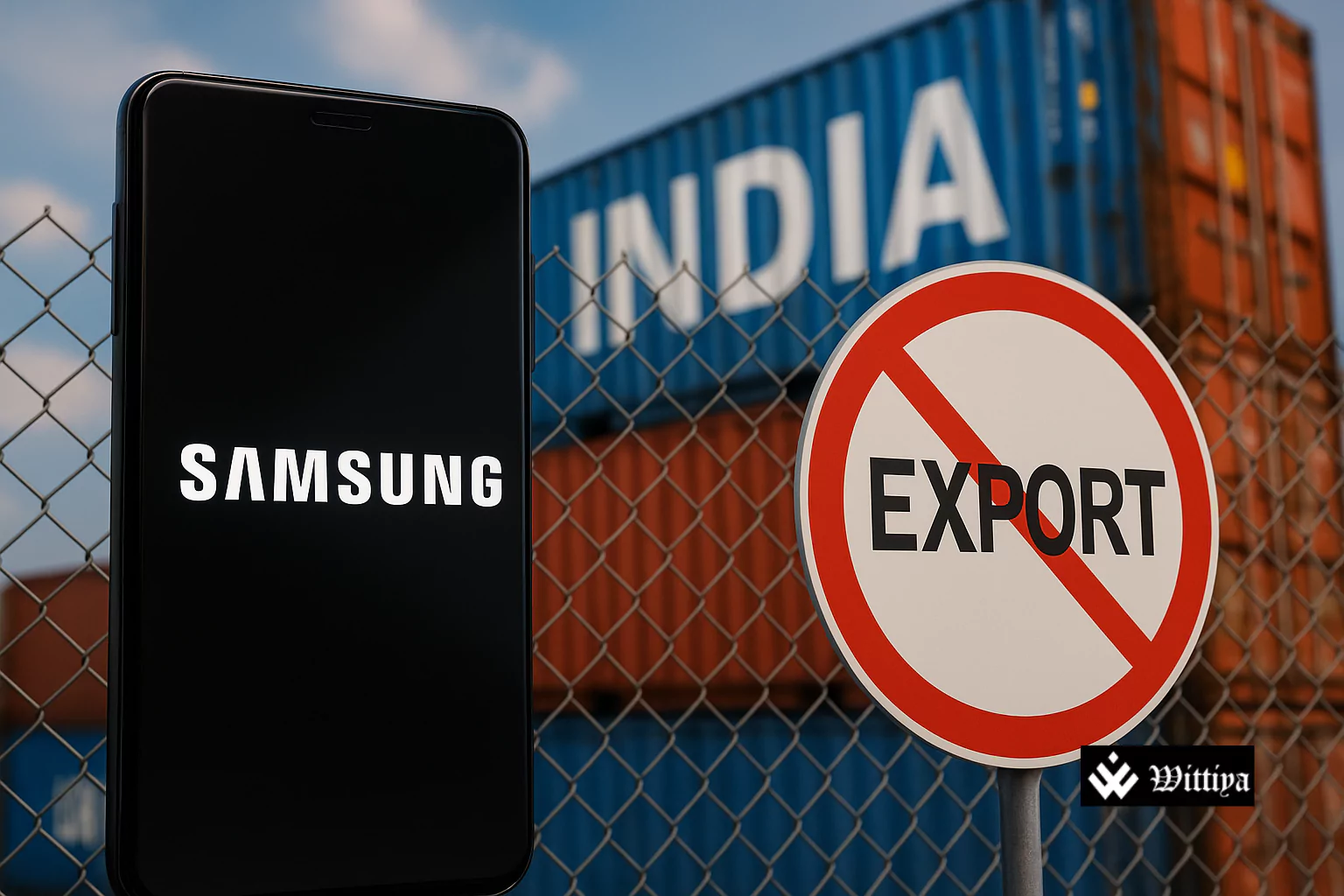
India’s smartphone export ambitions face fresh uncertainty as Samsung recalibrates its strategy following its exit from the PLI scheme. With exports down 20% year-on-year, industry observers caution that Apple and Dixon Technologies could be next to reconsider their manufacturing plans, possibly weakening India’s position in the global supply chain.
South Korea-based Samsung has begun recalibrating its smartphone export strategy after concluding its five-year participation in India’s production-linked incentive (PLI) scheme for electronics manufacturing. The move has led to a 20% year-on-year decline in Samsung’s exports for the June quarter of FY26, dropping to approximately USD 950 million from USD 1.17 billion a year ago.
The company’s exit from the PLI program — which incentivizes domestic production to enhance India’s position in global supply chains — may be a harbinger of deeper challenges ahead. Industry observers suggest that Apple and Dixon Technologies, also significant contributors under the PLI scheme, may reevaluate their strategies once their incentive windows close in FY26.
Erosion of Cost Competitiveness
While India’s smartphone exports surged from USD 200 million in FY18 to USD 24.1 billion in FY25, the country’s long-term manufacturing competitiveness remains fragile without subsidies. Even during the PLI regime, India maintained a manufacturing cost disadvantage—about 10% compared to Vietnam and 15% relative to China. The 4–6% incentive only partially bridged this gap.
Now, without those incentives, Samsung and others may reconsider the scalability of Indian operations. The company has already reportedly requested additional incentives for FY26 to compensate for FY22 shortfalls due to pandemic-related disruptions.
Also Read: Samsung’s Foundry and HBM Setbacks Hit Q2 Earnings Hard
Shift in Strategy Could Impact Apple, Dixon
Samsung’s current recalibration may influence the strategies of Apple, which currently leads India’s smartphone exports, and Dixon, a key contract manufacturer. The companies had received one-year PLI extensions due to delays in facility readiness during the COVID-19 pandemic. Their participation remains active until March 2026.
If both follow Samsung’s path post-PLI, the cumulative impact could derail India’s aspirations of becoming a preferred smartphone export hub. Industry stakeholders highlight that these three players have been central to the PLI program’s success story.
PLI Extension and New Incentives Await Clarity
India has launched a USD 2.75 billion component-focused PLI scheme to deepen value addition and domestic ecosystem development. However, analysts caution that unless major participants continue to invest, the new initiative may also face implementation hurdles.
Samsung was notably the only PLI participant to meet export and investment thresholds in the first year (FY21). Its exit has now raised concerns that even globally established manufacturers may find India’s ecosystem unsustainable without consistent policy support.
As global trade dynamics continue to shift under the “China+1” strategy, India’s retention of major electronics manufacturers will depend on both strategic incentives and timely execution of policy frameworks that support long-term competitiveness.
READ MORE ON