


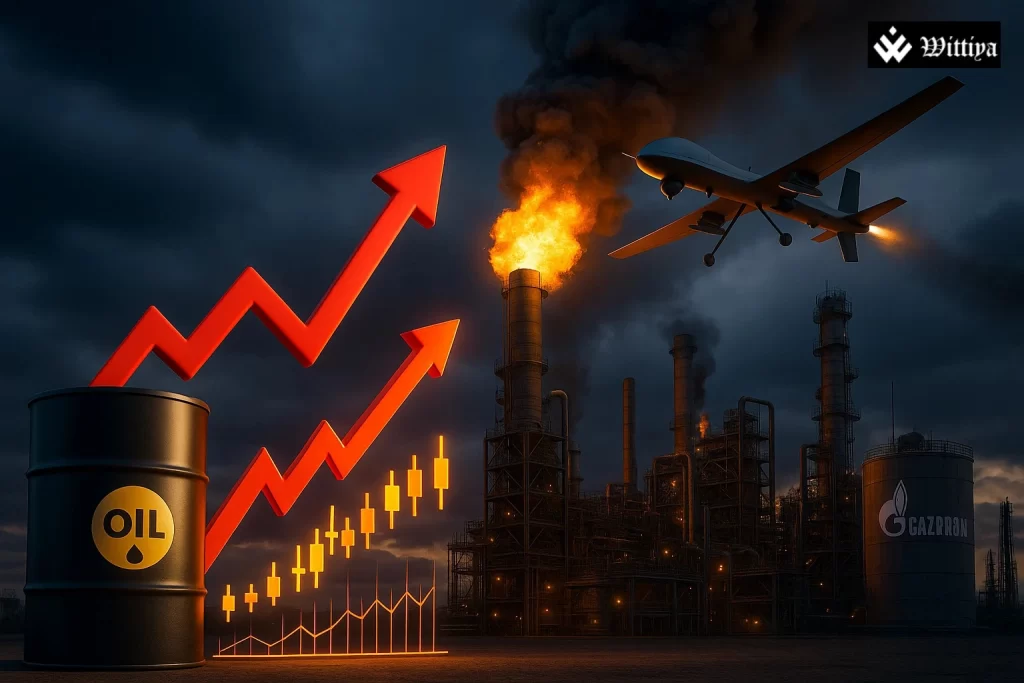
Ukrainian drone assaults on Russian energy installations have sent oil prices skyrocketing. The attacks have caused a halt to exports and stirred traders to recalibrate their positions amid the prevailing geopolitical hesitancy.
Russian Energy Hits Market Risks
Oil markets reacted strongly on Monday after Ukrainian drone strikes hit a number of Russian energy facilities from a major refinery to an export terminal. The traders and investors rapidly changed their positions to adapt to the unfolding risks of supply interruptions in one of the largest oil-producing countries in the world.
Market Movements Amid Geopolitical Tensions
By 0632 GMT, Brent crude futures were up by 36 cents or 0.5% at $67.35 per barrel, while U.S. West Texas Intermediate (WTI) crude also rose 36 cents, or 0.6%, to $63.05 per barrel. The upward trend for both contracts had already been established last week since the crisis in Ukraine has led to heavy attacks on Russian oil infrastructure, and thus the prices had increased accordingly.
The targets hit by the missiles were the Primorsk export terminal, the largest seaport in the west of Russia from where about 1 million barrels/day of crude oil can be loaded, and the Kirishinefteorgsintez refinery operated by Surgutneftegaz, which with a capacity of about 355,000 barrels per day is the fifth-largest producer of petroleum products in Russia.
JPMorgan analysts led by Natasha Kaneva were of the opinion that the conflict escalation “marked the readiness to obstruct crude oil flows from abroad, which means the prices could be pushed to the upside”, in a report referring to the attack on Primorsk.
Traders Adjust Positions
As the markets digested the risks associated with the geopolitical situation, investor sentiment was transformed almost immediately. IG Markets analyst Tony Sycamore observed, “The implication that Ukraine might strategically target Russian energy export infrastructure sets a trend of upside risks to forecasts no matter OPEC+’s production plans.”
The traders are cautiously examining supply interruptions in connection with the general situation of global oil production. The market is especially attentive to the energy trading hubs in Europe and the US, where concerns of volatility due to the uncertainty of Russian exports have appeared despite a forecast of OPEC+ preparing to raise output.
Also Read: Russia Dominates India’s Oil Imports as OPEC’s Influence Dips to Record Low
U.S. Fuel Demand and Macro Factors
The geopolitical tension is not the only factor on investors’ minds. U.S. fuel demand growth figures are also being taken into account. Last week softer job growth and rising inflation triggered anxieties about the American economy. Moreover, the Federal Reserve is very likely to lower interest rates at its September 16–17 meeting, thus adding another dimension to the market.
President Trump was very clear about it: the U.S. would be ready to impose additional sanctions on Russia but European action has to be in line with Washington. This, apart from causing market volatility, is changing strategies.
Strategic Implications for Russian Energy
The attacks on Primorsk and Kirishi have exposed the weak points of the Russian export infrastructure. The drone strike over the weekend on a refinery in Bashkortostan means, says governor Radiy Khabirov, the facility that produces oil for the region will not stop its work, but he is worried about the extent of the damage and the noise created by the delivery of oil and gas in the area.
Per the analysts, Russia continuously attacking energy installations will cause global oil supply to shrink and thereby potential risk and gain for investors. The use of both hedging and position adjustment of dealers in today’s trading decisions make for an accurate reflection of the higher stakes in a volatile market setting.
Looking Ahead
Such happenings are now part of the daily routine foreign investors keep an eye on during U.S.-China trade negotiations in Madrid , apart from the usual suspects in the geopolitical drama. The oil markets will probably keep reacting to these events for some time, and this will have repercussions on futures prices, trading volumes and risk perception in the near term.
As tensions between powers become more acute, questions about whether energy supplies from Russia will survive and the stability of the world oil market will be there. The responding and repositioning of traders’ strategies will be their method of trying to take oxygen from uncertainty and profiting from movements in the price.
FAQ’s
How much oil does Russia produce?
Russia produces around 10 to 11 million barrels of oil per day, thus ranking as one of the top oil producers in the world.
What is the impact of Russian energy on global oil prices?
The supply of Russian energy affects the prices of Brent and WTI crude oil. For instance, any interruption or change in production can lead to a rise or fall in oil markets worldwide.
What is West Texas Intermediate (WTI) crude?
WTI crude is a light, sweet, low-sulfur crude oil of high-quality origin in the United States, which is extensively referred to as a standard for oil price determination over the world.
READ MORE ON