







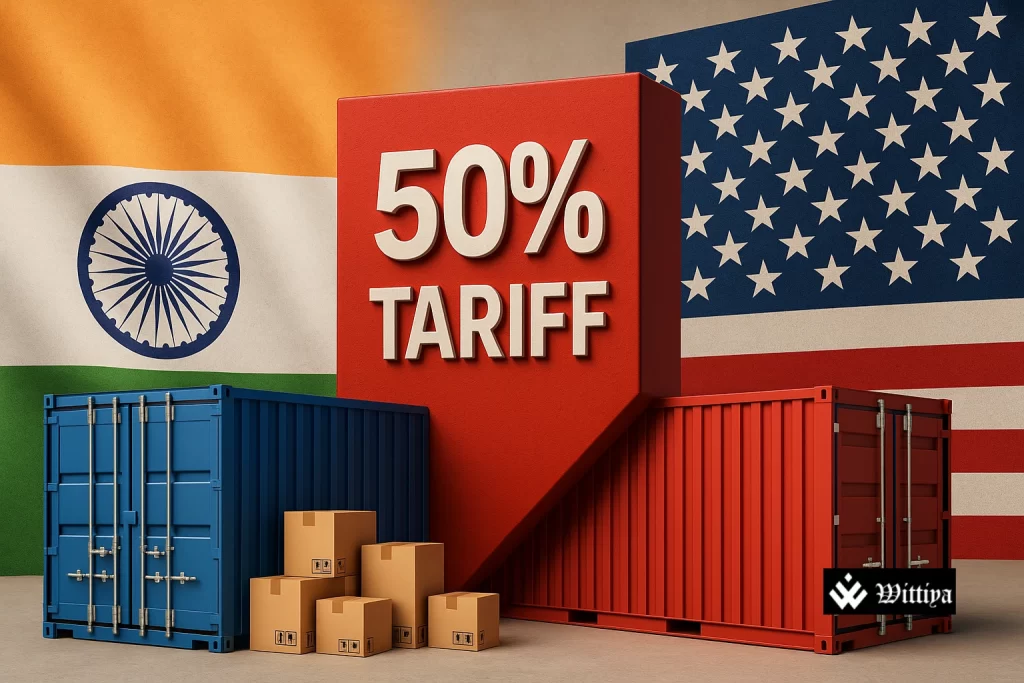
The United States has decided to put a 50% tariff on Indian products, this action will cause a domino effect on exports, GDP forecasts, and trade relations. The Indian government characterizes the step as unjust and is devising counter measures to soften the blow.
50% Tariffs Hit Indian Exports
The United States has imposed a 50% tariff on Indian products that will be in effect from August 27 if New Delhi does not manage to agree with Washington before the expiration of the deadline. The act is likely to lead to a decrease in Indian exports to the US amounting to billions of dollars, which will, in turn, complicate the bilateral trade relations and present new obstacles for the Indian government.
Tariff Breakdown and Timeline
From August 7, a 25% reciprocal tariff had already been in place, with an additional 25% punitive measure on Russian oil imports, which was to start from August 27. The president of the US, Donald Trump, signed the relevant tariff order earlier this month, while the US Department of Homeland Security officially announced it on August 26.
Impact on Indian Exports of 50% Tariff
During the fiscal year 2023, India sent goods worth 86.51 billion dollars to the United States with the top sectors contributing almost 60 billion dollars. The new tariffs will be imposed on goods worth about 48.2 billion dollars, resulting in these exports having a direct exposure to US trade barriers.
- Engineering goods are set to be hit by the maximum 50% tariff.
- The rate of import duty on gems and jewelry will be 52.1%.
- Shrimp exporters will face 60% import duties, and at the same time, the chemical industry, auto parts, footwear, and leather sectors will also experience negative impacts.
Labour-intensive sectors, such as textile, apparels, and leather industry, are anticipated to be the biggest losers of this market access, which, in their turn, jeopardize the employment and the exporting capabilities in international markets.
Also Read: Indian Exporters Hit Hard as U.S. Retailers Abruptly Halt Orders
Exemptions to Cushion the Blow
There are some sectors that are not hit by the tariffs. The exemptions also include goods that are already on the way to their destinations, humanitarian supplies, drugs and pharmaceuticals, as well as electronic goods like mobile phones and semiconductors.
India’s Reaction
New Delhi has termed the tariffs “unfair, unjustified, and unreasonable,” accusing the West of double standards over Russian oil imports. Prime Minister Narendra Modi stated, “We will not compromise on the interests of farmers, cattle-rearers, and small-scale industries.”
The decision has soured bilateral relations, with India leaning closer to China and Russia to open new trade avenues. Reports also highlight India’s plan to diversify export destinations and reduce dependency on the US market.
Trade Talks in Limbo
Six rounds of trade talks between India and the US have failed to break the deadlock, with the latest round scheduled for August 25 postponed indefinitely. Both nations recently held a virtual meeting to stress commitment to long-term ties, but tariffs remain a sticking point.
GDP Impact and Forecasts
S&P Global expects India’s GDP growth to remain resilient, projecting 6.5% growth in FY26, as exports contribute just 2% to the country’s GDP. Exemptions on electronics and pharmaceuticals provide further cushion.
However, a Moneycontrol poll of economists predicts GDP growth in the first quarter of FY26 will fall to 6.6% from 7.4% in the previous quarter, signaling near-term risks.
Expert Commentary
Mark Linscott of The Asia Group warned the standoff has converted a “win-win” into a “lose-lose” situation for both nations. Partner Nisha Biswal added that the 50% tariffs would price Indian textiles and garments out of the US market, undermining India’s role in the global “China+1” supply chain strategy.
India’s Mitigation Strategies
The Indian government is reportedly preparing a relief scheme for exporters while cutting GST rates to support businesses. It is also exploring opportunities in Russia and easing trade frictions with China to secure alternative markets.
FAQ’s
Q1. What is the US tariff on Indian goods?
Unsuccessful trade talks led the US to impose a 50% tariff on Indian exports as of August 27.
Q2. Which Indian industries will be most affected?
The sectors of engineering goods, gems and jewellery, auto components, chemicals, footwear, and shrimp exports are going to be hit with the highest tariffs.
Q3. How will India mitigate the impact?
Where India is going to focus on diversifying exports to new markets, reducing GST burden on businesses, and enhancing trade relations with China and Russia.