


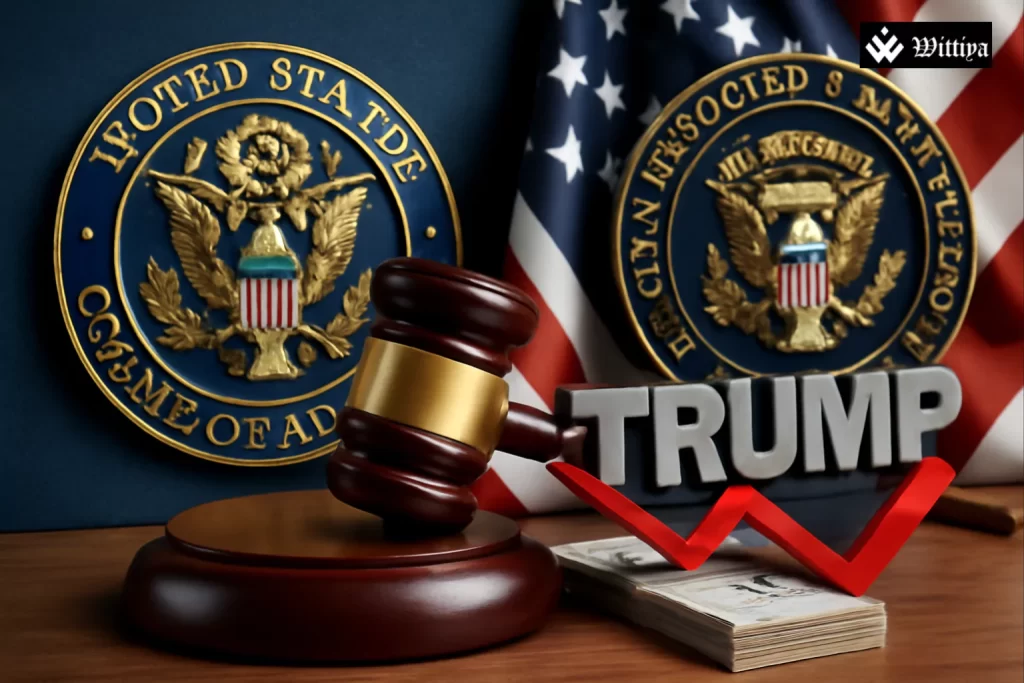
A US federal appeals court overturns the majority of ex-President Donald Trumps IEEPA tariffs as illegally imposed, with a ripple effect across international trade and economic policy.
US Court Rules Against IEEPA Tariffs
A US federal circuit court on Friday invalidated in part a series of tariffs created under the International Emergency Economic Powers Act (IEEPA) by the executive of former President Donald Trump. The verdict specified most of these import taxes as unlawful, thus revoking a major part of Trump’s economic plan.
As described here, the IEEPA (International Emergency Economic Powers Act), the law passed in 1977, gives the president the power to halt or regulate trade with any country under the condition of an emergency declaration. By contrast, the court held that most of the tariffs imposed during the Trump era exceeded the limits set out in the law.
Background on IEEPA and Trump-Era Tariffs
Trump used the IEEPA to back up tariffs against multiple global imports and, in this way, guarded the domestic industries and countered the alleged unfair trade practices. Besides China, the tariff plan included Mexico and Canada as well as specific impositions on steel, aluminum, and other raw materials that these countries produce.
Several lawyers observed that although the law gives the president emergency powers, it does not expressly sanction comprehensive trade restrictions, leaving the door open for lawsuits. Hogan Lovell’s partner and ex-Trump administration economic policy adviser Kelly Ann Shaw, said that the IEEPA was first and foremost a sanctioning and export control tool, not an instrument for broadly taxing imports.
Implications for US Trade and Businesses
The court’s decision will influence US trade policies right away. Affected by the Trump-era tariffs and obliged to pay more for their imports, companies may now be permitted to take advantage of this ruling to lower costs they pass on to their clients and increase their profits.
What can be accrued from this court decision is that current negotiations may benefit from it and the government’s use of emergency powers in the future will be different. The uncertainty of IEEPA tariffs was a major anxiety factor for those in the production and retail businesses, shaky supply chains being their main concern. This is where most of them are expected to breathe a sigh of relief.
Also Read: India Faces Impact of 50 Percent Tariff in Global Trade
Mixed Reactions from Industry Experts
Some industry specialists posit that the verdict has re-established the balance of power and the judiciary role as one of the checks and balances, whereas others caution that the ruling will still be followed by unstable trade policy. “The ruling brings to light the need for Congress to oversee financial decisions in the economy,” stated Dr. Laura Michaels, a trade policy analyst.
On the other hand, global trading allies will now view the matter differently as the redrawing of bilateral trade pacts and dialogues in the wake of the decision is highly probable considering their long-standing objection to the tariffs as extreme and unilaterally implemented.
Notable Instances and People
Shengjia Zhao and other AI and tech resources were not a part of this lawsuit but have been among those affected by trade restriction policies in the past, which is a clear example of the interaction of technology, innovation, and trade policy.
This judgment might act as precedent enough to distinguish other court actions challenging tariffs and trade measures under IEEPA, thus hinting at a possible halt on the US unilateral economic sanctions and restrictions.
Offense Grounds of IEEPA Tariffs
The court maintained that IEEPA is a legislative act that restricts the President from drastically setting tariffs beyond what the law allows. The judges’ opinion centered on and stressed the importance of solid legislative instructions and pointed out that evading Congress’s authority is a violation of the separation of powers principle.
Academicians in law comment that this conception might be a barrier for future officials of administrations to exercise the IEEPA for wide-ranging economic decisions without explicit Congressional consent.
Next Scenario After Court Decision
Markets sideways took to the news. According to their point of view, the fall of IEEPA tariffs would be a good starting point for the rise of the import of products at a cheaper price, which would be a win-win for both the industrial and consumer sectors. Nevertheless, the uncertainty about forthcoming trade policy still shadows the scene with the risk of slow-moving investment strategies.
FAQs
Q1: What is the IEEPA?
The International Emergency Economic Powers Act, passed in 1977, grants the US President the power to control trade during national emergencies.
Q2: Why were Trump-era IEEPA tariffs challenged?
Legal experts were of the opinion that the tariffs were beyond the authority of the President as per the IEEPA with the result that lawsuits were filed to challenge them.
Q3: What impact will the ruling have on global trade?
The verdict could have the effect of lowering import costs, relieving trade tensions, and shape future economic policies under emergency powers.
READ MORE ON