






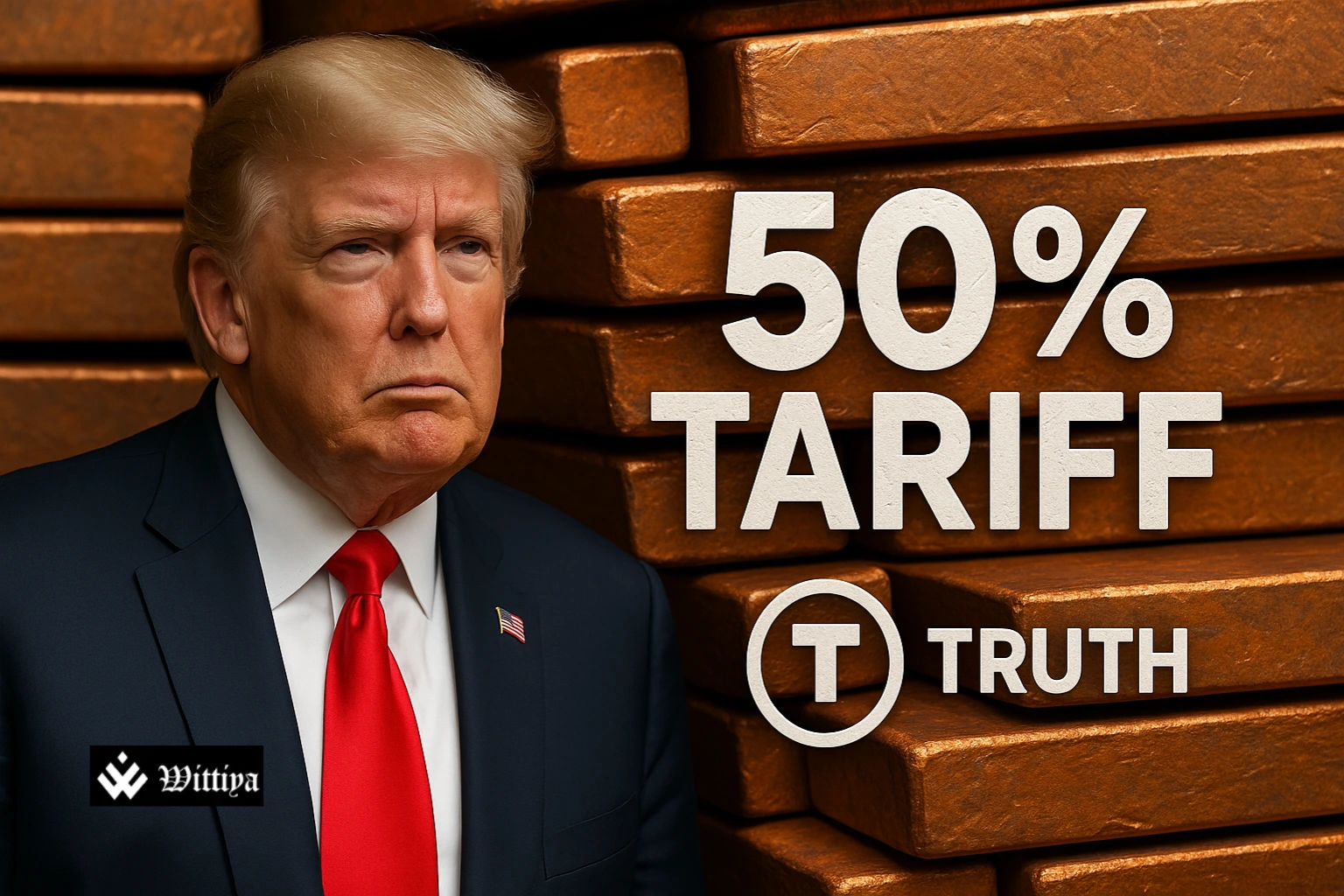
On July 9, 2025, U.S. President Donald Trump announced that a 50% tariff on copper imports will take effect on August 1, 2025. The move is based on a national security assessment, as copper is essential to multiple defense and technological sectors. The U.S., which imports nearly half its copper—mainly from Chile—could face increased domestic prices and temporary supply challenges as the administration pushes for more domestic production
The U.S. federal government, under President Donald Trump, has officially declared a 50% tariff on all copper imports starting August 1, 2025. The announcement came via a post on the social platform Truth Social, where Trump cited a “robust national security assessment” as the basis for the new trade measure.
Copper, a critical material used in semiconductors, military equipment, data centers, and advanced defense systems, is now being prioritized under the same security considerations as aluminum and steel, which are already under 50% tariffs. The United States currently imports nearly half of its copper, primarily from Chile, according to the U.S. Geological Survey.
Copper is necessary for Semiconductors, Aircraft, Ships, Ammunition, Data Centers, Lithium-ion Batteries, Radar Systems, Missile Defense Systems, and Hypersonic Weapons.”
President Donald Trump
He emphasized that copper is the second-most-used material by the Department of Defense.
Following the announcement, copper prices in the U.S. market spiked 2.62%, extending a record-setting gain of 13.12% the previous session. However, benchmark copper futures on the London Metal Exchange dropped 1.63%, reflecting a growing premium gap between domestic and international markets. Reports suggest that U.S. buyers could face prices as high as $15,000 per ton by August, while the global average remains closer to $10,000.
The administration’s tariff policy, supported by U.S. Commerce Secretary Howard Lutnick, aims to align copper tariffs with existing duties on other industrial metals. Lutnick reiterated earlier that the intention is to bring copper production back to the U.S.
While domestic copper output is not expected to meet demand in the short term, the move signals a longer-term strategy to reduce reliance on foreign suppliers. Analysts project global copper mine output will rise steadily through 2034, with notable contributions expected from Chile, Peru, Russia, Zambia, and Mongolia.
President Trump’s latest trade action underscores his administration’s emphasis on using strategic tariffs to strengthen U.S. manufacturing and safeguard key industrial sectors vital to national defense.