






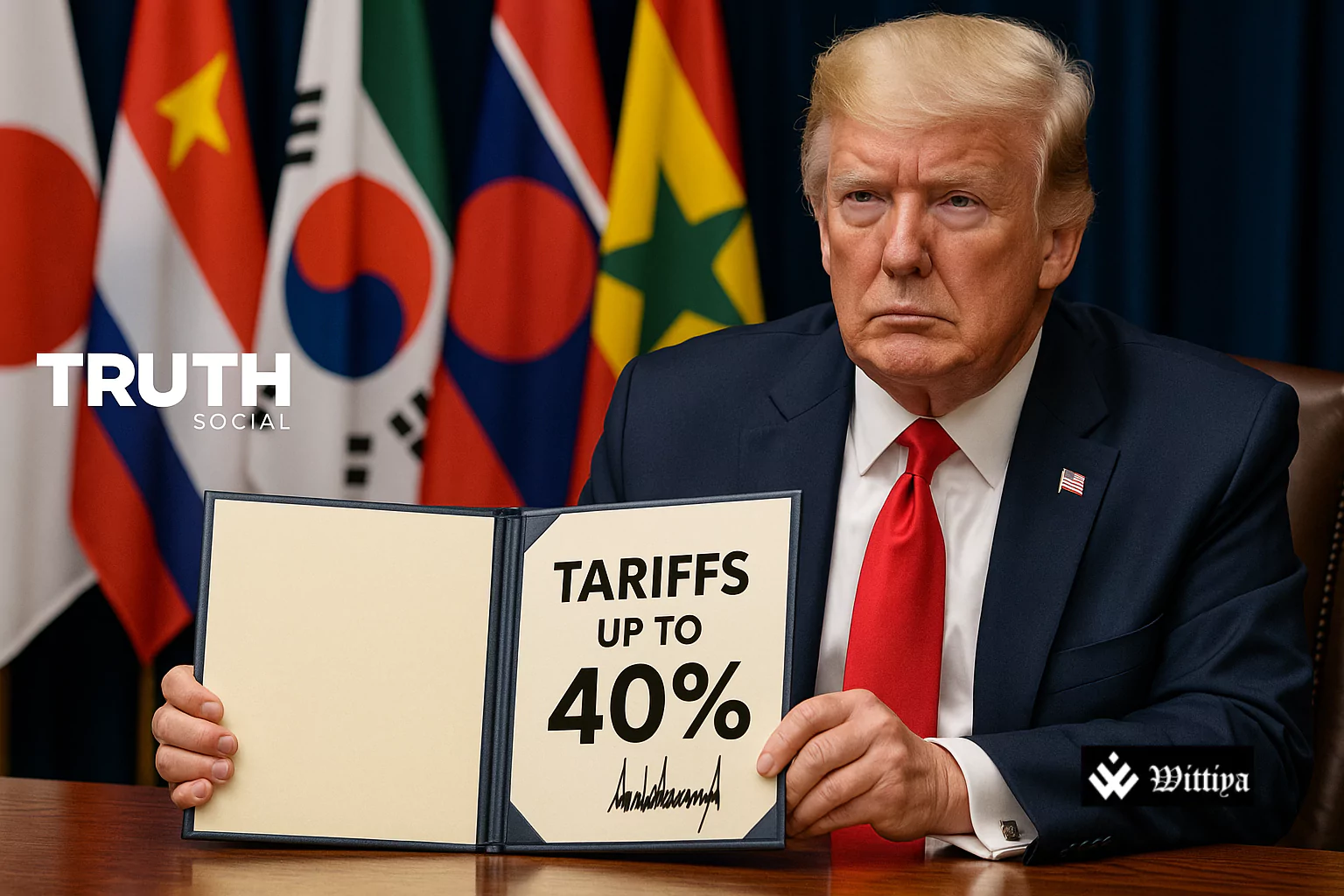
On July 8, 2025, U.S. President Donald Trump announced new steep tariffs on imports from 14 countries, effective August 1, citing trade deficits and transshipping concerns. The tariffs range from 25% to 40%, and include countries such as Japan, South Korea, and Bangladesh. The announcement follows a previously paused “reciprocal tariff” policy and has stirred global market reactions and diplomatic uncertainty.
U.S. President Donald Trump has announced new steep tariffs on imports from at least 14 countries, citing efforts to correct persistent U.S. trade deficits and to discourage transshipping practices. The tariffs will take effect from August 1, 2025, following the expiration of a 90-day pause initiated in April.
The announcement was made via Truth Social, where President Trump posted signed letters to foreign leaders, informing them of the new tariff rates. Among the affected countries are Japan, South Korea, Malaysia, Kazakhstan, South Africa, Laos, and Myanmar—all of which will now face import tariffs ranging from 25% to 40%.
Also included are Bosnia and Herzegovina, Tunisia, Indonesia, Bangladesh, Serbia, Cambodia, and Thailand.
According to the letters, 25% tariffs will be imposed on goods from Japan, South Korea, Malaysia, Kazakhstan, and Tunisia. South Africa and Bosnia will face 30% tariffs, Indonesia 32%, Bangladesh and Serbia 35%, Cambodia and Thailand 36%, and Laos and Myanmar the highest at 40%.
The letters also warned that retaliatory tariffs would result in an additional increase. “If for any reason you decide to raise your tariffs, then, whatever the number you choose to raise them by, will be added onto the 25% that we charge,” one letter read.
This marks a return to the “reciprocal tariff” strategy Trump originally launched on April 2, 2025, before announcing a 90-day pause on April 9 amid global market volatility. During that pause, all countries were charged a uniform 10% tariff.
The new announcement also follows a federal district court ruling in May 2025, which found Trump lacked legal authority under emergency powers to impose broad tariffs. The Trump administration has since appealed, and the tariffs remain in effect pending review by the U.S. Court of Appeals for the Federal Circuit.
In a statement, White House Press Secretary Karoline Leavitt said additional tariff letters would be sent to more countries in the coming days. Later in the day, President Trump signed an executive order delaying the implementation date to August 1 based on “additional information and recommendations from senior officials.”
The Office of the United States Trade Representative (USTR), which manages trade policy and data, reported large trade deficits with countries like Japan (USD 68.5 billion) and South Korea (USD 66 billion) in 2024, while countries like Myanmar had far smaller deficits.
U.S. financial markets reacted negatively to the announcement. On July 8, the Dow Jones Industrial Average dropped 422.17 points (0.94%) to close at 44,406.36, the S&P 500 fell 0.79% to 6,229.98, and the Nasdaq Composite slid 0.92% to end at 20,412.52.
These blanket tariffs are separate from existing sector-specific duties and include new penalties for goods suspected of transshipping—i.e., routed through a third country to avoid tariffs. Trump reiterated that all rates are subject to change “depending on our relationship with your Country.”
As negotiations continue globally, Trump’s trade strategy has drawn both support from protectionist circles and criticism from economists who dispute the effectiveness of tariffs in reducing trade deficits.