


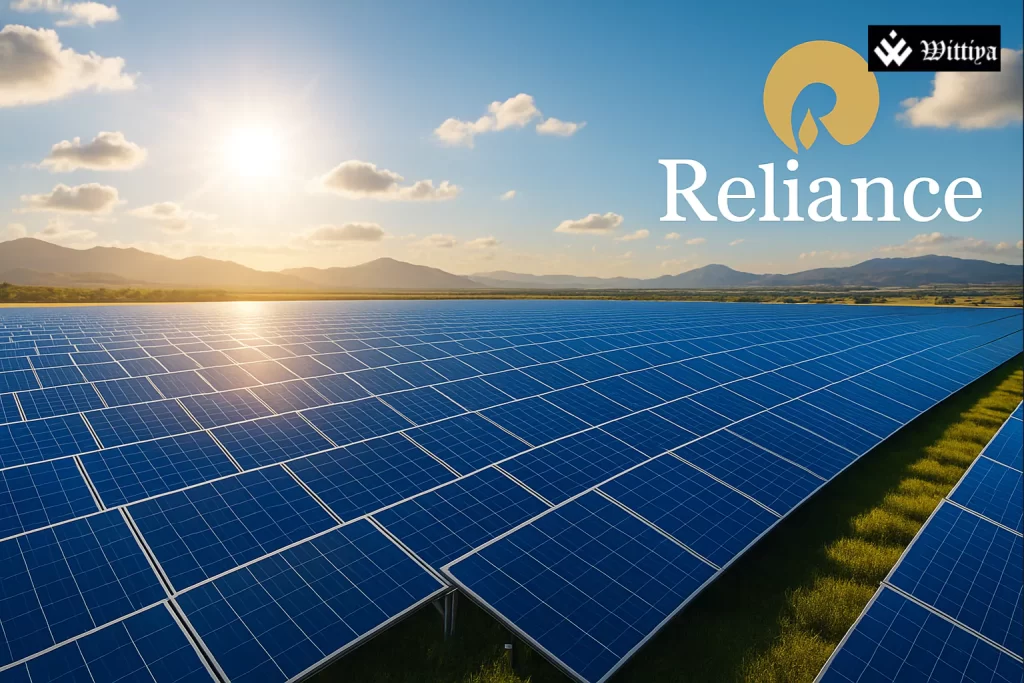
Reliance Industries is implementing a solar project covering 550,000 acres in Kutch, India, that is three times the size of Singapore. The purpose of the project is to provide 10% of India’s electricity requirements in the next ten years while facilitating the generation of green hydrogen and clean energy at a large scale.
Reliance Solar Project India 2025
One of the world’s largest single-site solar projects has been announced by Reliance Industries Limited (RIL), India. It was a statement made by the chairman, Mukesh Ambani. This will be a solar power unit in Kutch, Gujarat, covering 5,50,000 acres, or almost three times the size of Singapore. The project aims to meet about 10% of India’s power requirements in the following ten years. It is a quantum jump in India’s clean energy aspirations, reflecting the overall clean energy trend across the globe.
A Bold Step for India’s Energy Future
Mukesh Ambani, in his address at RIL’s Annual General Meeting, stated that this solar project only demonstrates the grandeur of the scale but also openness when it comes to the company’s other works at Jamnagar and Kandla. The aim of easy hybridisation of solar and hydrogen at such vast scales is to use the green ammonia, green methanol, and sustainable aviation fuel industries as the mechanism for energizing the clean energy transition.
Cogeneration with renewables is indeed a clean and green way to combine energy sources. The goal of accomplishing green hydrogen consumable capacity (GHCC) of 3 million tones per annum (MTPA) by 2032 is a pioneering move that sets the future course of the most extensive clean energy plan in India and in the world.
Also Read: Fraud Allegations Slam Reliance Stocks Into Lower Circuit
Technology and Scale Advantages
The total installation of the Reliance solar project at the peak will be 55 MW of solar modules and 150 MWh of battery containers per day. This will be one of the fastest deployments globally. Such size and speed are not expected only to change the renewable portfolio of Reliance but also the whole country’s capability of meeting its clean energy targets before time.
On the other hand, Reliance has made its solar PV manufacturing platform functional, and they are already their first 200 MW of heterojunction technology (HJT) modules production. These high-tech modules promise:
- 10% more energy generation
- 20% more efficiency at high temperatures
- 25% less degradation rates
If the company goes according to its plan, it will be the largest and the most integrated solar manufacturing facility in the world with a capacity of 20 GWp of integrated solar PV.
Building a Green Energy Ecosystem
Besides solar energy development, Reliance is planning to establish a battery giga factory along with an electrolyser giga factory to support its solar activities. The first phase of the battery giga factory, which will be 40 GWh expandable up to 100 GWh, is scheduled to start its operations in the year 2026 and the annual capacity of the electrolyser factory will be 3 GW by the end of 2026 and it will be the first to start working.
With these their full ecosystem—solar, storage, and hydrogen—are completed. They do not need to use different suppliers or factories, which provides them with the advantages in terms of costs, scales, and supply chain resilience, thus allowing them a long-term competitive position in the global energy markets.
Financial and Strategic Insights
In terms of finance, the project represents a transformation of Reliance from traditional petroleum-based business to renewable energy, highlighting a safe growth model for the future. The solar project and the integrated green energy ecosystem could be the factors that set Reliance apart from its competitors in the energy transition sphere and make it similar to the petrochemicals and telecom sectors, where it is a leader.
Such a clean energy move, combined with the energy targets of India nation and the firm’s dominance as a result of economies of scale, will allow Reliance to bring down significantly the production cost of green hydrogen. This development will not only make India a leader in the global clean energy market but will also position it as a key exporter of renewable fuels, especially when the demand for clean energy will be rising worldwide.
Industry-Wide Implications for India
The solar project of this magnitude catapults India to a leader-ship position in the race for clean energy. This will unlock the flow of investments into areas such as infrastructure, storage, and renewable manufacturing. As a result, the country will not only generate more jobs but will also be able to attract more global partners and at the same time, stay true to its sustainability commitments.
Since governments all around the world are increasingly setting more ambitious decarbonization goals, Reliance’s project should not only be seen as a tactical bet, but also a key player in a green future; but rather, as a strategic move which is able to maintain the company’s competitiveness in a scenario where green hydrogen and renewable derivatives are crucial for trade and energy security.
FAQ’s
Q1: How big is Reliance’s solar project in India?
The project is located on an area of 5,50,000 acres in Kutch, Gujarat, which is three times larger than Singapore, and is thus considered one of the world’s largest single-site solar projects in terms of area.
Q2: What is the expected energy contribution of the project?
The project is forecasted to fulfill nearly 10% of the total electricity demand in India within the next 10 years
Q3: What role will hydrogen play in this project?
According to Reliance, large-scale clean production of green hydrogen is their plan, and they establish a goal that by 2032, the output of green hydrogen equivalent will be 3MTPA.
READ MORE ON