






India’s cooling inflation and rising U.S. price pressures are reinforcing a downward bias on dollar-rupee forward premiums. The diverging monetary outlooks of both nations’ central banks, driven by their contrasting inflation trajectories, are increasingly impacting forward rates and investment sentiment.
A sharp deceleration in India’s inflation rate is intensifying downward pressure on dollar-rupee forward premiums, as a widening gap in monetary policy expectations emerges between New Delhi and Washington.
India’s consumer price index (CPI) fell to a six-year low in June, setting the stage for a potential rate cut by the Reserve Bank of India (RBI). On the other hand, the United States recorded its highest consumer price growth since February, reflecting early signs of tariff-induced price pressures.
Economists expect India’s CPI inflation to drop below 2% in July, strengthening the case for policy easing. Meanwhile, U.S. inflation is likely to remain elevated through August due to pass-through effects of recent trade tariffs, which could keep the Federal Reserve on hold.

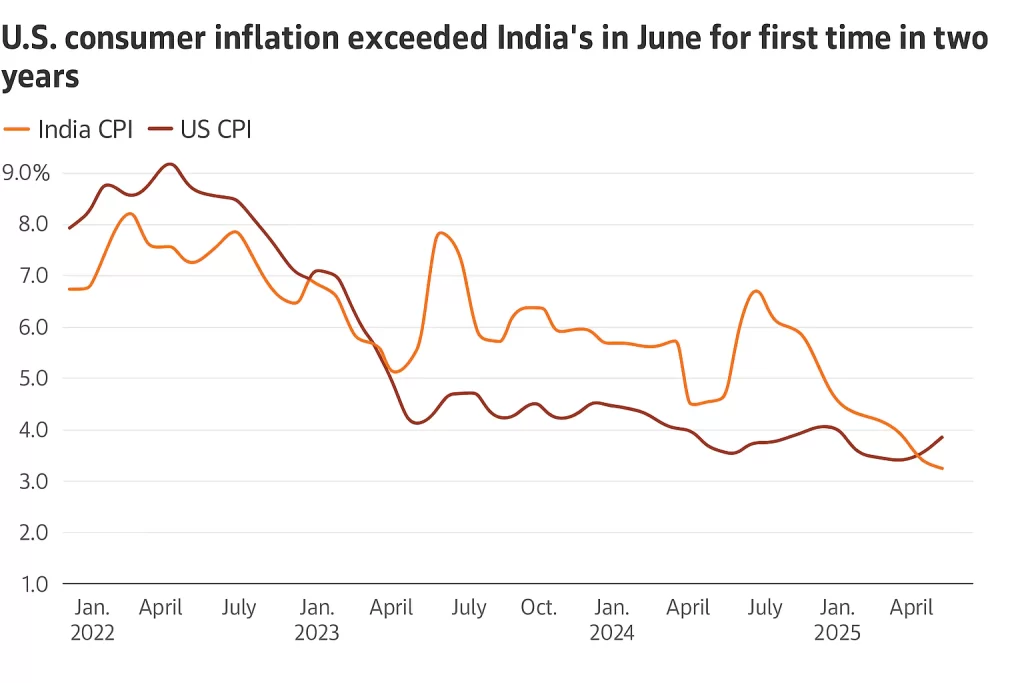
Line-chart depicting trajectories of U.S. and India’s consumer price inflation data
This divergence is materially influencing dollar-rupee forward premiums. On the date of assessment, the one-year implied yield dropped by 2 basis points to 1.96%, and market participants expect it to edge further toward 1.90%.
“With Indian inflation softening significantly, the likelihood of a rate cut at the upcoming RBI policy review has increased. This is putting pressure on the forward premia curve,” said a forex strategist at a private bank.
At the same time, expectations of U.S. rate cuts have moderated. Traders have started reducing bets on multiple cuts in 2025, aligning with a cautious stance in light of persistent goods inflation. The contrasting inflation trajectories are compressing the interest rate differential between the two economies—a key driver of forward premiums.
The Indian rupee traded modestly higher at 85.78 against the U.S. dollar, supported by robust interbank dollar sales. This helped stabilize spot market sentiment even as forward markets remained under pressure.
The macroeconomic outlook suggests continued divergence. India’s policy bias appears increasingly dovish amid improving domestic price stability, while the U.S. remains wary of stoking inflation further. This fundamental disconnect may continue to depress forward premiums in the near term.
Market participants are now closely watching the RBI’s August meeting for potential policy signals, while assessing how tariff effects will unfold in the next U.S. inflation prints. For currency strategists, the narrowing premium may create opportunities for tactical positioning in USD/INR derivatives.