


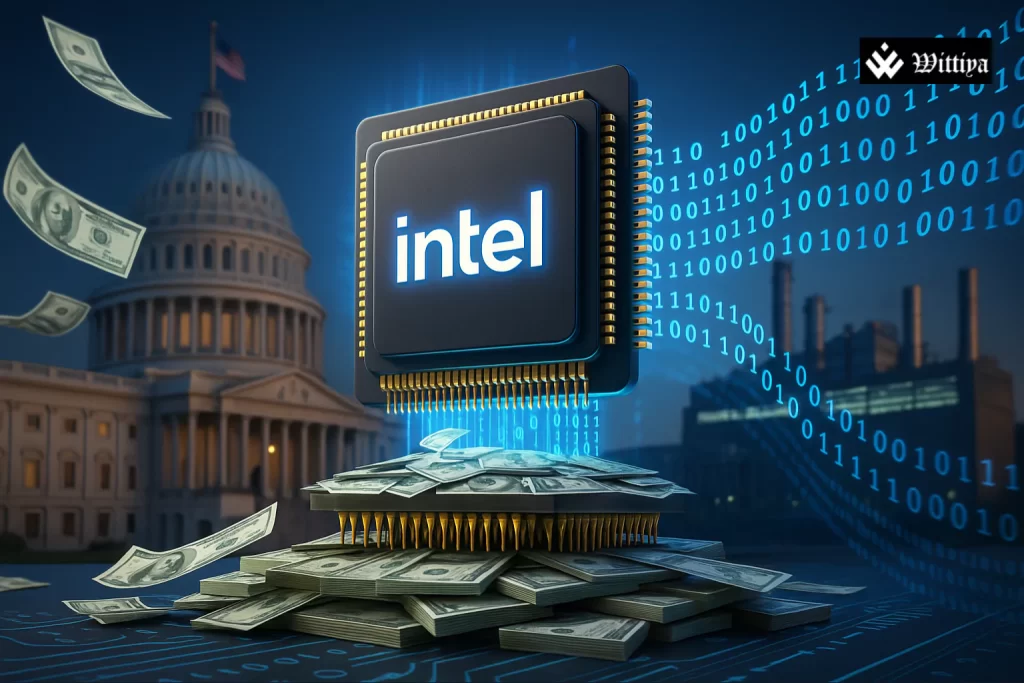
Intel changed its CHIPS Act funding agreement with the U.S. Commerce Department and a $5.7 billion check was made earlier than expected. By this turn, the chip maker can better manage the funds, while the U.S. government is increasing its involvement in the semiconductor sector, a move described as strategic.
Intel CHIPS Act Funding $5.7B Boost
Through its semiconductor strategy, the United States has made a giant stride; Intel declares it has updated its CHIPS Act funding deal with the U.S. Department of Commerce, thus surpassing the planned value by $5.7 billion. The amendment allows Intel not only to align with Washington’s evolving priorities to invigorate local chip manufacturing but also to avail more treasurable financial options.
U.S. Government’s Strategic Stake
Intel in the updated deal has raised 274.6 million shares to the U.S. government, and with the conditions allowing the government to acquire up to an additional 240.5 million shares, subject to specific circumstances. This gives the government a much stronger role and authority in the U.S. tech sector as the deal represents one of the largest moves to the semiconductor industry by the government.
These shares with a total of $8.9 billion help grants of $2.2 billion that the government has already given, lifting the support of the government up to $11.1 billion in total. Intel on its side, has confirmed that the company has funded more than $7.87 billion worth of projects that are qualified for CHIPS Act, thus, showing the big scale of its production capacity extension.
Financial Flexibility and Guardrails
According to Intel’s Chief Financial Officer, David Zinsner, the early access to Intel CHIPS Act funding is likely to allow much larger dexterity in the deployment of the funds. Nevertheless, the amended pact does maintain some limitations: there are certain activities excluded from the use of the funds such as the distribution of dividends, the repurchase of the stock, or specific control-altering transactions.
Furthermore, there are also remaining restrictions for the long term expansion in particularly sensitive areas, most notably, China. It is clear that the deal shows a sort of parity between giving Intel the tools it needs to stay competitive and protecting the interests of the U.S. that are related to advanced technology.
Foundry Control and Long-Term Vision
On the other hand, the U.S. government’s financial support to Intel acts in a way that is favourable for the company to keep the tightest possible control over the foundry division, a business unit,which the company says is key to maintaining the leadership of the Americans in the production of semiconductors. As Taiwan and South Korea still are the major producers of chips globally, the government’s strategy is to empower the U.S. through extensions and subsidies.
Finally, the release of 158.7 million escrowed shares related to the Secure Enclave program-was introduced to spur secure chip production in the U.S.-is contingent on the availability of furtherCHIPS funds. This represents a long-term, phased plan to drive U.S.-based chip production.
Market and Policy Implications
Intel’s equity-based funding from the CHIPS Act diverges from traditional subsidies, and questions about government ownership in private corporations have already been raised. For Intel, this move indicates that the U.S. government supports the company, but Intel should also expect the U.S. authorities to keep a closer watch over them. Policymakers can consider this decision as an example of a precedent that can impact future investments in the semiconductor and tech sectors.
On the other hand, the financial side tells us that the capital injection will give Intel the opportunity to overcome its financial constraints. In this way, Intel will be able to expand its production facilities both in the state of Arizona, as well as in Ohio and other places in the United States (U.S.).
Industry Impact
What happens with Intel in the CHIPS Act is only the beginning of wider repercussions for the global semiconductor supply chain. It demonstrates that the U.S. can use equity stakes as one of the instruments of industrial policy rather than relying only on the traditional subsidies for ensuring that highly advanced chip production capacity will be kept at home.
If such examples were repeated with other companies, these could disrupt the pattern of private-public collaboration, which in turn could bring about a redefinition of the capital structures in the semiconductor industry.
FAQ’s
Q1. What is Intel CHIPS Act funding?
This term represents financial support from the U.S. government that is given to Intel under the CHIPS Act with a view to boosting domestic semiconductor production.
Q2. How much funding has Intel received?
Intel has received a total of $11.1 billion that consists of $8.9 billion in a government stake and $2.2 billion in grants.
Q3. Why is the U.S. government taking equity in Intel?
The stake ensures accountability, incentivizes Intel to maintain control of its foundry business, and aligns public investment with national security interests.
READ MORE ON