


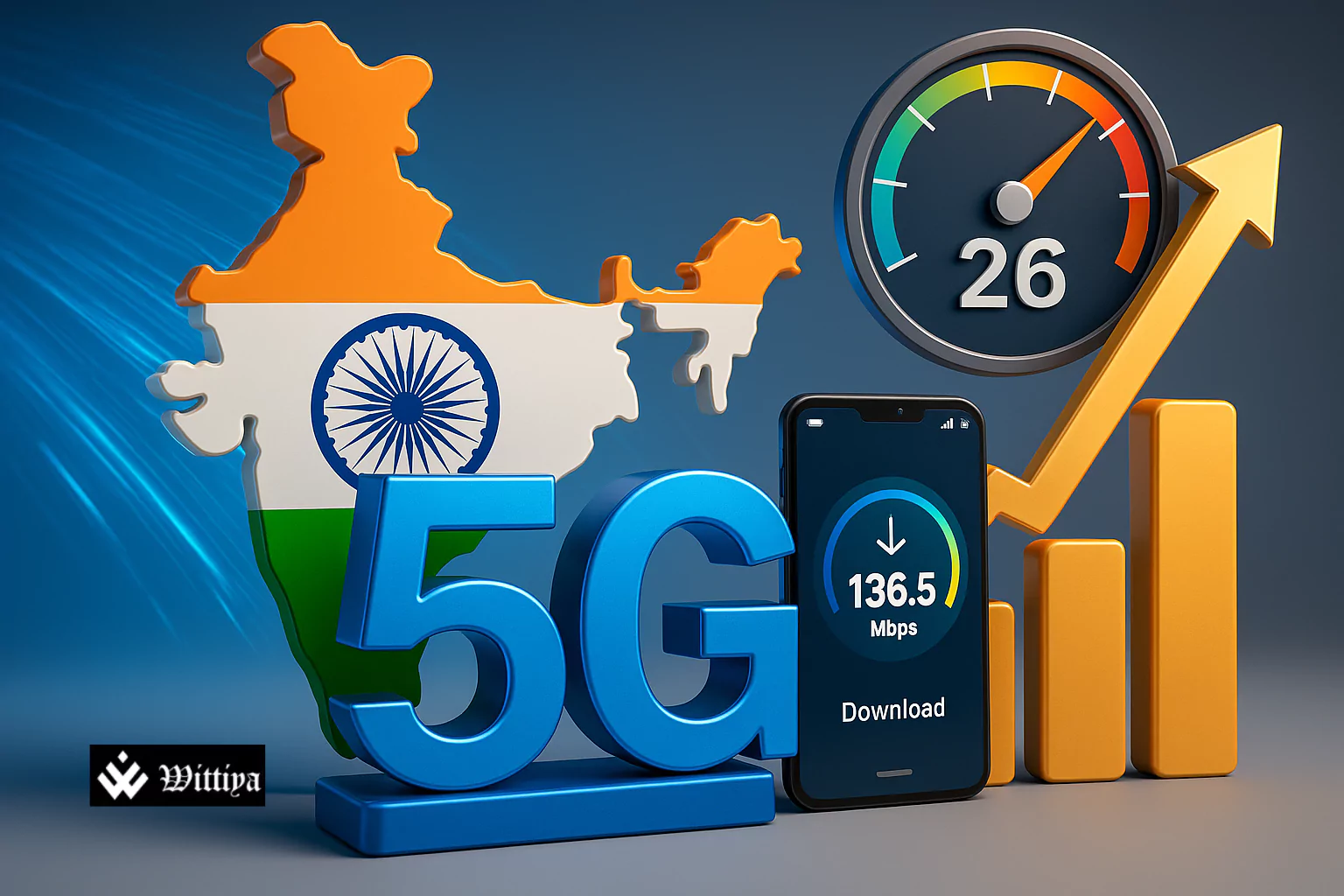
India has climbed to 26th globally in mobile internet speed rankings, driven by rapid 5G adoption and heavy telecom investment. With median speeds reaching 136.53 Mbps and data usage at 32 GB per user per month, the country is narrowing the digital divide with advanced markets like the US and China.
India is witnessing a digital revolution as it climbs to 26th place globally in mobile internet speeds, according to recent performance data. Driven by its expanding 5G infrastructure, affordable data plans, and massive smartphone usage, India has significantly closed the performance gap with advanced economies like the United States and China.
According to Ookla, India’s median download speed reached 136.53 Mbps between April and June, up from 13.87 Mbps in September 2022—a staggering improvement that underscores the country’s rapid digital transformation. In comparison, the US ranks 13th with 176.75 Mbps and China 8th at 207.98 Mbps.
This acceleration aligns with India’s aggressive 5G deployment. Since the commercial rollout of 5G in October 2022, telecom operators have scaled the network to cover a majority of the country. As of March 2025, India has over 326 million 5G subscribers, accounting for nearly 28% of total wireless connections.
India’s position as the world’s largest mobile data consumer further illustrates this momentum. Average monthly data consumption has surged to 32 GB per user, surpassing China (29 GB) and the US (22 GB). Analysts credit this to India’s 600-million-strong smartphone base, affordable data tariffs, and consistent capital investments by telecom operators.
Telecom players are estimated to have spent over ₹1.40 lakh crore (approx. USD 16.8 billion) between FY23 and FY25 on 5G infrastructure, contributing to better speeds and wider accessibility. Despite the rise in operational costs, Indian telcos have maintained pricing strategies aimed at affordability, which in turn has driven massive user adoption.
Industry experts emphasize that while speed and coverage are improving rapidly, telcos must now focus on rural penetration, indoor connectivity, and edge computing to prepare for an AI-native digital ecosystem. Infrastructure approvals and public-private collaboration will be key to sustaining momentum.
Digital engagement is also surging. In 2024, Indians spent an average of 4.9 hours daily on mobile apps, resulting in more than 1.1 trillion cumulative hours on digital platforms—higher than any other nation. Subscription-based video streaming services saw fivefold growth since 2019, reflecting deeper content engagement.
India’s Unified Payments Interface (UPI) adoption also continues to soar, with 460 million users and 65 million merchants participating in digital transactions—another testimony to how connectivity is reshaping everyday commerce.
With continued 5G rollouts, increasing smartphone adoption, and an enthusiastic digital user base, India is not only catching up with developed nations but also laying the foundation to be a global digital leader in the near future.