


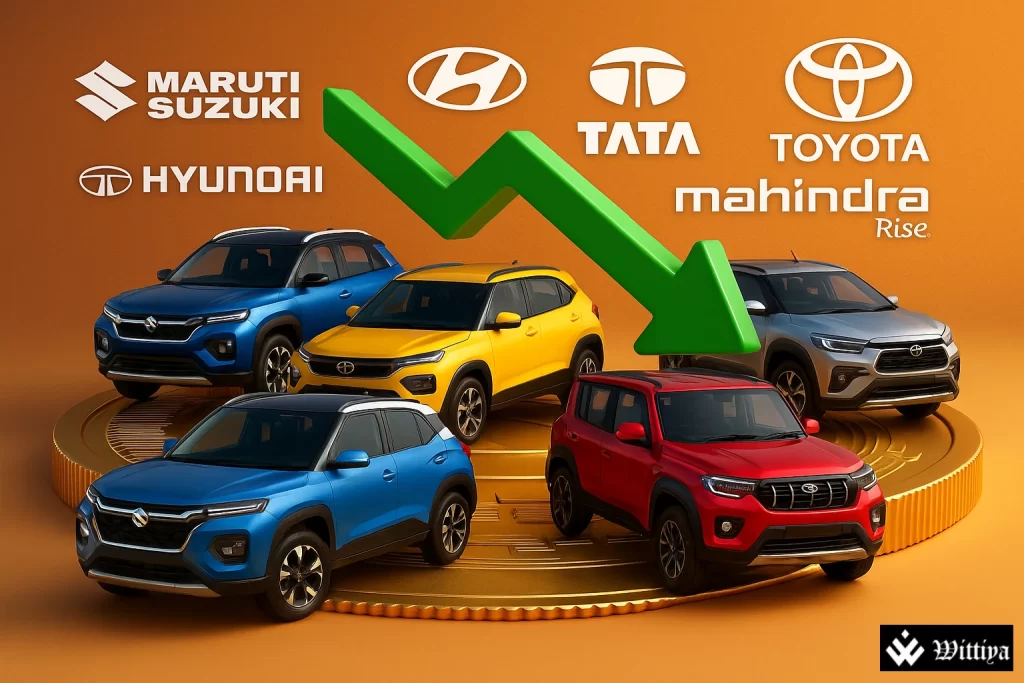
GST 2.0 reforms reduce the tax rates on small cars, motorcycles, and hybrids to make them more affordable and simultaneously, the larger SUVs will be moved to a 40% slab. Electric vehicles will still enjoy a temporarily low rate of 5%, which will promote affordability in the most popular vehicle categories.
The GST 2.0 Framework and Its Impact on the Auto Industry
The Goods and Services Tax (GST) Council has introduced the next-generation GST reforms, widely referred to as GST 2.0, aimed at rationalising tax slabs and reducing the burden on consumers. The new system simplifies the structure to two main slabs—5% and 18%, with a 40% rate applicable only on super-luxury, large, and demerit goods.
For the automobile sector, which is one of the strongest pillars of India’s economy, this reform represents a structural shift. The new rates are expected to improve affordability, streamline classification, and encourage higher sales volumes across passenger cars, two-wheelers, hybrids, and electric vehicles.
GST 2.0 Car Prices Dips: Key Tax Changes
Small Cars and Motorcycles Become Affordable
- Petrol, LPG, CNG Cars (<1200 cc): GST was 28%, now reduced to 18%
- Diesel Cars (<1500 cc): GST was 28%, now reduced to 18%
- Motorcycles (<350 cc): GST was 28%, now reduced to 18%
- Commercial Vehicles: GST was 28%, now reduced to 18%
This means hatchbacks, compact sedans, entry-level SUVs, and commuter motorcycles will see a direct 10% tax cut, translating into significant price drops.
Larger SUVs Shift to 40% Slab
The petrol-powered vehicles with engine sizes over 1200 cc, diesel engines above 1500 cc, or lengths greater than 4 metres will be subject to 40% tax under the new GST system (GST 2.0).
Also Read: GST 2.0 Tax Changes: Cheaper & Costlier Goods List
This is a disadvantage in comparison with the present situation if one only considers the nominal tax rate, but as a matter of fact the vehicles had a high rate of additional taxes from which the compensation cess is the largest contributor and the actual tax burden was sometimes close to 50% Effective tax rates on large cars were thus very close to 50% before the changes. With the cess phased out, the actual tax burden will be similar or a little less, thus the models like Hyundai Creta, Toyota Fortuner, and Mahindra Scorpio-N will stay competitive in the market.
Hybrids Enter the Affordable Zone
The hybrid cars have just been simplified, as they were previously charged at 28% GST + a 15% cess = 43% total.
- Small Hybrids (<1200 cc petrol / <1500 cc diesel, length <4m) → 18% GST
- Larger Hybrids → 40% GST
Henceforth, compact hybrid cars will become one of the alternative options for buyers who want to save on fuel and thus, the Indian automobile companies such as Maruti Suzuki, Toyota, and Honda will be compelled to launch more hybrid models in India to attract this segment of consumers
EVs Retain 5% Concessional Rate
The electrified vehicles (EVs) will still have to pay only 5% GST irrespective of their size or segment. This steadiness favors the domestic releases as well as the imported premium EVs. The consignments of the premium EVs from Tesla, Mercedes, and BMW besides the locally made EVs like Tata Harrier EV and Mahindra XEV9e get equal treatment. With this action, the manufacturers and buyers get a kind of certainty for a more extended period.
Brand-Wise Predicted Car Prices Dips Under GST 2.0
Brand & Model (Segment) Current Ex-Showroom Price Estimated Price Drop New Price Range (Approx.)
| Vehicle / Segment | Ex-Showroom Price (Before GST Cut) | GST Benefit | Effective Price (After GST Cut) |
| Maruti Suzuki Swift (Hatchback, Petrol <1200 cc) | ₹6.0 – ₹9.0 lakh | ₹60,000 – ₹80,000 | ₹5.4 – ₹8.2 lakh |
| Hyundai i20 (Hatchback, Petrol <1200 cc) | ₹7.5 – ₹11.0 lakh | ₹80,000 – ₹1.0 lakh | ₹6.7 – ₹10.0 lakh |
| Tata Nexon Diesel (SUV, <1500 cc) | ₹9.0 – ₹14.0 lakh | ₹90,000 – ₹1.2 lakh | ₹8.1 – ₹12.8 lakh |
| Honda Amaze Diesel (Sedan, <1500 cc) | ₹7.2 – ₹9.6 lakh | ₹70,000 – ₹85,000 | ₹6.4 – ₹8.8 lakh |
| Kia Sonet (Compact SUV, <1500 cc) | ₹8.0 – ₹14.0 lakh | ₹90,000 – ₹1.2 lakh | ₹7.1 – ₹12.8 lakh |
| Bajaj Pulsar 150 (Motorcycle <350 cc) | ₹1.2 – ₹1.5 lakh | ₹12,000 – ₹15,000 | ₹1.1 – ₹1.35 lakh |
| Ashok Leyland Dost (Commercial Vehicle) | ₹8.0 – ₹9.0 lakh | ₹80,000 – ₹1.0 lakh | ₹7.0 – ₹8.0 lakh |
(Numbers are represented as approximate and are based on GST 2.0 rate change. They do not indicate the official manufacturer’s prices.)
Industry Outlook Post-GST 2.0
The auto sector will have to face the following situation after the implementation of the GST 2.0 system:
- Demand for hatchbacks, compact SUVs, hybrids, and EVs is expected to get stronger as these models will become more affordable.
- More or less stable demand for bigger SUVs is anticipated with the removal of the cess leading to neutral or marginal price changes.
- The two-wheeler sales will get an uplift, especially the commuter bikes which are under 350 cc and form the largest part of the Indian mobility market.
- The manufacturer’s attention to hybrids will be greater as they will be able to use the lower GST bracket to target urban consumers who are conscious of their fuel consumption.
Keeping in mind the simplification of GST slabs, registration management, and automated refunds, it is envisaged that this reform will unlock working capital, raise compliance, and speed up the growth of the automotive ecosystem of India.
FAQ’s
How will GST 2.0 affect car prices in India?
Under GST 2.0, the tax rate on small and mid-sized cars will be reduced to 18%, effective September 22, 2025. This is expected to make vehicles from brands like Maruti Suzuki, Hyundai, Tata, and Mahindra significantly more affordable for consumers.
What will be the GST rate on luxury cars under GST 2.0?
Luxury cars will be taxed at a higher rate of 40% under GST 2.0. This ensures premium vehicles continue to attract steep levies, while mass-market models become more budget-friendly.
Why is GST 2.0 considered a major shift for the auto industry?
GST 2.0 simplifies the earlier complex system of 28% GST plus additional cesses (sometimes pushing total taxes above 50%). By moving to a two-slab system of 18% and 40%, the government aims to revive consumer demand, boost affordability, and ease compliance for manufacturers in India’s automobile sector.
READ MORE ON