


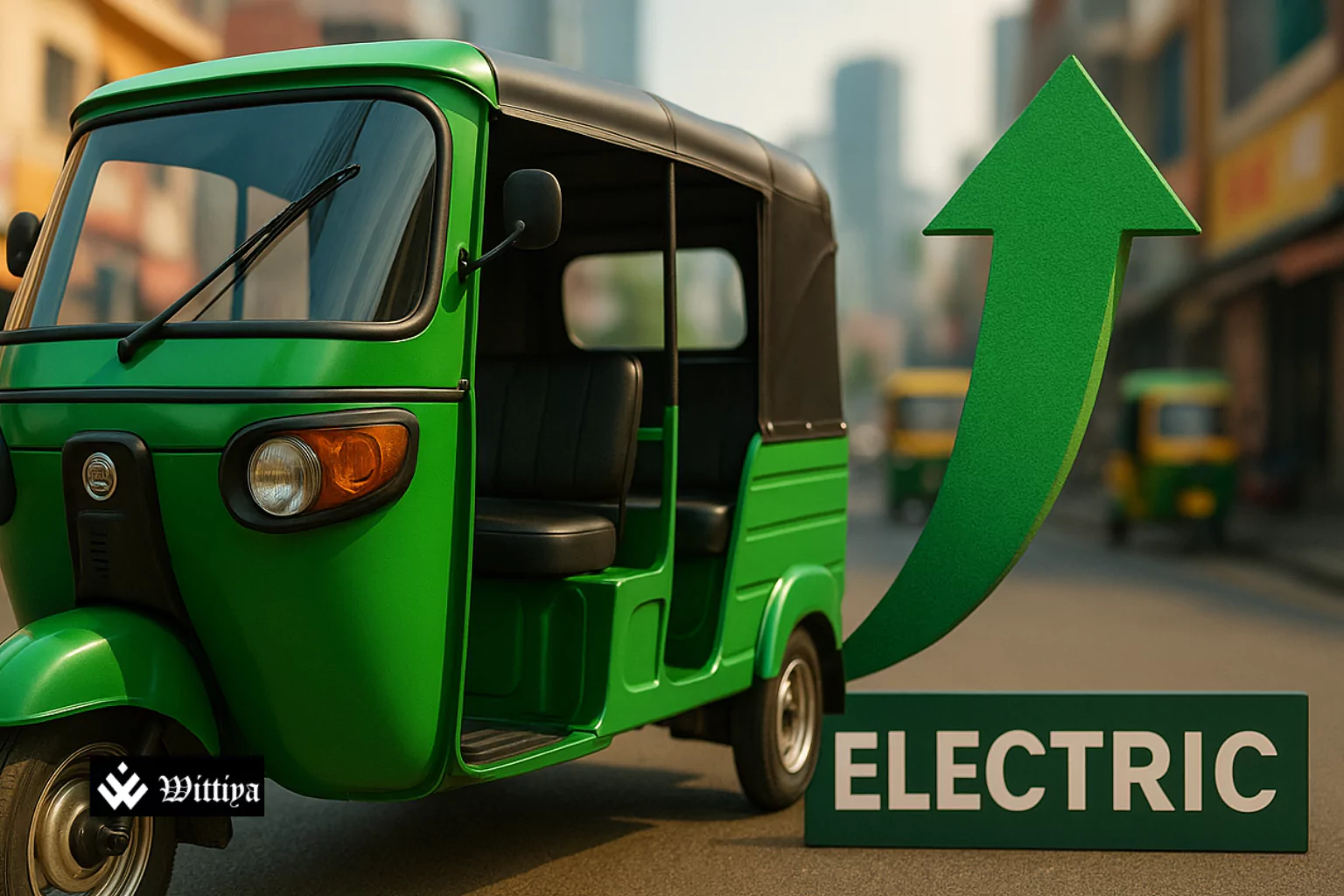
India’s electric three-wheeler (e-3W) market continues its rapid expansion, setting a new monthly retail record in July 2025. With 69,145 units sold, the segment now dominates 62% of total 3W market share, while CNG vehicle demand drops significantly. Analysts forecast total e-3W sales to exceed 700,000 units this year, driven by rising urban demand, cost advantages, and supportive policy environments.
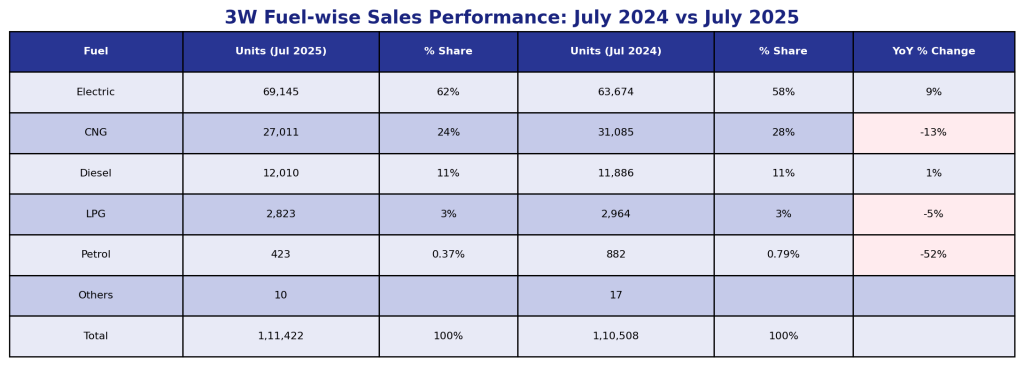
India’s electric three-wheeler (e-3W) market has crossed a critical threshold, hitting its highest-ever monthly retail sales in July 2025 with 69,145 units sold. The segment’s share of the overall three-wheeler market rose to 62%, up from 58% in July 2024, underscoring the rapid pace of electrification in the last-mile mobility space.
This surge in sales reflects a robust 9% year-on-year (YoY) growth, beating the previous high of 66,014 units recorded in May 2025. On the back of this momentum, the industry is projected to breach the 700,000-unit sales milestone by the end of CY2025 — a first for the sector.
CNG 3-Wheelers Lose Ground Amid Rising Fuel Costs
While the electric segment grows, CNG-powered three-wheelers have seen a notable contraction. Retail figures for July 2025 show a 13% YoY decline, with only 27,011 units sold — a drop of 4,074 units from the same period last year. The CNG segment’s market share has fallen from 28% in July 2024 to 24%, mirroring the exact growth witnessed by electric alternatives.
Industry analysts attribute the slowdown in CNG 3W sales primarily to higher operational costs driven by fuel price hikes, which increase the total cost of ownership — a crucial factor for small-scale transport operators and fleet owners.
Market Composition Reflects Strong Shift Toward EVs
Of the 111,422 total three-wheelers retailed across India in July 2025 — including electric, CNG, diesel, LPG, and petrol variants — electric models clearly led the pack. Diesel variants maintained an 11% market share with marginal YoY growth of 1% and 12,010 units sold, while LPG held steady at 3% with 2,823 units. Petrol-powered 3Ws, on the other hand, saw a 52% YoY decline with just 423 units sold, reflecting consumer aversion to high fuel costs.
The consistency in electric 3W sales, supported by government policies, favorable economics, and rising acceptance among drivers, continues to accelerate the transition from internal combustion engine (ICE) vehicles to zero-emission alternatives.
Also Read: India’s Green Fuel Shift Sparks Questions on Insurance Premiums
Projections for CY2025: Record Sales Likely
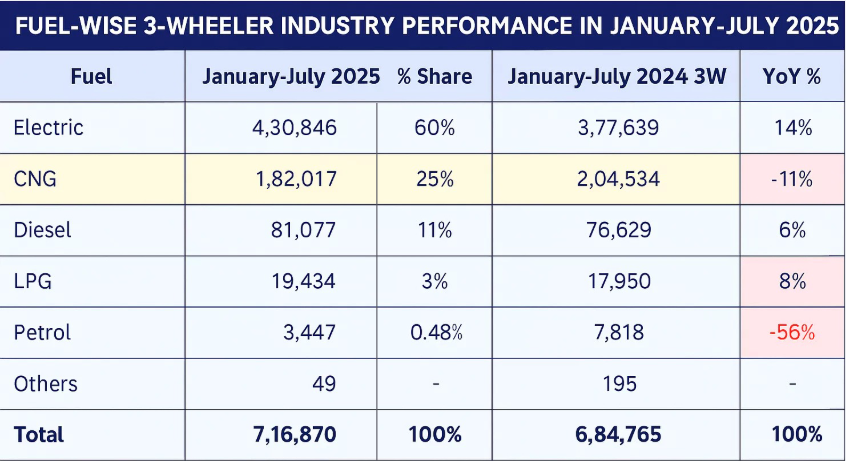
Between January and July 2025, electric 3W sales have already reached 430,846 units — up 14% from 377,639 units in the same period last year. This figure represents 62% of the record 691,301 units sold in CY2024. At the current average of 61,549 units per month, the industry is on track to easily surpass the 700,000-unit mark by year-end.
Several tailwinds are expected to sustain this growth in the remaining months of 2025, including the upcoming festive season, growing demand in Tier 2 and rural markets, and continued adoption for urban last-mile logistics. OEMs in the sector are already scaling production to meet this rising demand.
Structural Shift, Not a Trend
The persistent decline in CNG three-wheeler sales alongside the consistent rise in electric adoption indicates a structural market shift rather than a cyclical trend. The economics of electric vehicles — lower running costs, reduced maintenance, and government incentives — are proving decisive for commercial operators looking to maximize margins in a cost-sensitive segment.
Moreover, the improved performance, battery life, and charging infrastructure for electric 3-wheelers have addressed many of the initial adoption barriers, accelerating this transition.
READ MORE ON