



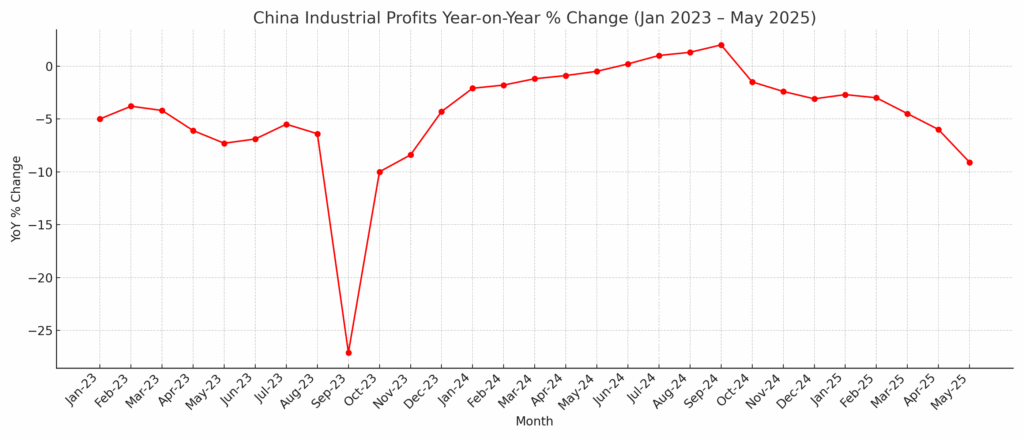
China’s industrial profits declined 9.1% in May 2025—the sharpest drop in seven months—highlighting the ongoing struggle of Chinese factories, utilities, and mines to rebound despite Beijing’s stimulus efforts. The fall signals weakened domestic demand and continued deflationary pressure as policymakers assess whether further economic support is needed.
The National Bureau of Statistics of China reported a 9.1% year-on-year drop in industrial profits for May, highlighting continued stress on enterprises despite ongoing stimulus measures from the central government. This marks the largest monthly decline since October 2024, when profits fell by 10%.
The Bureau attributed the fall to weak domestic demand and declining prices of industrial products. Cumulatively, industrial profits fell 1.1% in the first five months of 2025 compared to the same period last year.
The impact varied across sectors. The mining industry recorded a 29% decline, while automotive manufacturing was down 11.9%. On the other hand, manufacturing and utility sectors showed modest gains. State-owned enterprises saw a 7.4% drop, while non-state-owned firms declined by 1.5%. Meanwhile, foreign-invested firms from Hong Kong, Macau, and Taiwan registered a 0.3% increase in profits.
Despite these figures, some segments of the Chinese economy showed resilience. In May, retail sales grew 6.4%, the fastest since late 2023, fueled by government subsidies. However, industrial output and fixed-asset investment missed expectations.
Robin Xing, Chief China Economist at Morgan Stanley, noted that China’s GDP is on track to grow by 5.2% in the first half of 2025, exceeding the government’s official target of 5%. He suggested this growth may lessen the need for further stimulus at the Politburo meeting in July.
Neo Wang, Lead China Economist at Evercore ISI, shared a similar view, highlighting improved consumer sentiment and retail recovery. However, Wang also noted that any future stimulus would depend on the outcome of U.S.-China trade talks scheduled for late July.
Even with U.S.-bound exports falling 34.5% in May, China’s total exports rose 4.8%, buoyed by strong shipments to Southeast Asia and the European Union. Citi forecasts overall export growth of 2.3% in 2025, despite a projected 10% drop in U.S. exports.
In May, both countries reached an understanding under the Geneva agreement, resulting in a temporary easing of tariffs and export restraints. Still, concerns about long-term trade relations persist.
Morgan Stanley’s Xing warned that growth might slow in the latter half of 2025, citing deflationary pressure, reduced export momentum, and the potential fallout from tariffs on direct exports to the U.S.