


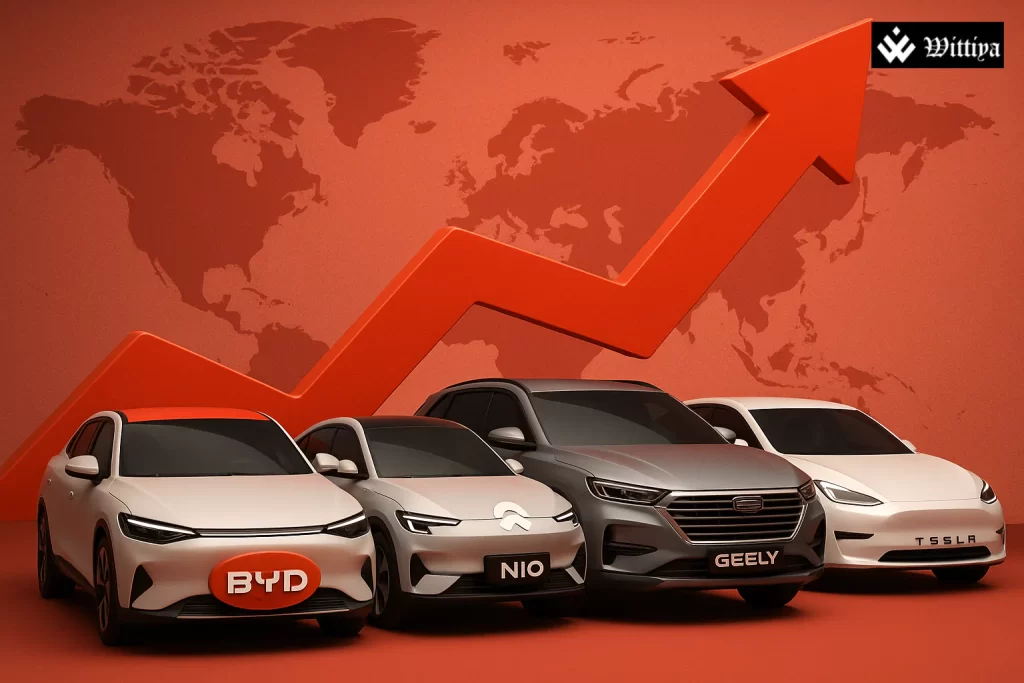
China’s electric vehicle evolution( EV) has changed the car market worldwide which dominates the traditional players by its speed of expansion, lower costs, and exports with a solid strategy of pricing.
Global Surge of China’s EV Industry
China has quickly become the world’s top vehicle exporter, outdoing Japan in 2023, as the China EV sector reshapes global competition. The rest of the world except for China, and the EV giant CEO Elon Musk has been totally surprised while Chinese EV makers have mobilized to the top of the game. BYD and Tesla in global EV revenues in 2024 is the perfect evidence.
Beijing’s EV strategy, which faced many challenges but was supported by more than $230 billion in government subsidies and incentives between 2009 and 2023, was powered by lower labor costs, technological breakthroughs, and strong domestic demand. Last year, China set a new world record in vehicle production reaching 31.4 million, with electric cars making up 41% of the total output.
BYD Leads as a global leader in EV
Once labeled a loser in the global competition, BYD has boosted its power to a large extent. During three years in a row, BYD has nearly added 1 million units annually, making it one of the go-to companies of the world.
Geely and SAIC Motor are also going into the offensive, although the two companies are not pushing for a stronger presence as aggressively as in the case of BYD. The battery giant of China, CATL, is providing the support for most of the EV global productions, by installing its batteries in the cars in question.
The Chinese car manufacturers were hardly in the picture as really competitive players just a couple of years ago, Not only are they on a completely different level today, but they are also redefining the whole industry.”
Henner Lehne from S&P Global Mobility.
Export Boom and Global Pressure
Domestic demand in the Chinese market is approaching saturation. Chinese carmakers in Europe and the United States are bored by the bright future brought by the foreign markets. The remarkable history of the Chinese car is the story of the fierce competition that they have encountered in a market that cares about quality and prestige. Their share of the markets has reached 10% in areas like the UK and Norway.
It is predicted by analysts that by 2030, annual production of China’s new energy vehicles will reach 36 million and the export volume will be 9 million, rising from only 1 million in 2020. Spain and South Africa are less large in the auto industry and are among the first who experience the consequences of this wave against their auto markets.
Western markets, however, have been pushing back. Both the U.S. and the European Union have imposed tariffs on EVs manufactured in China, charging the country with using subsidies and undercutting to gain market share.
FAQ’s
Q1: Q1: Why is China considered the global leader in EVs?
China leveraged subsidies, a well-established battery supply chain, and cost advantages to leave traditional global automakers far behind.
Q2: What companies are behind the EV growth in China?
The six companies – BYD, Nio, Li Auto, Geely, SAIC Motor, and CATL – are the main players that are leading the charge globally.
Q3: What is Europe doing about the EVs rise in China?
The EU, under the influence of ACEA, is putting in place tariffs and re-examining regulations with a view to safeguarding its car manufacturers from China’s domination.
READ MORE ON