






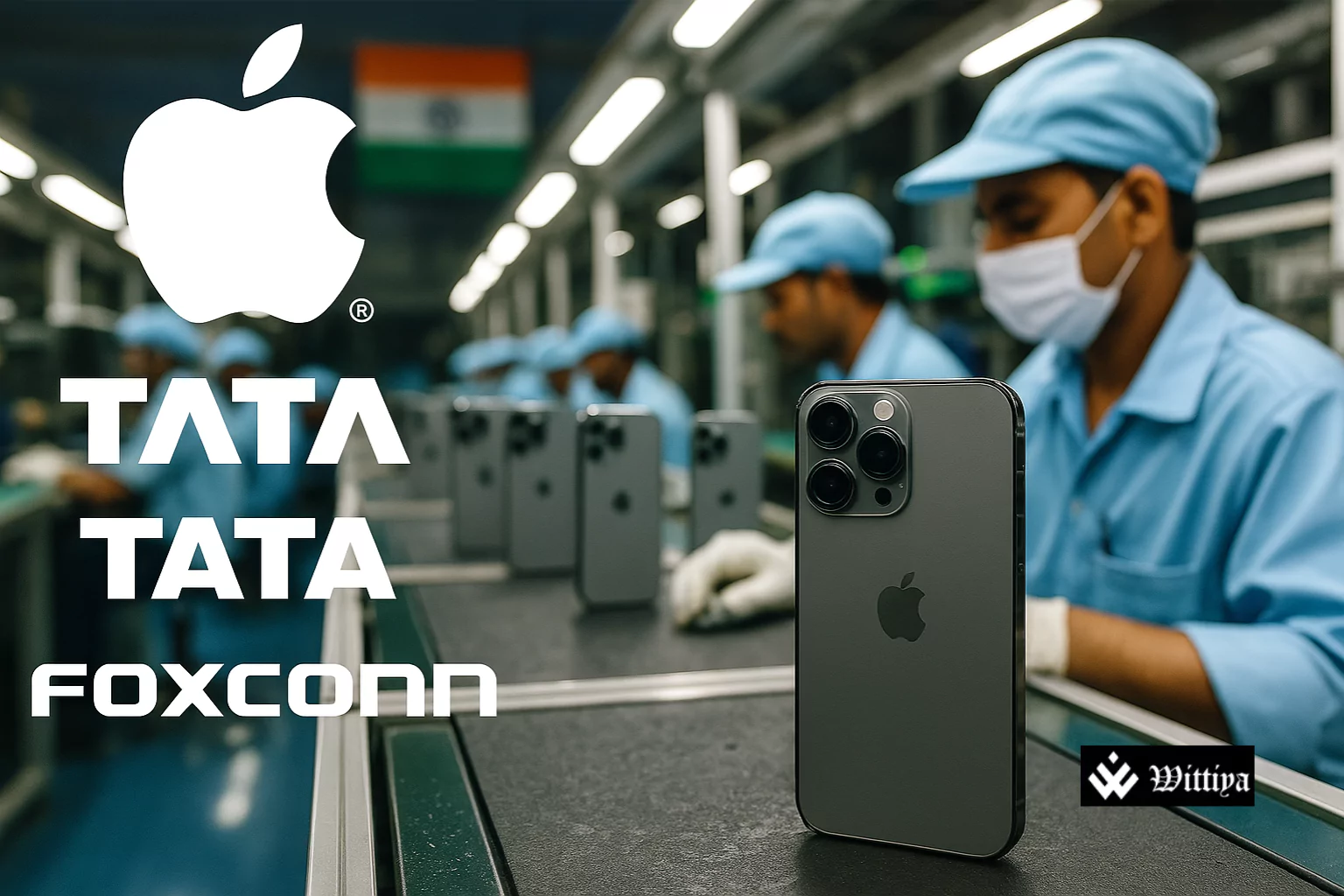
Apple has expanded iPhone production in India, shifting a significant portion of US-bound models to the country. The move strengthens India’s role in Apple’s global supply chain while diversifying away from China and mitigating tariff risks.
Apple has significantly expanded iPhone production in India, marking a major step in its strategy to reduce reliance on China and mitigate tariff risks. The expansion comes as part of Apple’s ongoing efforts to make India the cornerstone of its global manufacturing network.
The company has broadened its supplier base, with production now being carried out at Tata Group’s plant in Hosur, Tamil Nadu, and Foxconn Technology Group’s facility near Bangalore airport. Tata’s role as a key Apple partner is set to grow, with projections indicating that its plants could contribute up to half of India’s iPhone output within the next two years.
Export Growth and Tariff Diversification
In the four-month period beginning April, Apple exported iPhones worth $7.5 billion from India, compared with $17 billion for the entire previous fiscal year. This surge highlights the success of Apple’s diversification strategy and India’s growing role in the global electronics supply chain.
Financial experts note that Apple’s India push also shields the company from shifting US trade policies. With tariffs on Chinese goods creating uncertainty, India-based manufacturing provides Apple with a more stable production base for the US market.
Also Read: Musk vs. Apple: The App Store War No One Saw Coming
New Models and Future Plans
Apple’s current focus is the upcoming iPhone 17 lineup, which includes a slimmed-down standard model alongside redesigned Pro models with enhanced camera and video capabilities. Importantly, Apple plans to manufacture the new iPhone 17e in India, set to launch next year, while also laying the groundwork for future iPhone 18 production in the region.
Industry observers emphasize that India is not just an assembly hub anymore — Apple is now engineering, developing, and testing iPhones locally, signaling deeper integration of India into its global operations.
Strategic Shifts and Long-Term Outlook
The ramp-up in India also reflects broader geopolitical shifts. China has attempted to slow down the relocation of high-tech manufacturing, while India continues to attract global investors with incentives and subsidies. Despite these challenges, Apple’s production in India remains on track, underscoring the country’s role as a rising manufacturing powerhouse.
Over the longer term, Apple’s commitment to India highlights a structural transformation in global supply chains. Analysts suggest that by making India a primary hub, Apple not only diversifies risk but also positions itself to serve both domestic and international demand more efficiently.
READ MORE ON