






Foreign portfolio investors have pulled out nearly $1 billion from Indian equities in the first four trading days of August 2025, reflecting renewed caution amid rising US yields, high valuations, and macroeconomic concerns. This aggressive selloff follows July’s $2 billion withdrawal, taking the year-to-date FPI outflow to $11.84 billion. Analysts warn that unless sentiment improves or a domestic catalyst emerges, the downtrend may persist.
India is witnessing a renewed wave of foreign portfolio investor (FPI) outflows, with nearly $1 billion (₹8,005 crore) withdrawn in just the first four trading sessions of August 2025. This aggressive selloff follows July’s $2 billion exodus, bringing the total foreign capital outflow for the year to approximately $11.84 billion (₹1.03 lakh crore).
According to financial experts, the accelerated withdrawals underscore rising investor anxiety around emerging markets. A confluence of macroeconomic risks — including high valuations, volatile global yields, and geopolitical uncertainties — appears to be eroding investor confidence.
FPI Behavior: A Deepening Trend
The exodus is not new. January 2025 set the tone with $9 billion in outflows over 23 sessions — the highest monthly figure this year. While FPIs briefly returned between April and June, injecting around $4.5 billion into Indian equities, the renewed flight in July and August reveals the underlying fragility in foreign sentiment.

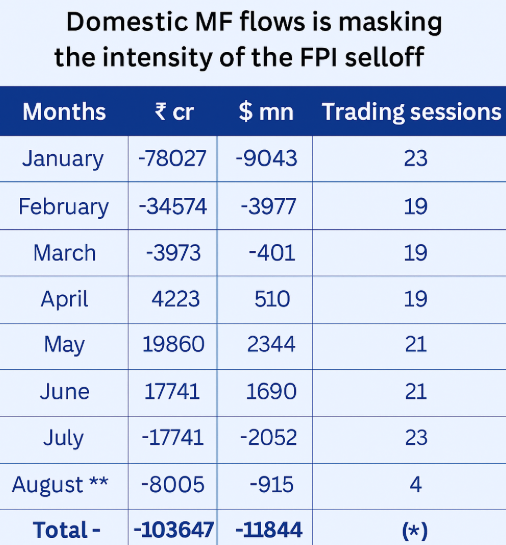
***Data Upto 6 Aug 2025
The latest pace of selling — averaging ₹2,001 crore per day — is the second-highest this year, behind January’s ₹3,392 crore per session. With only four sessions in August so far, the sharp outflow already points toward another high-risk month.
Also Read: 100% Tariff Looms for Chipmakers Unless They Build in the U.S.
Underlying Concerns
Global factors continue to dominate FPI sentiment. The rise in US treasury yields has triggered a broad shift from risk assets like emerging markets to safer, higher-yielding instruments. Meanwhile, trade uncertainty and currency volatility are contributing to broader caution.
India’s valuation premium has also drawn scrutiny. The Nifty 50 currently trades at a price-to-earnings (PE) multiple of 24.2x — significantly higher than other Asian benchmarks. The premium, while reflecting growth potential, is now becoming a deterrent amid risk-off sentiment.
Equity Markets Under Pressure
Despite healthy domestic flows — with mutual fund equity inflows rebounding by 24% to ₹23,587 crore in June — the markets have struggled to gain upward momentum. The Nifty has remained flat year-on-year, reflecting the impact of foreign capital withdrawal.
Experts suggest that capital rotation is another factor in play. With some Asian markets trading at steeper valuation discounts, institutional investors are reallocating capital toward perceived undervalued opportunities.
Unless a strong domestic trigger or favorable global shift occurs, foreign capital outflows may continue in the short term. The trend underscores the need for Indian markets to brace for heightened volatility and focus on macroeconomic resilience to regain foreign investor trust.
READ MORE ON