






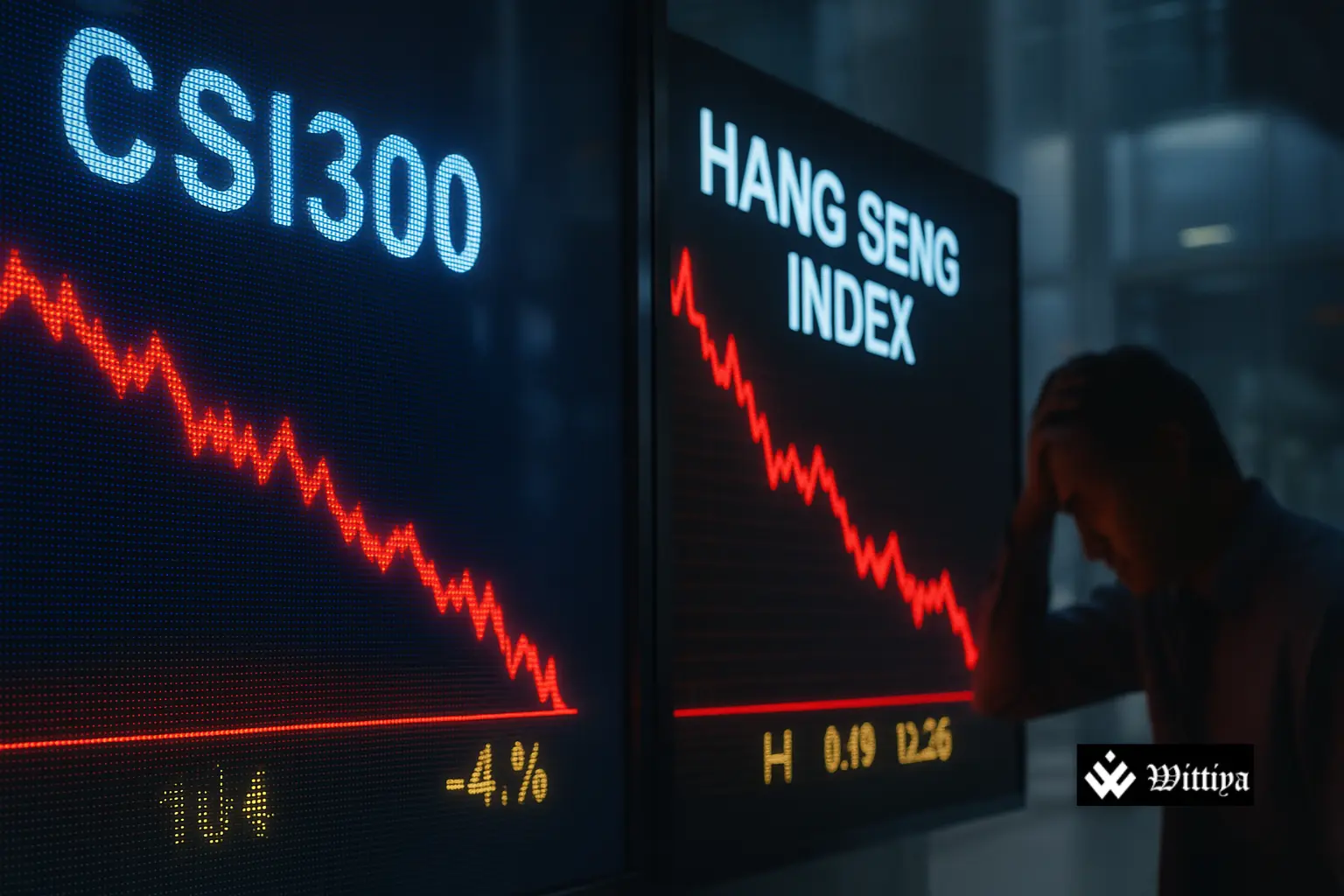
China and Hong Kong stock markets declined on July 7, 2025, amid investor uncertainty over the looming US tariff deadline on July 9 and upcoming inflation data. Despite a trade truce, US President Donald Trump’s warning of additional tariffs on BRICS-aligned nations has spooked global investors.
Equity markets in China and Hong Kong ended lower on July 7 as investors turned cautious ahead of the looming July 9 deadline for potential new US tariffs, with inflation data due midweek expected to add to market volatility.
At the close of trading, China’s blue-chip CSI300 Index dipped 0.4%, while the Shanghai Composite Index remained flat. In Hong Kong, the Hang Seng Index slipped 0.1%, reflecting global investor anxiety.
The downturn comes despite China currently being exempt from immediate new tariffs, due to an ongoing trade truce with the United States. However, sentiment remained muted after US President Donald Trump reiterated a hardline approach toward countries aligning with what he labeled as “Anti-American policies” of the BRICS bloc—which includes Brazil, Russia, India, China, and South Africa.
In a Truth Social post on July 6, Trump warned of an additional 10% tariff on any country supporting BRICS’ policies, adding further unpredictability to global trade discussions. He noted that new tariff announcements would be made by July 9, with implementation set for August 1.
Analysts at Huatai Securities warned that “markets are set to see more volatility from here,” due to the overlapping pressure of inflation expectations and geopolitical uncertainty.
Meanwhile, Chinese property developers offered a silver lining, gaining 1.4% in mainland China and 0.9% in Hong Kong. These gains followed the Chinese housing regulator’s commitment to prevent further home price declines.
Investors are also awaiting China’s key inflation data, due Wednesday, which is expected to reveal insights into the country’s struggle with deflation and weak demand. As the world’s second-largest economy faces ongoing trade and pricing challenges, the data will be crucial in assessing near-term recovery prospects.
The tariff uncertainty and economic indicators are likely to keep Asian equity markets on edge as policymakers and investors assess global economic realignments.