






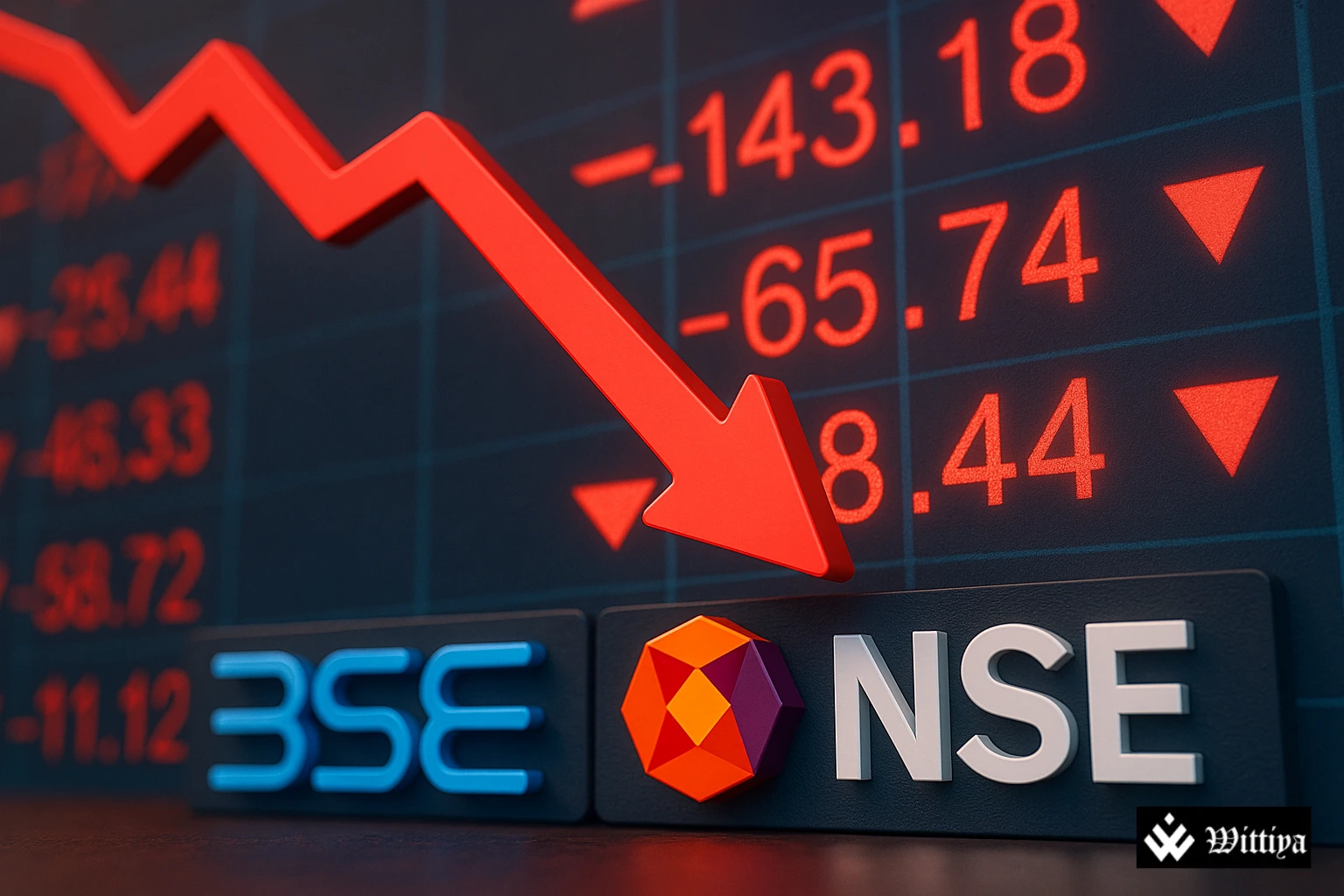
Indian stock markets extended their sharp decline for the second day, with benchmark indices falling nearly 1% amid a broad sell-off. A mix of weak earnings, FPI outflows, valuation pressures, and geopolitical uncertainties have led to investor wealth eroding by over ₹7 lakh crore in just two sessions.
The Bombay Stock Exchange (BSE) and National Stock Exchange (NSE), headquartered in Mumbai, operate India’s two leading stock markets. Both exchanges offer equity trading platforms and derivatives instruments across sectors, serving millions of retail and institutional investors.
Indian equities continued their downward trajectory on Friday, marking the second consecutive session of steep losses. The BSE Sensex dropped close to 800 points intraday, hitting 81,405.83, while the Nifty 50 slipped below the 25,000 mark, reaching a day low of 24,806.35—both indices shedding nearly 1%.
Mid- and small-cap stocks took a bigger hit, with the BSE Midcap index falling by 1.4% and the Smallcap index declining 1.7%. By 1:50 PM, the Sensex remained down by 616 points at 81,568, while the Nifty was trading at 24,867, a 195-point drop.
Also Read: BSE Share Price Dips 2% Despite 96% EPS Growth in FY25
In just two trading sessions, the Sensex has plunged more than 1,300 points, and the Nifty 50 has retreated 1.6%. This broad sell-off has led to a massive erosion in investor wealth—market capitalization of BSE-listed companies has shrunk by over ₹7 lakh crore, down from ₹460.35 lakh crore on July 23 to around ₹453 lakh crore.
Analysts and market observers point to five core reasons for the ongoing market slide:
1. Prolonged India-US trade uncertainty:
Despite progress in talks, a finalized India-US trade agreement remains elusive. The United States has already sealed trade pacts with Asian peers like Japan, Vietnam, and Indonesia. However, Washington’s demand for broader access to India’s agriculture and dairy markets continues to face resistance from Indian authorities, who are keen on protecting local farmers. Commerce Minister Piyush Goyal recently signaled that negotiations are advancing positively, raising hopes of preferential treatment.
2. Aggressive foreign investor outflows:
Foreign Portfolio Investors (FPIs) have withdrawn ₹28,528 crore from the Indian equity cash segment this month alone, with ₹11,572 crore exiting in just the last four sessions. Market participants attribute this trend to discomfort among foreign institutions with India’s stretched market valuations, despite macroeconomic resilience.
Also Read: India’s Stock Fortresses: NSE and BSE Lock Out the World
3. Underwhelming Q1 earnings performance:
The ongoing quarterly earnings season has failed to lift sentiment. Corporate results, especially in IT and financial sectors, have largely missed estimates. While muted performance was anticipated, cautious commentary from company leadership has further dampened expectations.
4. Valuation stress across broader markets:
Experts caution that while benchmark indices might seem reasonably valued, small- and mid-cap stocks appear overheated. Elevated pricing without earnings support has triggered a correction, particularly in sectors with speculative participation.
5. Technical weakness in key indices:
The Nifty’s breach of the critical 25,000 support level signals potential for deeper downside. Analysts such as Akshay Chinchalkar of Axis Securities note bearish patterns forming on technical charts. Support for the Nifty now lies between 24,800 and 24,735, with a further drop toward 24,000—the 200-day moving average—not ruled out.
Until the Nifty closes decisively above 25,340, technical experts believe bears will likely dominate. Resistance is now seen near 25,245, and the upside remains capped around 25,300.
As domestic and global factors converge, Indian equities could remain under pressure in the near term, urging caution among investors navigating this volatile phase.
READ MORE ON