


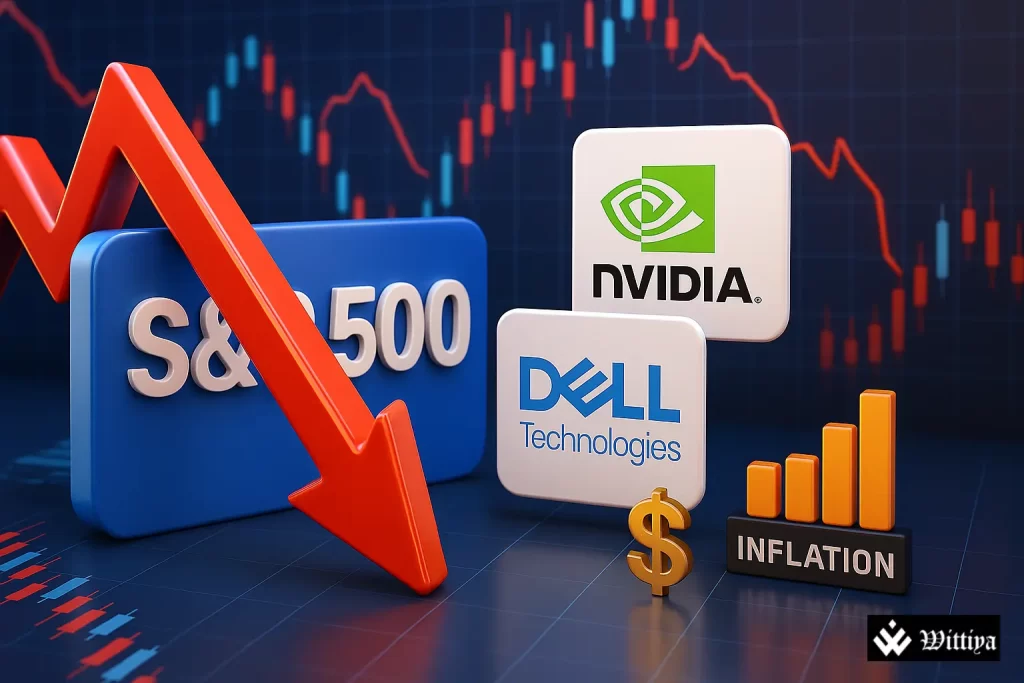
The S&P 500 index dropped from record values on Friday as steep Dell Technologies and Nvidia declines led to the fall in technology shares. Investors keeping a close eye on the increasing inflation pressures caused by tariffs, are still quite confident that the Federal Reserve will lower the interest rate in September.
Dell Technologies: Company Overview
Dell Technologies Inc., situated in Round Rock, Texas, is an internationally recognized leader in computer technology, the production of hardware, and IT infrastructure solutions. The company designs, manufactures, and sells data storage solutions, laptops, desktops, and cloud servers. Over the last several years, Dell has been aggressively expanding its business in AI (artificial intelligence) optimized servers to cater to growing demand in the enterprise and data center area.
Nvidia: Company Overview
Nvidia Corporation, located in Santa Clara, California, is a multinational technology company that deals with the production of semiconductors, GPUs, and AI computing platforms. Nvidia is commonly known as the most important component of AI infrastructure. Nvidia supplies many industries that use AI, such as cloud computing, computer gaming, electric cars, and big data.
S&P 500 Index Declines After Record Highs
On Friday, the S&P 500 Index lost 0.64% reaching 6,460.26 points, the day after the all-time high it made. The Nasdaq Composite Index decreased by 1.15% to 21,455.55 points, while the Dow Jones Industrial Average lost 0.20% to 45,544.88 points.
Most of the losses were concentrated in the tech sector, which was hit hardest by Dell and Nvidia. The S&P 500 Technology Index was down 1.63%, which showed the wide downturn in the large semiconductor and hardware companies.
Dell Shares Slide on AI Server Cost Pressures
Dell Technologies experienced a drop of 8.9%, thus, one of the top falls in the S&P 500. The company, however, foresaw strong demand for AI-powered servers but pointed out that it was facing higher production costs and that more competitors are entering the market.
The negative news took the wind out of Dell’s sails, as the company was looking for great potential in the long run with AI adoption, and so there was a sizable sell-off on Wall Street. Shareholders kept a skeptical eye on profitability in AI hardware, where the continuous cost-intense innovation keeps being a barrier.
Also Read: Nvidia Earnings Put Wall Street’s AI Optimism to the Test
Nvidia Extends Losing Streak Despite AI Momentum
Nvidia Corporation went down again this time by 3.4%, and the company was not able to stop its losing streak that lasted for three consecutive sessions. The last quarterly report of the chipmaker, although offering a confirmation of AI-related spending, did not meet the market expectations by a small margin.
The firm stated that the spending on AI infrastructure is strong across global enterprises, yet the shortfall against elevated anticipation put pressure on the mood of the investors. Nvidia’s performance is very much linked to the overall positive sentiment towards AI, so it is a key indicator of the US technology stocks movements.
Inflation Data and Tariff Impacts
The data released on Friday, which was alongside the corporate results, depicted consumer spending going up at the fastest rate in the last four months and that the services inflation was gaining pace. Part of this surge was linked by analysts to import tariffs, which have started to be reflected in consumer prices.
Moreover, a U.S. tariff exemption on package imports with a value of less than $800 ended on Friday, leading to higher costs for both businesses and consumers. Nevertheless, the expectations of the Federal Reserve announcing a 25-basis-point interest rate cut in September remain strong.
Broader Market Performance in August
Despite the losses on Friday, the US equity market had another solid month in August:
- S&P 500 climbed 1.9%
- Dow Jones grew 3.2%
- Nasdaq rose 1.6%
Russell 2000, the small-cap stocks index, closed with a 7% monthly increase
Thematically, healthcare was up 0.73%, whereas consumer staples rose by 0.64%. Nevertheless, technology stocks dramatically lost ground because of the downfall of Dell, Nvidia, and Marvell Technology.
Alibaba Surges on AI Cloud Business Growth
While the US tech sector was struggling, Alibaba Group Holding Ltd. went up by 13% after it reported better than expected quarterly expansion in the cloud computing area, supported by AI demand. The Chinese e-commerce giant also made it clear that it was making strides in the production of its own AI chips, thus gaining investor confidence further.
Other Notable Movers
- Marvell Technology dropped almost 19% after it projected revenue guidelines that were lower than the expected ones.
- Caterpillar Inc. lost 3.65% after it warned of higher costs related to tariffs in 2025.
- The Russell 2000 Index was down 0.5% in the day but, at the same time, it was one of the best performers in August.
Outlook: Interest Rates and Market Momentum
The Federal Reserve remains the key focal point as investors await a September interest rate cut. Besides the temporary tariff-driven inflationary pressures, the Fed’s accommodative stance is expected to be supported by the overall cooling labor market and stable demand.
Also Read: Nvidia AI Boom Revenue Surge
The S&P 500 rally in August—its fourth consecutive monthly gain—exemplifies the market sentiment’s strength, although the recent volatility in AI-related stocks highlights the risks of investors over optimistic expectations.
S&P 500 Market Wrap-Up
- S&P 500 closed: 6,460.26 (-0.64%)
- Nasdaq Composite: 21,455.55 (-1.15%)
- Dow Jones Industrial Average: 45,544.88 (-0.20%)
- Russell 2000: 0.5% lower (7% monthly gain)
- Technology Sector: -1.63%
- Healthcare Sector: +0.73%
- Consumer Staples Sector: +0.64%
FAQ’s
Q1: Why was the S&P 500 closed on Friday with a downward trend?
The main reasons for the index to go down were the big sell-offs in Dell and Nvidia shares and the fear of inflation associated with tariffs.
Q2: What have been the last movements of Dell and Nvidia shares?
Dell lost almost 9% of its value due to AI server cost fears, and Nvidia declined 3.4% after its earnings fell short of ambitious targets.
Q3: What the Fed is likely to do in September?
Amid rising inflation caused by tariffs, markets are still largely betting on the Fed taking a 25-basis-point rate cut in September.
READ MORE ON