






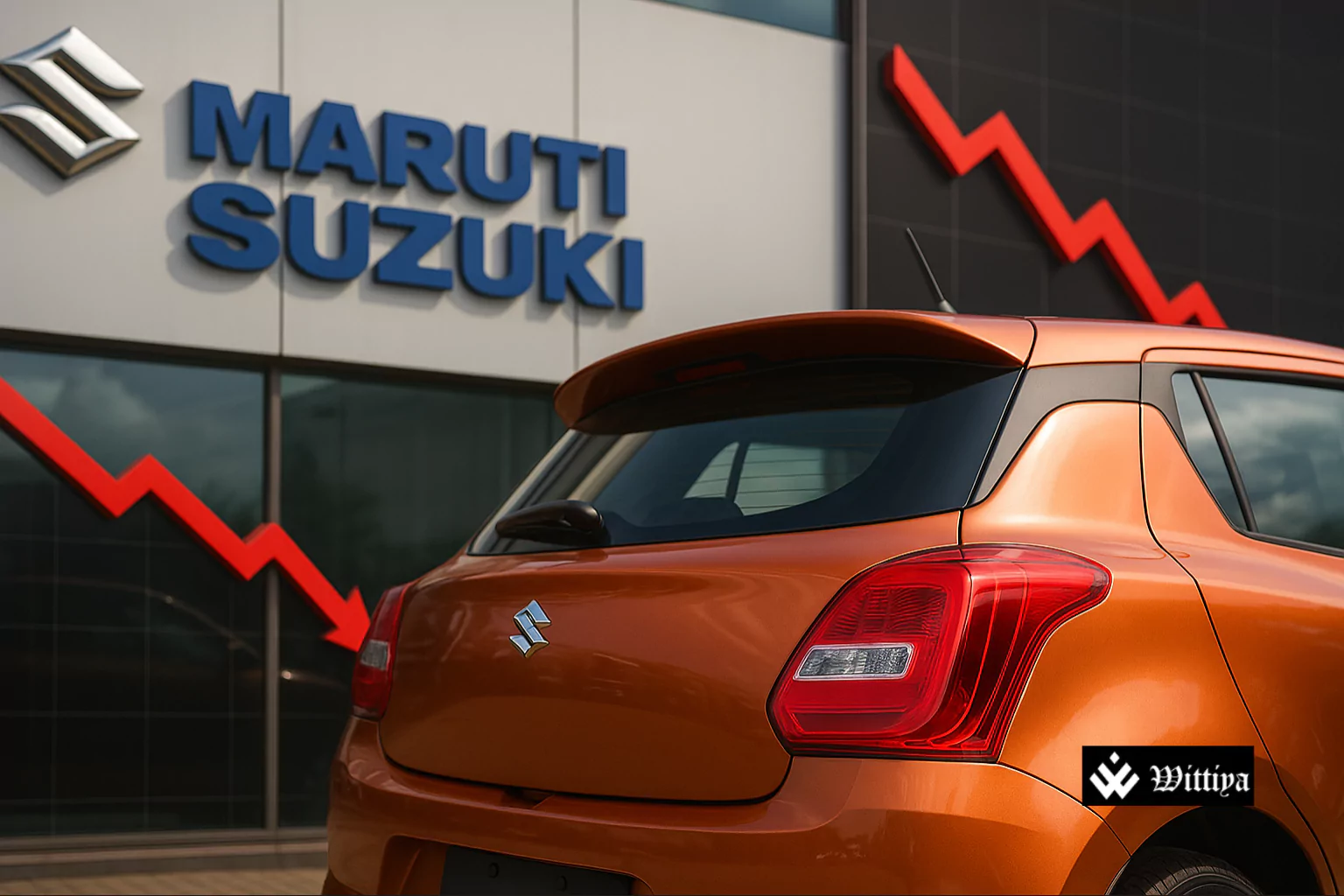
Despite reporting a 13.3% year-on-year drop in domestic passenger vehicle sales for June, Maruti Suzuki India’s share price climbed nearly 1% to ₹12,560 in Wednesday trading. Weak demand for small cars contributed to the lowest monthly dispatches since December 2023, though export growth and market sentiment sustained investor interest.
Shares of Maruti Suzuki India, headquartered in New Delhi and India’s largest automobile manufacturer, rose nearly 1% in intraday trading on July 2, 2025, despite a significant year-on-year drop in domestic passenger vehicle (PV) sales.
The automaker reported a 13.3% decline in domestic PV dispatches for June, delivering only 1,18,906 units compared to 1,37,160 units in June 2024. This marks the company’s lowest monthly dispatch volume since December 2023.
According to Rahul Bharti, Senior Executive Officer at Maruti Suzuki India, the contraction is primarily due to continued weakness in demand for smaller cars. “The slowdown in passenger vehicle sales is largely due to a sharp decline in the smaller segment cars. Historically, passenger vehicle sales used to grow at 1.5 times the GDP growth. But now, even after 6.5% GDP growth, the car market is nearly flat,” he explained.
Sales of entry-level models such as the Alto and S-Presso dropped nearly 32%, prompting Maruti Suzuki to implement production cuts in certain categories. However, the company managed to report a 22% growth in exports, offsetting some of the impact of weak domestic sales.
Despite this mixed operational performance, Maruti Suzuki’s shares climbed to a high of ₹12,560 on the Bombay Stock Exchange on Wednesday, reflecting investor optimism driven by robust export performance and resilient market positioning.
Maruti Suzuki, a joint venture between Japan’s Suzuki Motor Corporation and India’s Maruti Udyog, has long dominated India’s automotive sector, particularly in the affordable car segment.
As India’s automotive landscape continues to evolve amid urban demand challenges and global economic uncertainty, analysts suggest the company’s ability to maintain export momentum and align with shifting consumer trends will be critical in the quarters ahead.