






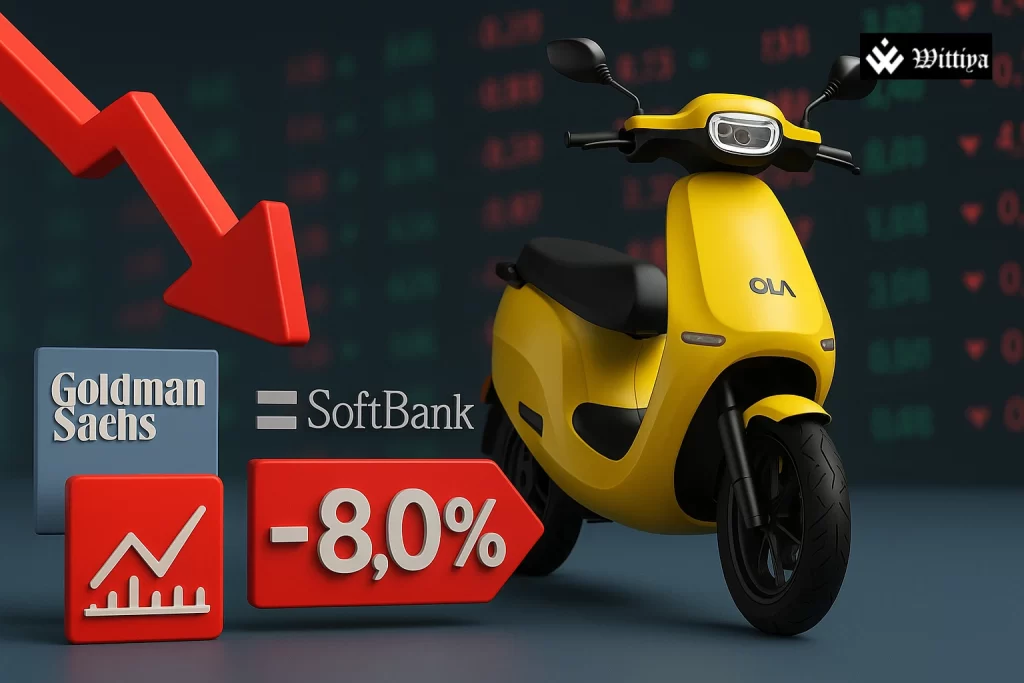
Following a strong rally over the past couple of weeks, Ola Electric shares fell by almost 8% after SoftBank sold a 2% stake, the move coming amid ongoing competition in India’s EV market.
Ola Electric Shares Drop Amid SoftBank Stake Sale
There were some storms in the Indian electric vehicle market as shares of Ola Electric dropped by nearly 8% on the 5th of September due to the sale of a 2% stake in the electric scooter manufacturer by SoftBank. The sale by SoftBank reduced its holding in the company to 15.68% through Open Market Transactions carried out between July 15 and September 2.
SoftBank, an early backer of Ola Electric, was initially the major shareholder with a total of 786.6 million shares (17.83% of the company) before the sale. The Japanese investment giant, although reducing the stake, is still quite comfortably one of the largest institutional shareholders in Ola Electric.
Share Price Performance
After the stake sale, Ola Electric shares went down to Rs 59.32 apiece, dropping more than 14% over two consecutive sessions after nearly an 80% rally over three weeks. The stock was first listed at Rs 76 per share during its IPO in August 2024, climbed to a 52-week high of Rs 123.9 in September 2024, next steep down of 68% to a low of Rs 39.6, and lastly, a rebound.
Goldman Sachs went ahead to reaffirm its ‘Buy’ annotation on Ola Electric stocks and in addition, raised its target price to Rs 72, which means that there is an approximately 12% upside from the last closing price of Rs 64.50.
Also Read: Ola Electric Stock Surges 20% with PLI Certification
Market Dynamics and Competition
Ola Electric has reportedly lost steam with the weakening demand and hardening competition in India’s EV market. The company from Bengaluru sold 18,972 units in August and thereby regained the second position ahead of Bajaj Auto, but the sales were down by 31% compared to the previous year.
The EV maker’s Gen 2 and Gen 3 scooter ranges in the entirety of the sales mostly, along with S1 Pro and S1 X models. Recently these scooters were given the PLI (Production Linked Incentive) certification
by the Automotive Research Association of India (ARAI), due to that the company will receive subsidies from 13% to 18% of the determined sales value (DSV) up to 2028.
Strategic Outlook
The PLI certificate is expected to be a major profit driver beginning from Q2FY26. The analysts comment that despite the recent slide in share price, the stock of Ola Electric should not be taken off the table in the long run and is very much a key player in India’s EV market with good growth prospects mainly due to government incentives and the expansion of product portfolios.
SoftBank’s limited departure is a reflection of early investors eventually making their exits post-IPO whilst at the same time retaining a strategic stake. Market behavior exemplifies investor sensitivity to institutional stake sales, even at times when the long-term fundamentals appear positive.
FAQ’s
How is Ola Electric performing in the EV market?
In August 2025, Ola Electric sold 18,972 scooters, reclaiming the No. 2 spot ahead of Bajaj Auto, though sales were down 31% YoY.
Which Ola Electric models drive most of its sales?
The Gen 2 and Gen 3 scooters, particularly the S1 Pro and S1 X models, account for the bulk of Ola Electric’s sales.
What role will the PLI scheme play in Ola Electric’s future?
With PLI certification from ARAI, Ola Electric will get 13–18% subsidies on sales value till 2028, expected to boost profitability from Q2 FY26 onward.
READ MORE ON