






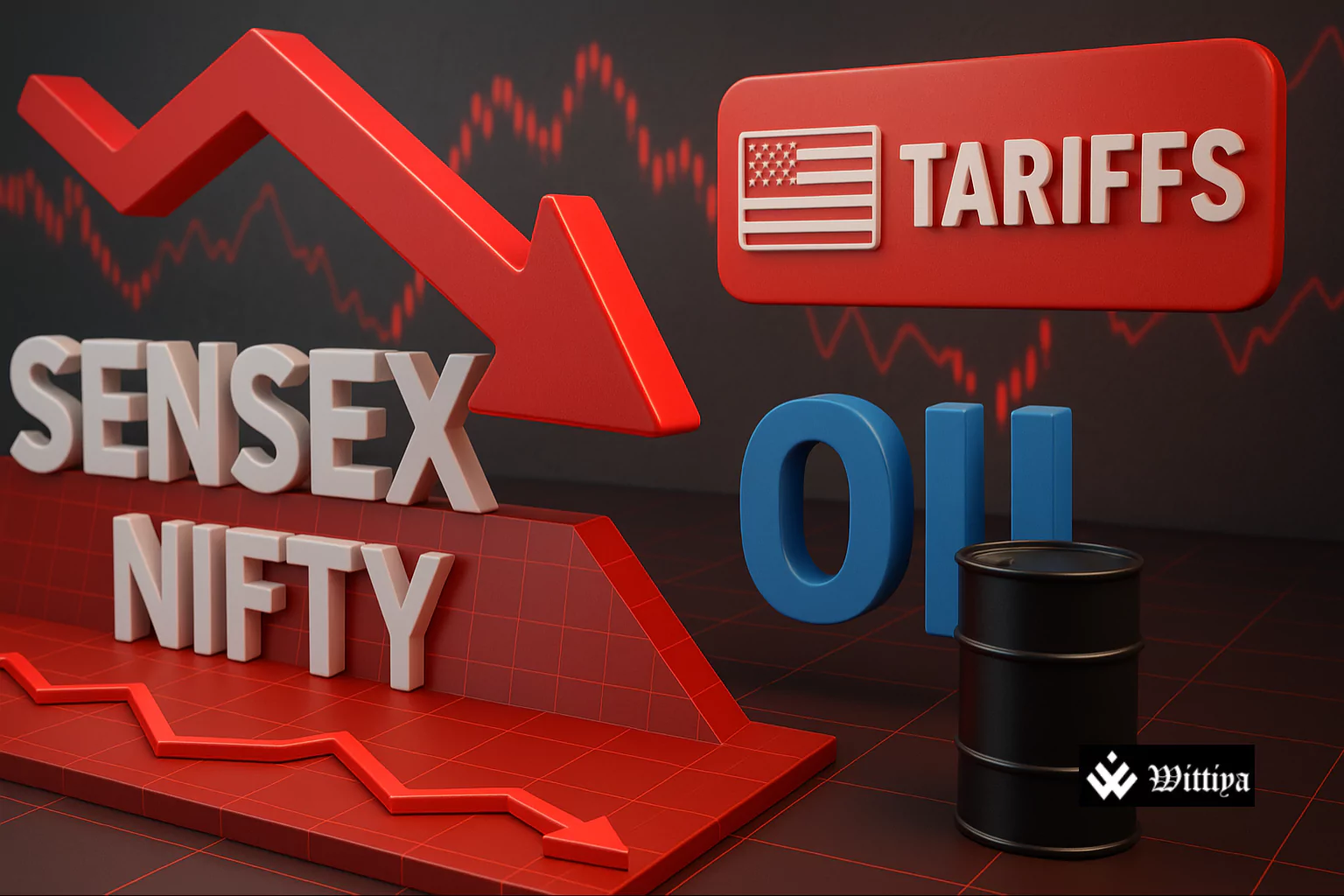
India’s stock market opened lower on August 5, 2025, as equity indices Sensex and Nifty fell due to pressure on oil and gas stocks and persistent foreign fund outflows. Investor sentiment weakened after renewed tariff threats from the United States regarding India’s oil imports from Russia.
India’s benchmark indices opened lower on Tuesday, August 5, 2025, as the BSE Sensex declined by 315.03 points or 0.39% to 80,703.69, while the NSE Nifty slipped 41.80 points or 0.17% to 24,680.95 in early trade. The slide was primarily driven by losses in oil and gas sector stocks and sustained foreign institutional investor (FII) outflows.
The downturn comes on the heels of escalating trade tensions with the United States. Market sentiment took a hit after a renewed warning from U.S. leadership suggesting a substantial increase in tariffs on Indian exports in response to the country’s continued import of Russian crude oil. The statement, perceived as a geopolitical escalation, raised concerns over future trade dynamics and export competitiveness.
Sector-Wise Drag: Oil & Gas Under Pressure
The oil and gas sector was among the top laggards, with market heavyweights like Reliance Industries and Oil & Natural Gas Corporation facing selling pressure. Investors appear wary of how US-led sanctions and tariff rhetoric may affect the profitability and international operations of major Indian energy firms.
Also Read: Russia Slams US ‘Neocolonial Agenda’ After Trump Targets India
Top Laggards and Gainers
Key decliners in the Sensex pack included Bharat Electronics Ltd. (BEL), HDFC Bank, ICICI Bank, Infosys, Hindustan Unilever, Adani Ports, Mahindra & Mahindra, Asian Paints and Tata Steel.
However, not all stocks were under pressure. Gainers included Maruti Suzuki, State Bank of India, HCL Technologies, Axis Bank, UltraTech Cement, Tata Motors, Titan Company, NTPC, and Bajaj Finance.
Trade Tensions and Market Valuation Concerns
Market experts noted that the Indian equity market remains richly valued, with forward price-to-earnings ratios at historically elevated levels. The fresh external shock, in the form of tariff threats, could challenge earnings estimates for FY26, particularly for export-heavy sectors.
While India’s macroeconomic fundamentals remain strong, including low inflation and robust domestic demand, any adverse development in trade relations with major economies could alter the trajectory of corporate earnings and capital inflows.
FII Outflows vs DII Support
Foreign Institutional Investors continued their selling streak, offloading equities worth ₹2,566.51 crore on Monday, August 4. In contrast, Domestic Institutional Investors (DIIs) provided counterbalance by purchasing equities worth ₹4,386.29 crore, reflecting domestic confidence in market fundamentals.
This divergence points to a cautious global outlook versus a relatively resilient domestic investment narrative. The coming weeks may reveal whether domestic flows can continue to offset global risk aversion.
Also Read: Understanding the Impact of China’s Economic Promises
Broader Global Trends
While Asian markets, including South Korea’s Kospi, Shanghai’s SSE Composite, Hong Kong’s Hang Seng, and Japan’s Nikkei 225, traded in positive territory, the Indian market’s sensitivity to geopolitical risks has been more pronounced due to its trade and energy dependencies.
The global benchmark Brent crude traded slightly lower at $68.53 per barrel, down 0.33%, but any sharp rebound could further complicate India’s import bill and inflation management.
In the near term, equity markets in India may remain volatile as investors weigh geopolitical risks, the US election cycle, and the potential for retaliatory trade measures. Portfolio managers are expected to adopt a cautious stance, rotating into defensive sectors while monitoring fiscal and monetary policy developments.
Given the market’s sensitivity to global headlines and its elevated valuations, short-term corrections could emerge as a healthy rebalancing, particularly if the tariff threats materialize.
READ MORE ON