






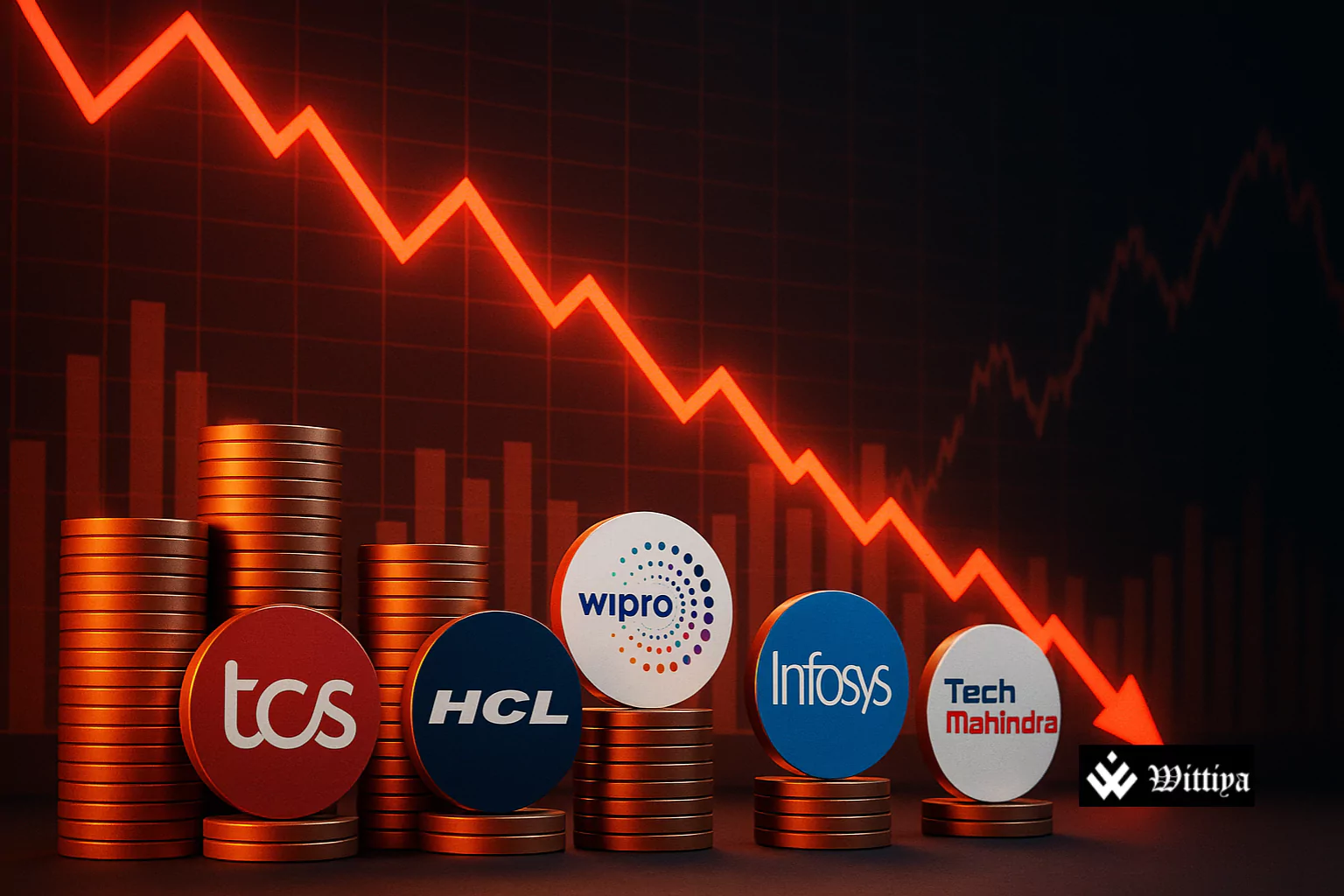
India’s tech sector witnessed its steepest decline in months as the Nifty IT index dropped 9.4% in July. Poor Q1 earnings, growing trade concerns, and cautious guidance from major firms such as TCS, HCL Technologies, Wipro, Infosys, and Tech Mahindra have rattled investor sentiment.
India’s tech-heavy Nifty IT index saw its sharpest monthly fall since February 2025, dropping 9.4% in July, as investors reacted strongly to disappointing earnings from top firms like TCS, HCL Technologies, Wipro, Infosys, and Tech Mahindra. A mix of lower-than-expected revenue growth, reduced margin forecasts, and escalating US trade tariffs contributed to the sector-wide decline.
All ten constituents of the Nifty IT index ended the month in the red, with HCL Technologies leading the losses—its stock down 15%. TCS and Tech Mahindra followed closely, each falling 13%. Mid-sized firms weren’t spared either, with Persistent Systems down 14.6%, and Wipro and Infosys declining by 6–7%.
This pullback came on the heels of Q1 results that highlighted stagnating top-line growth across the sector. Despite efforts toward digital transformation and AI investments, the numbers failed to impress.
TCS, the country’s largest IT exporter, posted a modest 1.3% YoY revenue growth at ₹63,437 crore and a net profit rise of 5.9%. The company also announced a 2% workforce reduction, amounting to 12,000 jobs, to align with its “future-ready” strategy focusing on technology modernization and global expansion.
Also Read: HCL Tech Faces Storm After Q1 Dip: A Turning Point for India’s IT Giant
HCL Technologies reported a stronger 8.1% revenue growth to ₹30,349 crore, but profits slipped nearly 10% YoY due to elevated costs and a client-related one-off charge. The company also cut its operating margin outlook for FY26, which dragged investor confidence.
Infosys and Wipro showed mixed performance. Infosys posted 7.5% revenue growth and 8.6% rise in profit, while Wipro barely grew with a 0.8% topline expansion and sequential decline of 1.6%, coupled with flat forward guidance.
Tech Mahindra emerged as the outlier with 33.9% YoY profit growth on 2.65% revenue expansion, but still saw its shares fall sharply due to macroeconomic uncertainty and limited future visibility.
The broader issue lies in US-India trade tensions, which have escalated with a 25% tariff imposed by the US on Indian imports. Analysts believe this could increase the cost burden on US clients—India’s primary export market for IT services—and reduce demand for outsourcing.
Also Read: Mahindra Grabs 54.2% LCV Market Share: Full Q1 FY26 Breakdown
Compounding these concerns is a noticeable shift in client preferences. Companies are now prioritizing AI and cloud infrastructure over traditional IT services, redirecting budgets accordingly. This reflects a strategic shift in global tech spending trends that Indian IT firms must adapt to swiftly.
Moreover, macroeconomic conditions in the US—India’s largest IT export destination—remain uncertain. The Federal Reserve’s decision to hold interest rates steady for the fifth straight time signals caution in the face of inflationary pressures from trade frictions. Indian IT leaders had hoped for a pro-growth US policy regime, but volatility in tariff decisions has tempered that optimism.
With valuation multiples being revised downward and cautious commentary from top firms, the near-term outlook for the Indian IT sector remains clouded. However, long-term growth prospects may still be preserved if companies successfully pivot to high-growth areas like AI, cloud transformation, and strategic consulting.
READ MORE ON