







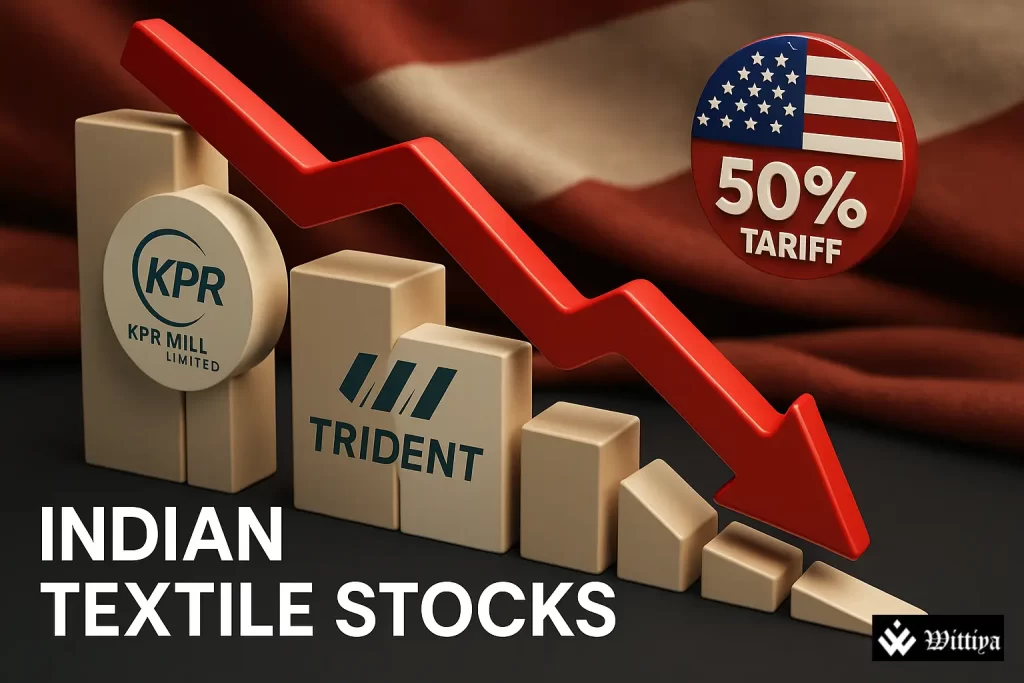
The shares of Indian textile companies were down by a maximum of 3% after the United States decided to further impose tariffs that will increase duties on Indian clothing and textile imports to 50%. The significant hike is likely to have a strong negative impact on the firms that are dependent on exports such as Trident, KPR Mill, and Gokaldas Exports.
Introduction to India’s Textile Sector
The India textile industry, which is situated in the large commercial centers of the likes of Coimbatore, Ludhiana, Ahmedabad, and Surat, is one of the most export-oriented sectors of the country. The domination in apparel, fabrics, and home textiles has been the hallmark of the sector that has been a major contributor to India’s GDP and the foreign exchange reserves. The industry is a vital part of the India manufacturing and trade ecosystem, as is evident from the fact that it contributes to the US with more than $ 10.3 billion worth of exports annually.
Fresh Tariffs Impact Indian Textile Companies
On August 27, the United States formally imposed an additional 25% tariff on Indian imports, effectively raising total duties to 50% on several categories, including textiles and apparel. The move immediately triggered weakness in Indian textile shares, with leading exporters KPR Mill, Trident, Vardhman Textiles, Arvind, Welspun Living, and Gokaldas Exports slipping up to 3% each in Thursday’s trade.
The tariffs under the new system have been raised to 63.9% for knitted apparel and 60.3% for woven apparel, which means Indian textile exporters are far behind their international counterparts.
India’s Export Market at Risk
The United States is the biggest buyer of Indian textiles, who largely supply the global market from there. India is the third-largest supplier of the US after China and Vietnam. Indian goods will be subject to higher levies than those of China (30%), Vietnam (20%), Indonesia (19%), and Japan (15%), with the new duties.
The difference in rates may cause buyers to place their orders with other countries and thus India will lose its competitive advantage in the global textile supply chain. The increase of the tariffs so drastically directly affects nearly 55% of India's shipments to the US, based on trade data.
Impact on Stock Market Performance
The news had a big negative effect on the mood of the investors. Shares of major textile firms such as KPR Mill Limited, a leading vertically integrated textile manufacturer based in Coimbatore, and Trident Limited, known for its home textiles and paper products, recorded notable declines. Gokaldas Exports Limited, a Bengaluru-based garment exporter with strong US exposure, also fell in line with broader sector weakness.
The downfall in share prices shows the doubts concerning the export revenues and profit margins in the coming future. Most of these companies are involved in long-term contracts with US retailers and fashion brands, which according to the current situation may require renegotiation or maybe some orders will be redirected because the landed costs will be higher.
Long-Term Challenges for India’s Textile Sector
Along with negatively affecting current exports, the additional US tariffs also give rise to long-term issues for the Indian textile industry. In the face of the steadily more fierce global supply chains competition, domestic manufacturers will have to take the step of diversifying their export markets, escalating the cost-efficiency of their production, and even negotiating bilateral trade agreements with other countries so as to offset the declines in trade brought about by the tariff hikes.
Furthermore, the policy change highlights the susceptibility of export-reliant sectors like that of India to instability arising from geopolitical and trade-related issues. The textile industry that has millions of workers depending on it, can be very affected by the problems unless new markets and policy support are found.
FAQ’s
Q1. Why did Indian textile stocks fall on August 28, 2025?
On August 28, 2025, Indian textile stocks fell as the US imposed higher tariffs to raise import duties on textiles and apparel to 50%.
Q2. Which companies were most affected by the tariff hike?
After the tariff hike, KPR Mill, Trident, Vardhman Textiles, Arvind, Welspun Living, and Gokaldas Exports have been affected the most and their stock prices have dropped up to 3%.
Q3. How do the new tariffs affect India’s global competitiveness?
The increase in US tariffs makes Indian textiles more expensive, thus losing India’s global competitiveness in the markets of China, Vietnam, Indonesia, and Japan.
READ MORE ON