






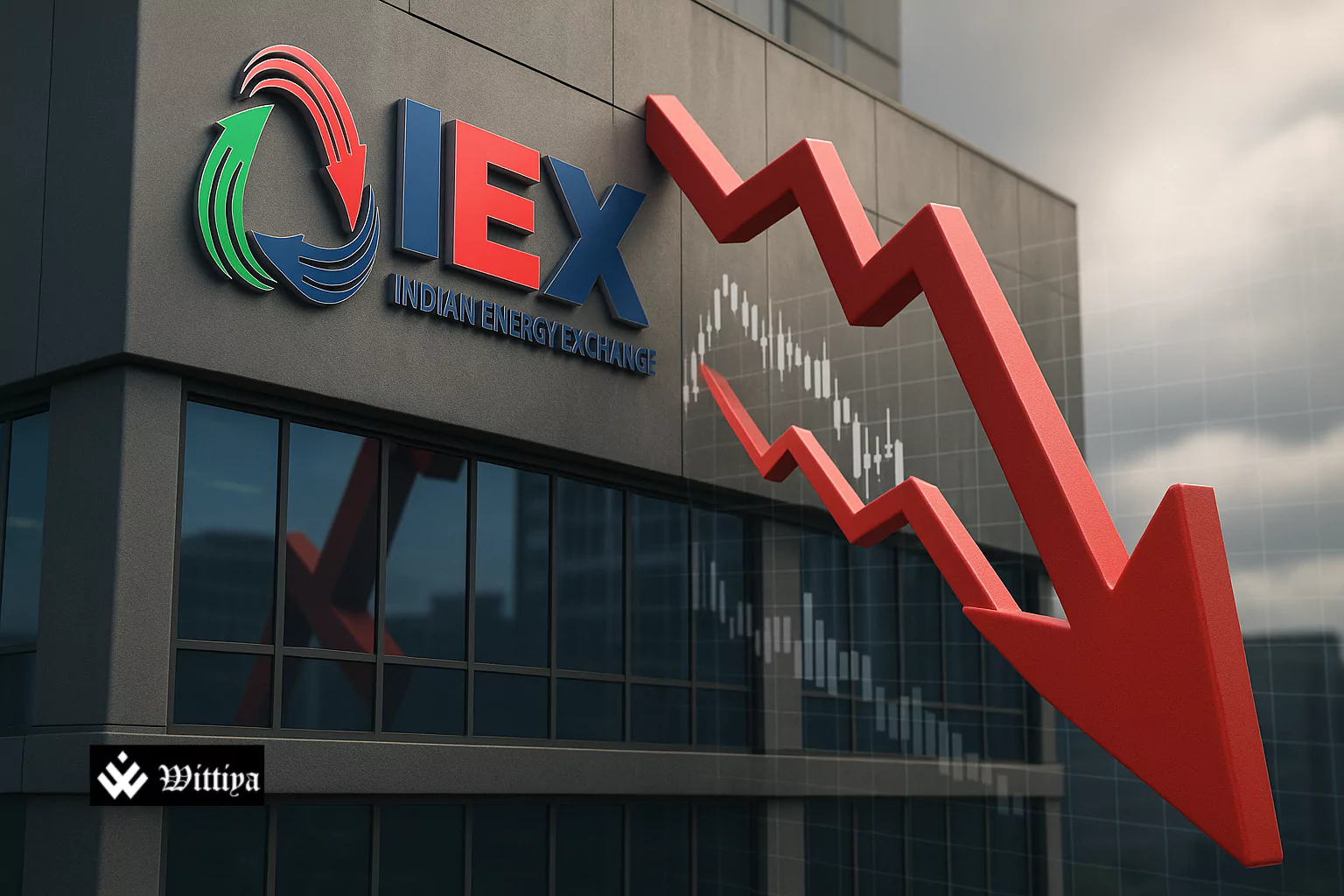
India’s Indian Energy Exchange shares fell 23% after the country’s power regulator ordered implementation of market coupling, triggering concerns over pricing power loss and revenue pressures.
Shares of Indian Energy Exchange (IEX) plummeted 23% to ₹144.65 on July 24, hitting its lower circuit limit, after the Central Electricity Regulatory Commission (CERC) announced the implementation of market coupling by January 2026. This decision sent shockwaves through the market, raising structural concerns over the company’s future revenue model.
Regulatory Shift Disrupts IEX’s Business Model
Under the proposed market coupling mechanism, the power sector’s day-ahead market (DAM) will see centralized price discovery handled by the Grid Controller of India, rather than being determined independently by exchanges like IEX. This move aims to unify prices across platforms and eliminate arbitrage but directly impacts the core value proposition of IEX—competitive price discovery and liquidity dominance.
Currently, IEX commands over 90% market share in the DAM and Real-Time Market (RTM), both of which are crucial to its topline. In FY24, IEX reported DAM volumes exceeding 73 billion units, while RTM volumes grew 19% year-over-year. With market coupling, the exchange will no longer set prices—a shift that compresses margins and diminishes the firm’s pricing power.
Also Read: Monsoon of Results: 58 Powerhouses Declare Q1 Earnings
Investor Reaction and Strategic Risk
The market response was swift and sharp, as investors reassessed the long-term profitability and moat of IEX. The stock hit its 10% lower circuit of ₹169.10 early in the session but extended losses as the impact of the regulatory move became clearer. The announcement came just ahead of IEX’s Q1 results, adding further volatility to an already tense trading session.
Strategic Outlook: From Monopoly to Margin Pressure
The order poses a paradigm shift for the Indian power trading landscape. As centralized price determination replaces exchange-driven competition, IEX faces margin erosion, increased cost sensitivity, and loss of product differentiation. Analysts believe the company’s moat—built on deep liquidity and speed of execution—may no longer offer a pricing edge.
With the ability to command higher transaction charges potentially curbed, IEX will need to rely more on cost competitiveness and platform innovation to retain participants. The company has not yet released a formal response but is expected to address this in its earnings commentary.
While Indian Energy Exchange remains the country’s leading power trading platform, this regulatory shift brings its business model under pressure. The upcoming quarters will test the firm’s adaptability as it navigates a more neutralized and centrally governed trading environment.
For now, investors appear to be pricing in a structural de-rating, as uncertainty looms over the company’s future earnings trajectory and dominance in the evolving electricity trading ecosystem.
READ MORE ON