





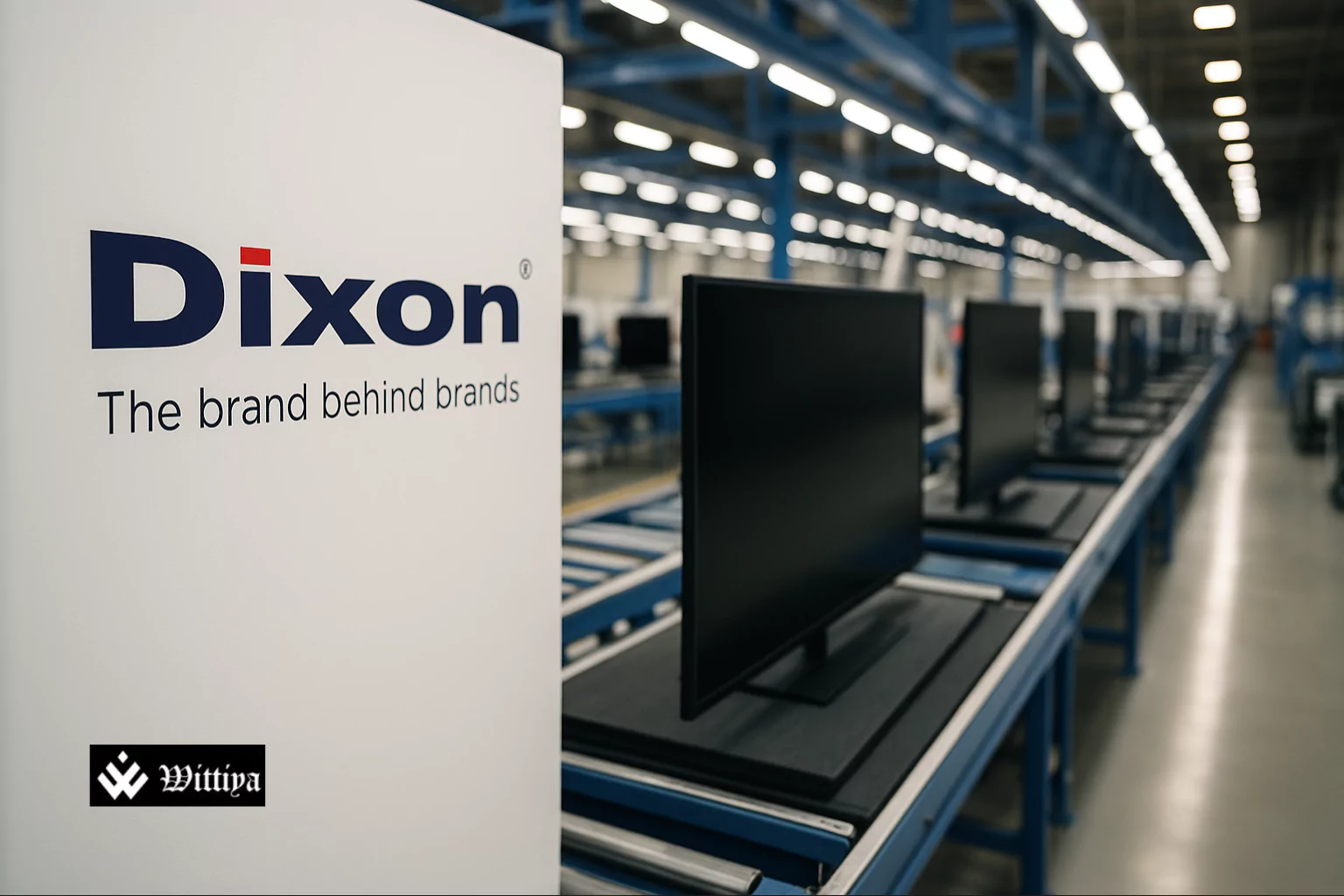
On June 25, 2025, in Maharashtra, India, shares of Dixon Technologies, a leading electronics manufacturing services (EMS) provider, fell 2.5% after Phillip Capital downgraded its revenue and earnings estimates. Rising competition, particularly from Karbonn acquiring Motorola’s mobile phone assembly volumes, is seen as a threat to Dixon’s growth trajectory.
Dixon Technologies, one of India’s largest EMS (Electronics Manufacturing Services) firms, saw its stock fall by 2.5% to ₹14,585 following a downgrade by global brokerage Phillip Capital. The firm cited intensifying competition in the mobile assembly sector—especially from Karbonn, which is gaining ground with Dixon’s key client, Motorola—as a major reason for its revised financial outlook.
Phillip Capital lowered Dixon’s FY27 revenue, EBITDA, and PAT estimates by 4%, 6%, and 9%, respectively. This was accompanied by a reduction in the company’s target price to ₹9,085, down from ₹11,077, due to changes in its price-to-earnings (PE) valuation from 50x to 45x based on FY27 EPS projections.
Motorola Diversifies Supply Chain
Motorola, which contributes roughly 72% of Dixon’s mobile revenues, has started outsourcing its Indian mobile volumes to Karbonn, reducing its dependency on Dixon. Karbonn now handles 25% of Motorola’s monthly volumes—a figure expected to reach 35% by the end of June. In comparison, Motorola had entirely depended on Dixon in calendar year 2023.
Karbonn’s cost competitiveness stems from its eligibility under India’s Production Linked Incentive (PLI) scheme, making it an appealing alternative for large-scale mobile phone manufacturing.
Longcheer Also Diversifies
Phillip Capital also flagged early signs of diversification from Longcheer, Dixon’s second-largest mobile client. Though the shift is currently small—Karbonn took 2% of Longcheer’s production in May 2025—the brokerage warns it could scale rapidly, following Motorola’s outsourcing pattern that began with a mere 1–2% earlier this year.
Bright Spot: Vivo Joint Venture
Amid the rising competition, Dixon’s recently announced joint venture with Vivo India, structured as a 51:49 split, is expected to become operational by FY27. The JV is anticipated to manage two-thirds of Vivo’s local mobile production, contributing up to ₹160 billion in annual revenues at peak capacity. Dixon’s share of this could be around ₹80 billion.
Outlook and Risks
While Dixon benefits from favorable working capital terms currently, Phillip Capital warns that post-PLI, Dixon’s Net Working Capital (NWC) days may align with industry peers like Foxconn, which recorded over 40 NWC days in CY24. This shift could compress Dixon’s return on capital employed (RoCE) over time.
Despite steady export growth, Dixon’s domestic share loss to Karbonn could limit Motorola-led YoY growth to a mere 15%. As Karbonn scales operations and gains clients, Dixon’s market dominance in mobile assembly is expected to be challenged further.