






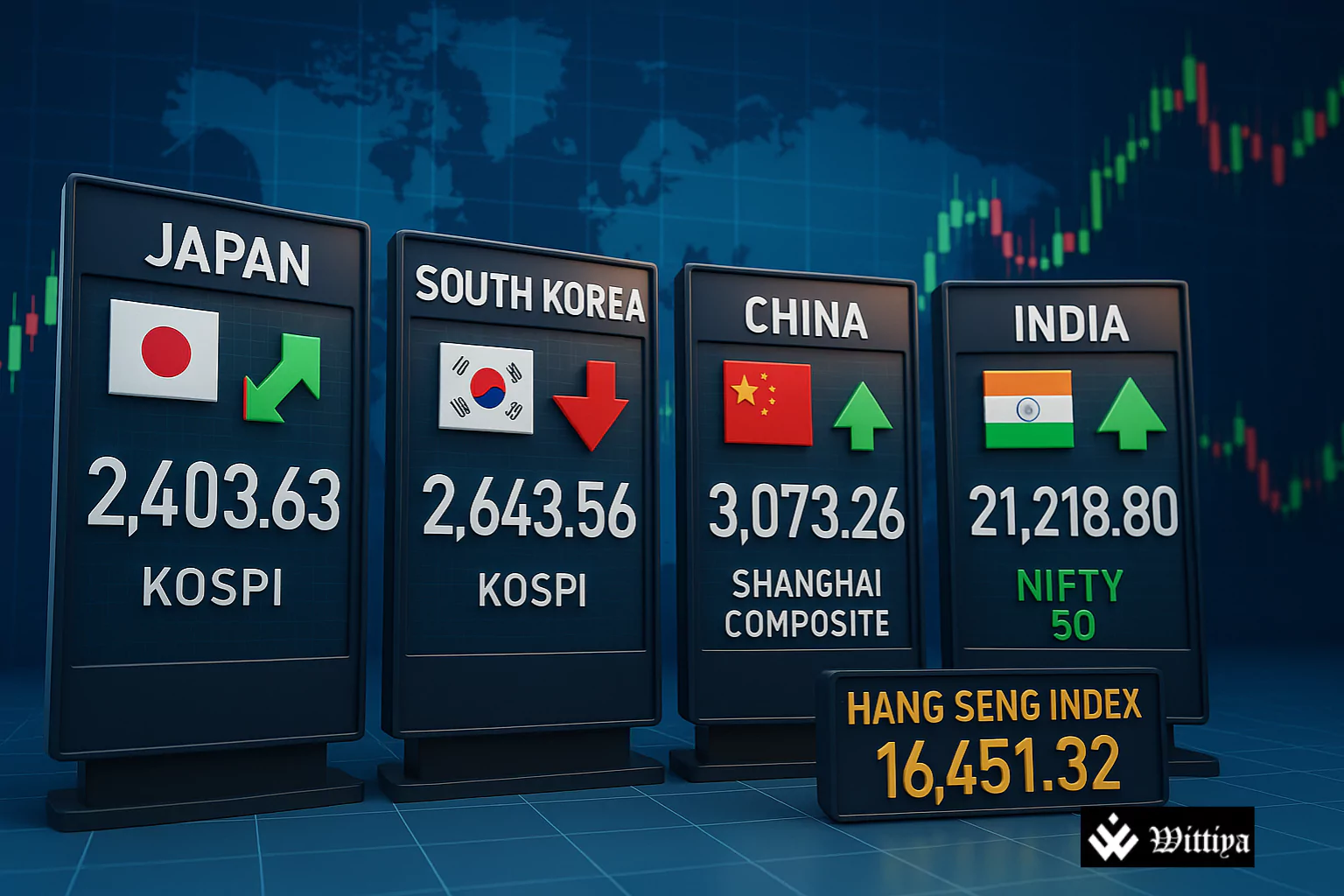
Asia-Pacific stock markets saw mixed movements as investors tracked U.S.-Ukraine talks and assessed global growth prospects. Gains in Japan, China, India, and Hong Kong were offset by declines in South Korea and weak export data from Singapore.
Asia-Pacific markets opened the week on a mixed note Monday, as investors closely watched developments from the planned talks between the U.S. President and Ukraine, while digesting regional data and shifting global trends.
In Japan, the Nikkei 225 surged 0.96% and the Topix rose 0.7%, supported by strength in large-cap exporters and renewed buying momentum. Analysts noted that the weaker yen continues to offer tailwinds to Japanese equities.
South Korea’s Kospi fell 1.17%, with tech-heavy shares leading declines, while the Kosdaq slipped 1.78%. Market experts highlighted concerns about slower global semiconductor demand weighing on investor sentiment.
Also Read: Oil Falls as Critical US-Ukraine Talks Set to Begin
In China, the CSI 300 gained 1.5%, reaching its highest level since October 2024, signaling renewed investor confidence in domestic stimulus measures. The Shanghai Composite also advanced 0.76%.
Hong Kong’s Hang Seng Index rose 0.62%, supported by financials and property stocks.
India’s Nifty 50 climbed 1.35% and the BSE Sensex added 0.89%, reflecting strong domestic inflows into equities as investors bet on continued corporate earnings growth.
Meanwhile, Australia’s S&P/ASX 200 briefly touched an intra-day high of 8,960 before closing up 0.11%, aided by mining and energy stocks.
In Singapore, however, non-oil domestic exports fell 4.6% year-on-year in July, sharper than expectations. Economists pointed to weakening global demand as a challenge for Singapore’s export-driven economy.
On Wall Street, S&P 500 futures edged higher on hopes of U.S. rate cuts, keeping Asian investors cautiously optimistic.
Financial analysts noted that Asia-Pacific markets are balancing optimism from domestic drivers—such as earnings and policy support—against risks from global geopolitics and slowing trade. Equity trends in the coming weeks may hinge on central bank signals and further clarity from U.S.-Ukraine talks.
READ MORE ON