


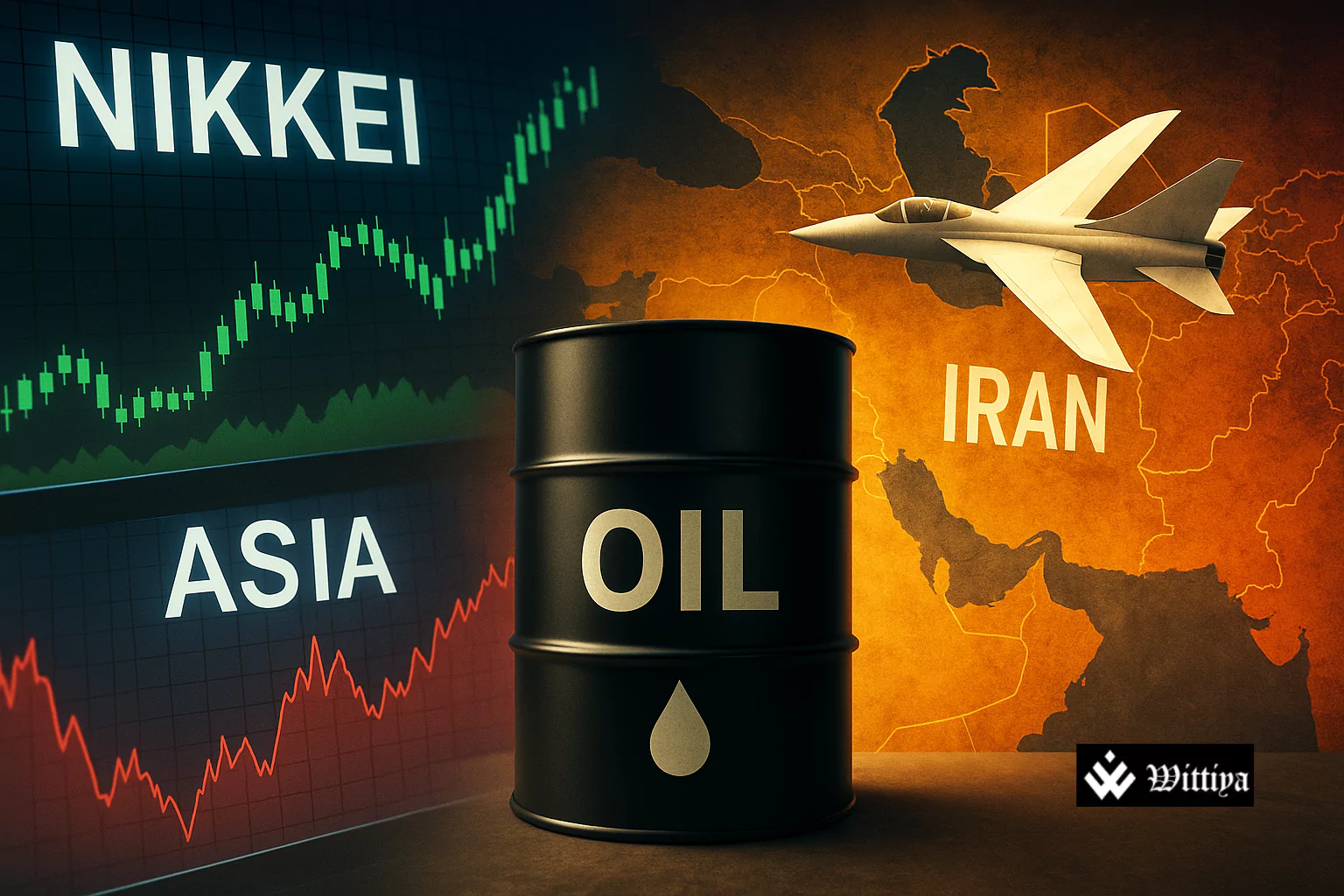
On June 20, 2025, global stock markets declined sharply as Middle East tensions escalated with Israeli strikes on Iran’s nuclear facilities. Central banks, including the U.S. Federal Reserve and Bank of England, held interest rates steady amid inflation concerns. Oil prices remained volatile as fears of supply disruption grew.
Global stock markets saw a significant retreat as tensions in the Middle East escalated, shaking investor confidence and driving up oil prices. On the seventh day of conflict between Israel and Iran, Israeli forces launched targeted airstrikes on Iran’s Arak heavy water reactor, intensifying concerns about the stability of the region and its impact on global trade.
Iran’s state media confirmed that the country’s Foreign Minister plans to meet European counterparts in Geneva, aiming to seek diplomatic resolution. The attacks on Iran’s nuclear infrastructure mark a serious escalation in the ongoing conflict that has already rattled global financial markets.
European indices reflected the market anxiety: France’s CAC 40 dropped 0.8%, Germany’s DAX fell 0.9%, and Britain’s FTSE 100 slid 0.5%. U.S. futures also dipped by 0.4% with Wall Street closed for the Juneteenth holiday.
In Asia, Japan’s Nikkei 225 declined 1.0%, although Nippon Steel Corporation surged 2.3% after completing its acquisition of U.S. Steel. The deal, long opposed by U.S. regulators, marks a major shift in global steel production ownership.
Hong Kong’s Hang Seng dropped 2.0% amid tech stock selloffs, while the Shanghai Composite lost 0.8%. South Korea’s Kospi managed a 0.2% gain, and Australia’s S&P/ASX 200 was nearly flat.
Meanwhile, the Federal Reserve in the U.S. decided to keep interest rates unchanged. Chairman Jerome Powell emphasized a cautious approach to any rate cuts, citing uncertainties caused by President Donald Trump’s ongoing tariff agenda and the inflationary impact of oil price surges.
“We can take the time to actually see what’s going to happen,” Powell said, referring to the potential effects of new tariffs and global instability. The Fed still anticipates two rate cuts this year.
In Europe, the Bank of England also held its main rate steady at 4.25%, while Switzerland’s central bank surprised markets by cutting its rate by 0.25 percentage points to zero, citing easing inflationary pressures.
In commodities, benchmark U.S. crude climbed 13 cents to $73.63 per barrel, while Brent crude rose 7 cents to $76.77. Oil prices remain volatile, driven by fears of a supply blockade through the Strait of Hormuz, which is controlled by Iran and critical to global energy trade.
Currency markets saw the U.S. dollar rise to 145.46 yen, while the euro edged down to $1.1476.
As geopolitical uncertainties mount and central banks navigate complex inflation dynamics, global markets remain under pressure, with eyes set on how the Israel-Iran conflict and trade policies evolve in the weeks ahead.