


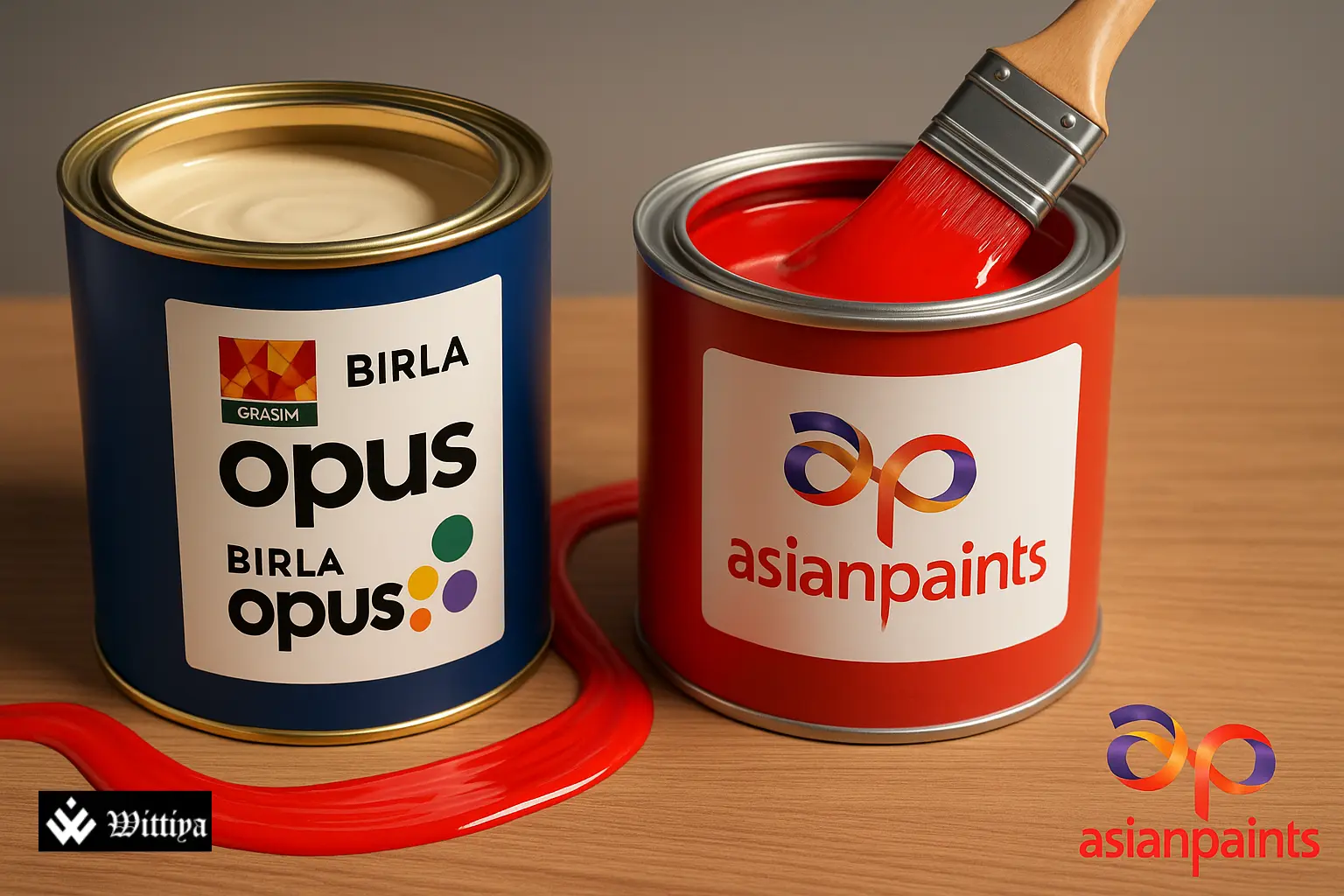
India’s decorative paints industry is undergoing a major shake-up as Grasim Industries challenges market leader Asian Paints with a strategic ₹10,000 crore entry under the brand Birla Opus, intensifying a high-stakes battle between two industrial powerhouses.
A seismic shift is underway in the country’s decorative paints sector as Grasim Industries, a flagship company of the Aditya Birla Group, launches a direct assault on market leader Asian Paints. With a planned investment of ₹10,000 crore into its new paint venture, Birla Opus, Grasim has clearly signaled its intent to disrupt the status quo.
The strategy is aggressive. Grasim aims to capture 40% of India’s decorative paints market in the coming years. This bold ambition is not just theoretical—it’s backed by capital, distribution strength, and a dealer-first approach. Grasim is offering higher dealer margins, competitive pricing, and leveraging its existing pan-India distribution infrastructure—something few new entrants can match.
For Asian Paints, this represents the most serious challenge in decades. The company, long seen as the undisputed leader in India’s decorative paints space, is now confronting margin pressure, dealer poaching, and investor unease. Its share price has come under pressure amid fears that its wide moat may be narrowing faster than expected.
The financial implications are deep. This is not merely a price war—it’s a structural challenge. Birla Opus’s entry could alter cost dynamics across the sector, squeeze operating margins, and force innovation cycles to shorten.
Also Read: Asian Paints Slips After Profit Shock: Market Reacts to Q4 FY25 Earnings
Paint Industry Disrupted: Birla Opus Challenges Asian Paints’ Dominance
Analysts highlight that legacy alone can’t sustain leadership in a disrupted market. The current development underscores the importance of strategic agility, supply chain resilience, and brand repositioning in retaining market leadership. Asian Paints may now need to revisit its long-standing strategies and possibly retool its product and dealer engagement models to protect its market share.
On the flip side, Grasim’s entry is being seen as a calculated play that leverages vertical integration and cross-industry synergies. The company has hinted at operational efficiency through backward integration—an area where it can control costs and scale quickly.
The coming quarters will serve as a litmus test for both companies. While Asian Paints brings brand equity and customer loyalty, Grasim brings capital, aggressive pricing, and an appetite for disruption.
As the Indian paint market evolves into a two-front competition, the broader lesson for corporates is clear: in today’s economy, market dominance is temporary without innovation and strategic evolution.