


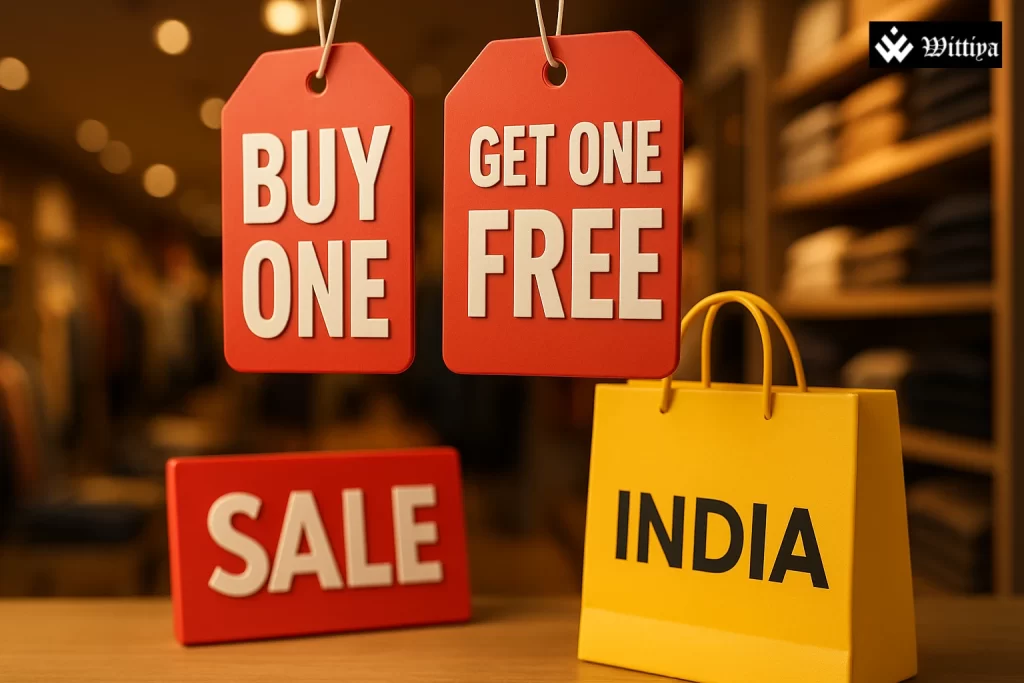
“Buy One Get One Free” is a common promotional campaign in India through which the customers get double the value of their shopping. Nevertheless, a business tactic is hidden behind all the thrill: high profits, clearance of stock, and consumer mentality. Such offers are not only giving back to the customers, but also one of the most clever retail profit models.
Buy One Get One Free Secrets
One cannot fail to see giant banners when walking through a busy shopping street in India that reads: “Shop for ₹6000 and get ₹6000 free.” With stores flooded with enthusiastic customers filling their carts, it appears brands generously give away half their stocks for free. However, the truth is, Buy One Get One Free (BOGO) does not imply help—it is a highly lucrative retail strategy.
In India, retailers, from major fashion chains to small apparel stores, have gotten the hang of this game. It seems to the consumer as if they are getting an unexpected bonus. To the company, it is a perfectly calculated way to reap the most profits, cut storage costs, and guarantee repeat visits.
Why “Free” is More Powerful Than Discounts
Behavioral economists have consistently referred to their research about the fact that “free” is more convincing than any discount. A 50% discount and a Buy One Get One Free deal are equal from a mathematical point of view—but not from a psychological one.
- According to science carried out by MIT and Duke University, people, when faced with the word “free”, see the gain as much more than with any other similar discount.
- In the country where the consumer is deeply price-sensitive, “free” triggers excitement and urgency that “50% off” seldom does.
This goes a long way explaining why fashion retailers prefer shopping offers like BOGO to mere price cuts. They don’t only lower prices—they elevate consumer craving.
How Retailers Afford Buy One Get One Free
The only thing that lies between these offers and their cost structures and consumer behavior.
1. High Margins in Fashion & Lifestyle
The fashion and lifestyle sectors are among the industries that have the highest price increases in retail. The clothing industry usually has a margin of 50–70% all over the world. A shirt that is sold at a retail price of ₹3000 in India might be made at a cost of ₹700–900.
Thus, if a store offers another shirt for “free,” it is not because they are losing money. Instead, they get rid of part of their margin while they still cover their costs and even make a profit.
2. Clearing Dead Stock Efficiently
Every collection leaves the retailers with the store of unsold articles. The unsold clothes not only block the money but also bring about the costs of warehousing besides it.
- The cost of the space for storage in metro cities in India varies from ₹50 to ₹100 per square foot per month.
- For big chains that have hundreds of outlets, managing old inventory is a financial burden.
BOGO resolves this problem by quickly moving old or slow-moving stocks and thereby creating space for fresh arrivals.
3. Increasing Average Bill Value
Most BOGO offers come with a minimum spend condition—say, ₹6000. This tends to make customers buy more than they initially planned.
- One who intended to buy a shirt worth ₹2500 but may then end up buying goods worth ₹6000 so that he/she can get the freebie.
- The studies of retail reveal that the promotions such as BOGO lead to an increase of basket size by 30–40% as compared to non-promo sales.
4. Boosting Footfall and Cross-Selling
The term “free” acts like a magnet. Once the shoppers arrive at the store for the deal, they normally buy the additional necessities like the accessories or the new arrivals at full price.
- A study conducted by Nielsen found that 65% of customers pulled-in by promotions also purchase the non-discounted goods.
- This equals out the expense of providing products “free”.
The Indian Festival Factor
The retail calendar in India largely revolves around festivals. Diwali, Durga Puja, and Independence Day sales are the times when shops do massive promotional blitz. Those sales have made the “Buy One Get One Free” offer a flagship of the promotions, especially in the fashion and lifestyle segments.
For the middle-class shoppers, such deals become a source of pride – they get to walk out with twice the things for the price of one. Retailers are well aware of this mentality and create their promotions with this in mind.
The results of a KPMG survey of Indian shoppers may be surprising as it shows that 70% of them wait for promotional sales to purchase big-ticket items. Thus, it is evident that offers like BOGO have become so entrenched in customers’ shopping habits.
Behind the Numbers: Retail Math
To get an idea of the profitability, let’s analyze a hypothetical scenario:
- A seller of retail would sell the shirt for ₹3000.
- The cost of manufacturing is ₹800, besides which there is ₹200 for transportation and store.
- Effective cost = ₹1000.
In a Buy One Get One Free promotion, however:
- The customer is within his or her rights to pay ₹3000 for the two shirts.
- Total cost for the retailer = ₹2000.
- Profit margin = ₹1000.
It is worth noting that despite the fact, the retailer still rakes in 33% profit while the customer is left with the feeling that he or she has doubled the value.
Why BOGO Outshines Straight Discounts
- Discount Fatigue: With year-round sales, customers in India grow used to the availability of discounts. A “flat 50% off” doesn’t get them as thrilled as it used to.
- Free Wins Emotionally: On the other hand, “Buy One Get One Free” always retains its appeal, even if the financial outcome is the same.
- Social Sharing: How would they feel if they could share such news with friends? “I bought ₹12000-worth of clothes for ₹6000”. Promoting the phenomenon is nothing else but word-of-mouth.
This is why BOGO is not just a pricing tactic but a powerful marketing tool.
What Lies Ahead for BOGO in India
The Buy One Get One Free method is presently transitioning from clothing to food, cosmetic, and online retail categories. E-commerce giants conduct BOGO-style deals as a part of mega sales to bundle products and ensure “free” is the result.
Indian retailers of the future may deem it attractive to combine BOGO with digital personalization in order to offer app-based coupons, membership-driven deals, and loyalty programs. Fashion apps for instance, could give exclusive BOGO deals only to their subscribers and increase the loyalty of their customers.
The Bottom Line
Before you run to a BOGO sale, take a second to think — it might not be just a way to save money but a strategy as well. Retailers in India are extremely skilled at using these deals to simultaneously increase their profit, clear shelves and build customer loyalty. In the end, what is presented to you as a reward is actually one of the smartest tools of modern retail to cash in profits.
READ MORE ON