




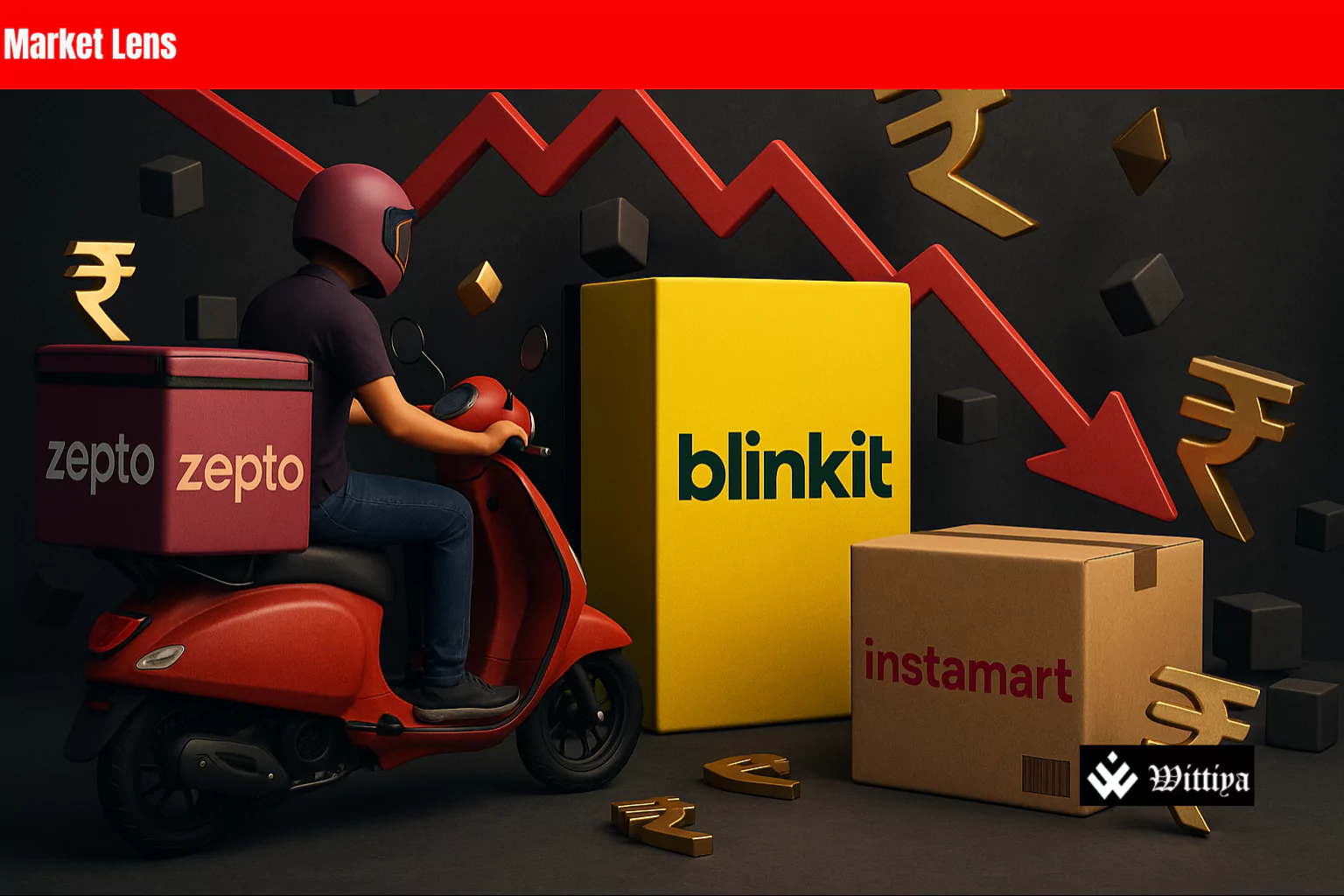
India’s quick commerce boom is at a crossroads. Platforms like Zepto, Blinkit, and Instamart have dazzled urban consumers with hyper-fast deliveries, but behind the velocity is a business model under intense financial and operational stress. This article takes a deep dive into the unsustainable economics of Q-commerce—high burn rates, logistical complexity, near-expiry inventory tactics, and volatile consumer loyalty. With D-Mart, BigBasket, and Reliance Retail avoiding this space or entering cautiously, the contrast is stark. From Dunzo’s downfall to labor risks and global parallels, this piece unpacks whether Q-commerce is a scalable future—or just a costly experiment in speed.
The 10-Minute Revolution
In the last two years, India has witnessed a retail disruption like never before: the rise of Quick Commerce (Q-commerce). Offering 10-minute delivery for essential goods, this model attracted urban consumers with unmatched speed and convenience. Platforms like Blinkit, Zepto, and Swiggy Instamart turned grocery shopping into an on-demand service, driven by app-based interfaces, dense city logistics, and hyper-local “dark stores.”
What started as an experiment quickly became a national obsession in metros like Delhi, Mumbai, and Bengaluru. From late-night snack cravings to forgotten grocery items, consumers adapted rapidly to this convenience-first habit.
However, behind this glamorous front lies an increasingly unsustainable model — one that’s propped up by massive VC funding, thin margins, and fragile supply chains. Unlike e-commerce or scheduled delivery, Q-commerce is a high-cost, high-speed operation with low economic defensibility. As it scales, its flaws — ranging from logistical strain to regulatory scrutiny — are becoming harder to ignore.
This article takes a comprehensive look at why Q-commerce may not be India’s next big retail revolution, and instead risks becoming a niche, convenience-driven offering reserved for a few city pockets.
The Market Landscape: Size, Players, and Reach
India’s Q-commerce market was valued at nearly ₹10,000 crore in 2024, growing at a CAGR of over 30%. However, this growth is highly concentrated in the top 8 metro cities.
Q-Commerce Market Share in India (2024)
- Blinkit leads the market with ~38% share, boosted by its integration into Zomato’s delivery ecosystem.
- Zepto is aggressively expanding with 30% market share, backed by over $700M in VC funding.
- Swiggy Instamart holds 20% share, leveraging its food delivery fleet and app ecosystem.
- BB Now (from BigBasket/Tata) has smaller but strategic presence.

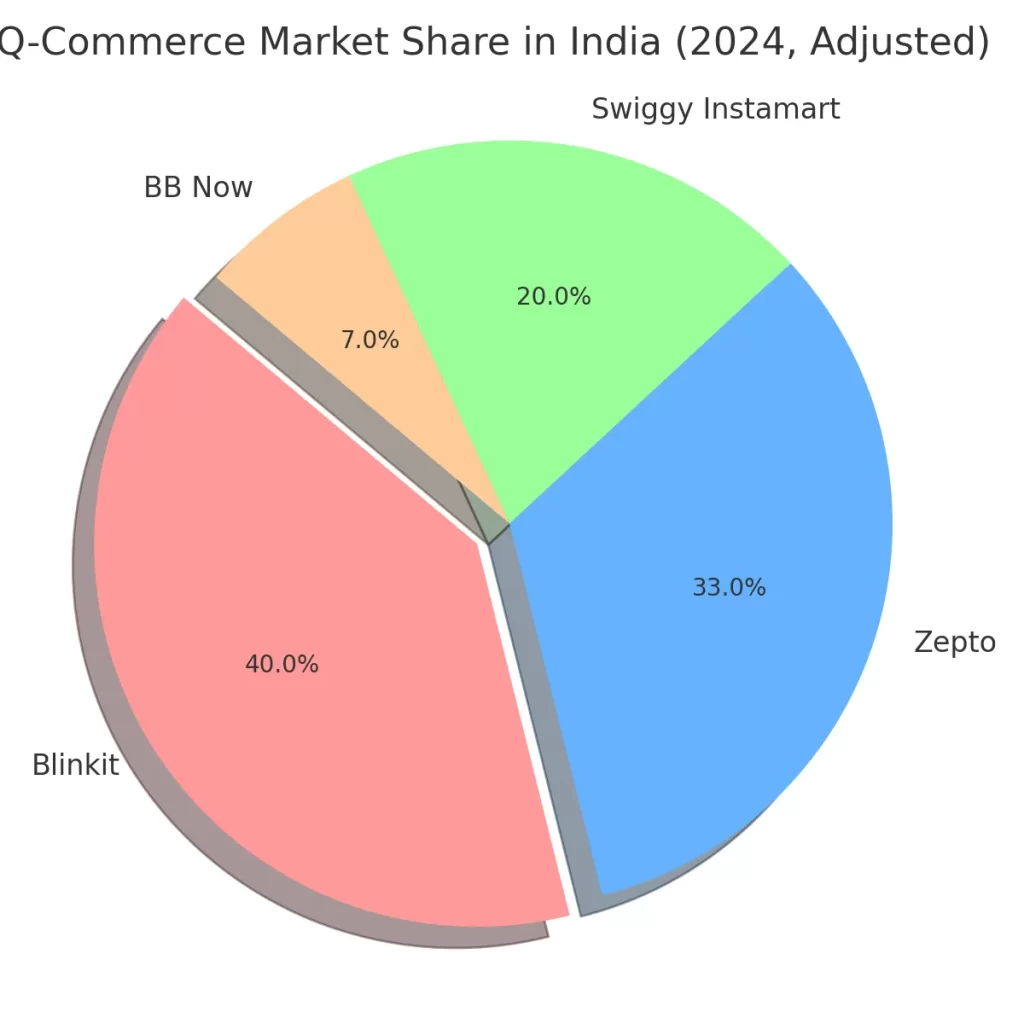
Table: Q-Commerce Reach & Scale (2024)
| Platform | Cities Present | Dark Stores | Orders/Day (Est.) | Parent/Backer |
| Blinkit | 25 | 400 | 3.5–4 lakh | Zomato |
| Zepto | 15 | 300 | 2.5–3 lakh | YC, Nexus, Glade Brook |
| Swiggy Instamart | 20 | 250 | 2 lakh | Swiggy (Prosus) |
| BB Now | 8 | 100 | 75,000 | TATA Group |
Despite the buzz, these services operate almost exclusively in urban clusters. The economics don’t scale to Tier-2 and Tier-3 cities without high density of demand — something yet to materialize in most parts of India.
Also Read: Zomato’s Profit Collapses as Blinkit Expansion Hits Hard
Business Model vs. Conventional Retail: The D-Mart Comparison
To understand why Q-commerce may not sustain, compare it with the highly successful, cash-positive model of D-Mart. India’s largest offline grocery chain, D-Mart offers everyday essentials at low prices, driven by bulk procurement, owned infrastructure, and optimized inventory turnover.
Additionally, Avenue Supermarts — the parent company of D-Mart — launched D-Mart Ready, a limited online delivery and pick-up model that focuses on scheduled deliveries and in-store collection. Unlike Q-commerce players, D-Mart Ready avoids deep discounting or free delivery, relying instead on its brand trust, assortment depth, and operational discipline- still unprofitable enterprise of the Avenue Supermarkets though.
Table: Q-Commerce vs D-Mart & D-Mart Ready — A Business Model Comparison
| Feature | Quick Commerce | D-Mart | D-Mart Ready |
| Delivery Time | 10–20 minutes | None (store-based) | Same-day/Next-day or pick-up |
| Inventory Model | Dark stores with ~2,000 SKUs | Large-format retail with >10,000 SKUs | Centralized warehouse + pick-up pts |
| Operating Costs | Very High (riders, dark stores, tech) | Low (owned property, bulk purchase) | Low to moderate |
| Customer Behavior | Frequent, impulse-based | Monthly, planned shopping | Weekly, value-driven |
| Margins | 4–6% average, unsustainable | >15%, stable and growing | >12%, warehouse-efficient |
| Expansion Model | VC-funded blitz scaling | Profitable, owned-store expansion | Asset-light digital-first rollout |
Why D-Mart Is Staying Away:
- D-Mart’s model thrives on value-seeking behavior rather than urgency.
- Its strategy is built around owned stores in high-footfall locations, ensuring profitability from day one.
- The Q-commerce model requires continuous cash burn and discounts to sustain frequency — something D-Mart sees as fundamentally flawed.
Meanwhile, BigBasket, now owned by the Tata Group, has cautiously tested the waters with BB Now. Instead of leading with speed, it is building on its robust warehousing and supply chain network to cater to high-density clusters in metros — a safer, more sustainable approach.
Also Read: Zomato’s Parent Builds a New Powerhouse with Blinkit Foods
The Cost of Speed: Logistics and Last-Mile Pressure
Speed is the foundation of Q-commerce, but delivering within 10–15 minutes comes at a significant operational cost. Companies must set up hyper-local dark stores across densely populated areas, maintain real-time inventory systems, and hire a large fleet of gig workers or riders.
A typical dark store serves a 2–3 km radius and stocks around 1,500–2,000 fast-moving SKUs. To maintain promised delivery speeds, companies like Blinkit and Zepto operate multiple warehouses per zone, with redundancy built in to avoid service lapses.
Cost Breakdown: Average Per Order
| Cost Head | Estimated Cost per Order (₹) |
| Rider payout | 22–30 |
| Packaging | 5–7 |
| Delivery infra | 8–10 |
| Warehouse ops | 10–15 |
| Discounts (avg.) | 8–12 |
| Total Cost | 53–74 |
With an average order value of ₹350–₹400, the effective contribution margins (after discounts and costs) often remain negative. Unless the basket size increases significantly or delivery frequency reduces, this model remains fundamentally fragile.
Distribution is King in this Business
In Q-commerce, logistics and distribution are not just enablers — they are strategic differentiators.
- Dealer Relationships: In traditional FMCG, brands rely on trusted dealer networks. Q-commerce skips this and builds internal distribution, which means higher capex but more control.
- Credit and Loyalty: Offline retailers offer dealer credit, sales-linked bonuses, and merchandising support. Q-commerce players invest in frequent rider training, real-time inventory mapping, and delivery guarantees instead.
- Logistical Complexity: Rural India poses distribution challenges — poor road infrastructure, lower order density, and higher costs per kilometer make scaling non-metro regions unviable.
The winning edge comes from dense micro-fulfilment networks, intelligent routing algorithms, and predictive stocking. Zepto, for instance, uses demand heatmaps to reposition inventory dynamically based on time-of-day and locality behavior.
Near-Expiry Sales: The Hidden Inventory Play
One under-discussed tactic in Q-commerce is the distribution of near-expiry FMCG products.
Here’s how it works:
- Brands or wholesalers offload short-shelf-life inventory to Q-commerce firms at deep discounts (sometimes 40–70% off MRP).
- Since Q-commerce customers are ordering for immediate consumption (snacks, dairy, ready-to-eat), the near-expiry nature doesn’t deter purchase.
- Platforms can maintain higher margins without overtly displaying the product’s expiry — or place it under “Offers” or “Flash Sale”.
This practice, while clever from an inventory standpoint, creates trust concerns. Consumer complaints have emerged around receiving milk, curd, or bread just a few days before expiry.
Potential Risks:
- Regulatory fines for not displaying expiry prominently
- Loss of repeat customers if such patterns become public knowledge
- Negative brand perception, especially among premium buyers
Pricing Power vs. Deep Discounts
The early wave of Q-commerce was built on aggressive discounting: ₹50 off on orders above ₹149, 20% off grocery combos, ₹1 delivery fees.
But this model is unsustainable long-term:
- Gross Margins in grocery are thin (~10–12%), so giving away ₹30–₹40 per order eats into profitability.
- Unlike electronics or fashion, basket sizes are small and repeat frequency is high — meaning every order bleeds unless subsidized.
- Price-sensitive Indian consumers may develop “coupon addiction,” reducing willingness to pay full price later.
By contrast, D-Mart and BigBasket rely on EDLP (Everyday Low Pricing) and volume-led margin protection, building loyalty without cash burn.
Current Strategy Shift:
- Zepto and Blinkit are now experimenting with tiered pricing, membership models, and private labels to improve unit economics.
- Swiggy Instamart offers bundled value packs and ₹99 plans with free delivery, but still subsidizes part of the logistics cost.
Until pricing power improves or customer LTV (lifetime value) increases, Q-commerce will likely remain stuck in a cash burn cycle.
Also Read: Blinkit-Fueled Glory: Eternal’s Soaring Ambition Captures India
Stock Market View: Investor Caution and VC Fatigue
Q-commerce is still largely private-equity funded, but public markets and institutional investors are becoming wary of the burn-heavy, profitability-lite business model.
Venture Capital Trends:
- Over $2.5 billion has been pumped into Indian Q-commerce players since 2021.
- In 2023–24, funding rounds became smaller and more valuation-sensitive, especially for second-tier players.
- Blinkit survives on the back of Zomato’s public listing, while Zepto is under pressure to prove a path to profitability ahead of its potential IPO in 2025.
Revenue vs Burn Snapshot:
| Platform | FY24 Revenue (₹ Cr) | FY24 Loss (₹ Cr) | Funding Raised (₹ Cr) |
| Blinkit | 2,300 | 800 | Merged into Zomato |
| Zepto | 1,100 (est.) | 1,200+ | 5,800+ |
| Instamart | 1,800 (via Swiggy) | NA (consolidated) | NA |

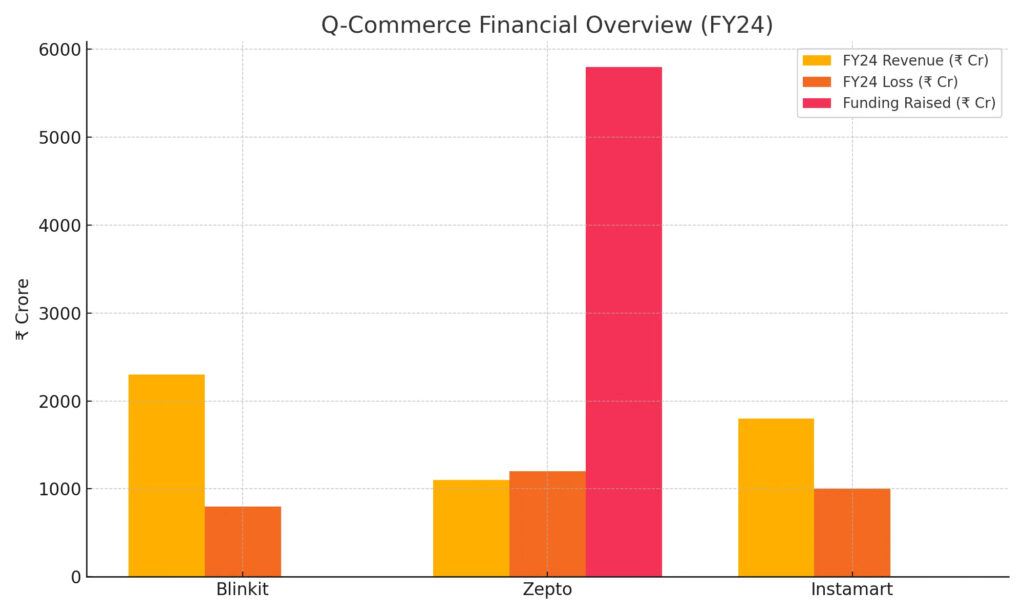
Public equity investors, who prioritize sustainable earnings and long-term visibility, remain unconvinced. Even Swiggy’s IPO plans were reportedly delayed due to questions around Instamart’s unit economics.
Capex Wars and Infrastructure Burn
Unlike digital-first models, Q-commerce is a brick-and-mortar business disguised as tech. Every new pin code requires physical infrastructure: warehousing, logistics hubs, local staff, and rider fleet support.
Infra Intensity:
- Zepto plans to open 700 dark stores by FY26, with capex upwards of ₹600 crore.
- Blinkit already runs 400+ dark stores, with frequent relocations to optimize delivery radius.
- BB Now and Dunzo scaled back expansion plans due to infra and operational costs outpacing growth.
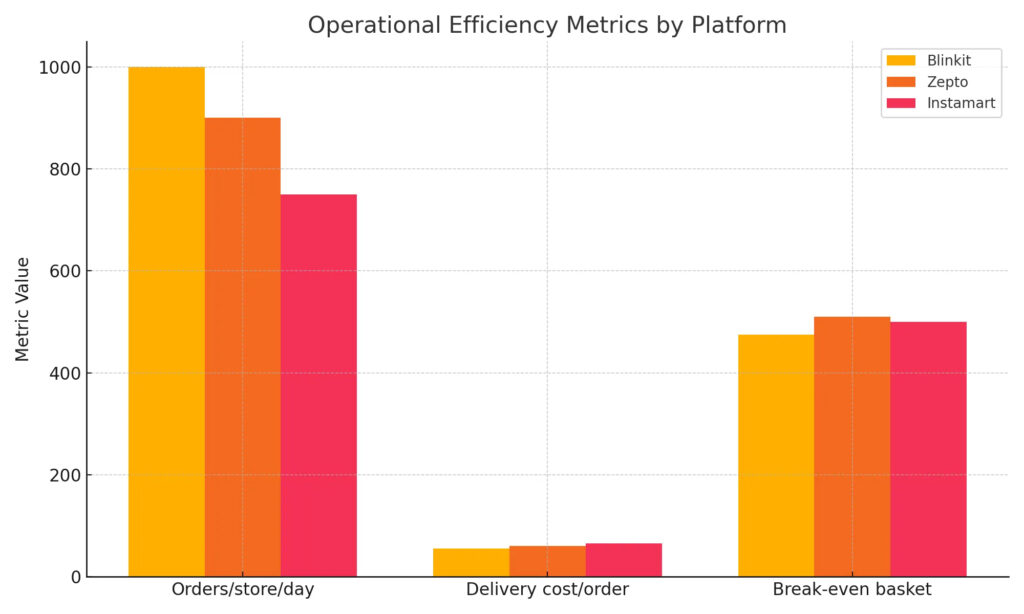
Efficiency Metrics:
| Metric | Blinkit | Zepto | Instamart |
| Orders per dark store/day | ~1,000 | 850–950 | 700–800 |
| Avg. delivery cost/order | ₹50–65 | ₹50–65 | ₹50–65 |
| Break-even basket size | ₹500+ | ₹500+ | ₹500+ |
Infrastructure costs are fixed, but demand is elastic. Unless cities reach critical mass (like South Mumbai or South Delhi), many dark stores operate below breakeven thresholds.
Rider Fatigue, Labor Risk & Regulatory Pushback
Q-commerce depends on thousands of gig workers, many of whom operate in high-pressure, time-bound environments.
Worker Realities:
- Riders are expected to complete 15–20 deliveries per shift in traffic-heavy urban zones.
- Real-time app tracking creates stress, especially during peak hours and rains.
- Incentive structures are volume-based, sometimes compromising rider safety.
Labor Contention:
- Gig workers’ unions are now demanding better pay, accident insurance, and regulated working hours.
- In states like Maharashtra and Karnataka, labor codes are being reviewed to potentially classify gig workers as platform employees.
- This would force players to provide social security, significantly increasing operating costs.
If regulation tightens, it may dismantle the cost arbitrage that Q-commerce currently thrives on — making it even harder to achieve profitability.
Private Labels: A Path to Margin Improvement?
In a bid to break the discounting cycle and boost margins, players like Blinkit and Zepto have launched private label products.
What They’re Selling:
- Snacks, staples, dairy, personal care under in-house branding.
- Zepto launched its own range of dry fruits, pasta, and even eco-friendly cleaners.
- Blinkit has piloted ready-to-cook kits and frozen foods under “Essentials by Blinkit”.
Margin Potential – Private Label vs. Branded
| Category | Avg. Margin (Branded) | Avg. Margin (Private Label) |
| Snacks | 15% | 38–42% |
| Home Care | 10–12% | 35–40% |
| Staples | 12–14% | 25–30% |
| Packaged Water | 5–7% | 45–50% |
Why It Matters:
- Private labels offer 30–50% higher margins than branded FMCG goods.
- Control over sourcing, pricing, and packaging improves profit visibility.
- Helps create brand loyalty if quality is maintained.
However, private labels require:
- Strong supply chain backend
- Marketing investments
- Consumer education and trust — which takes time
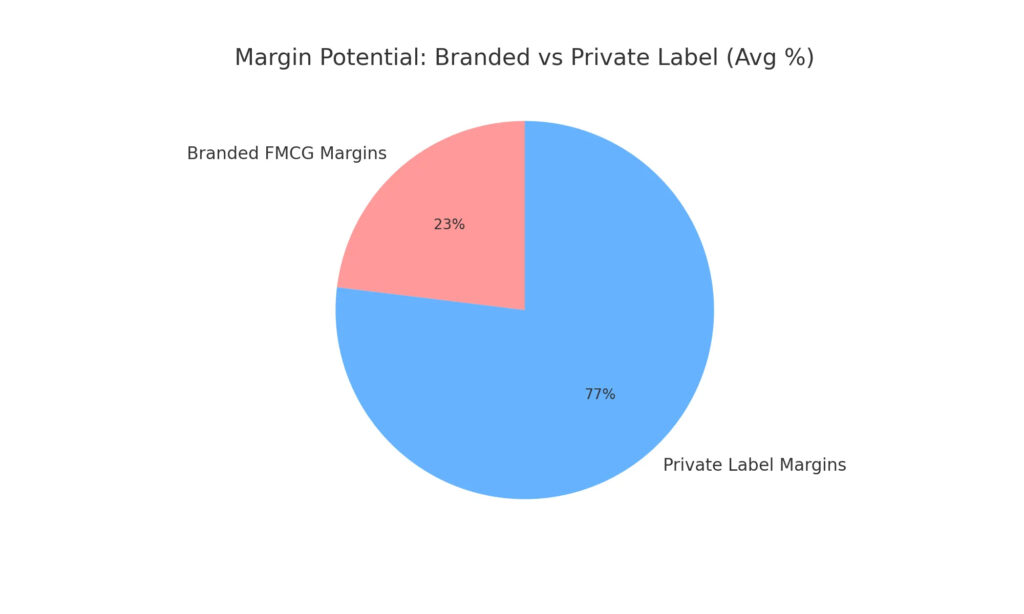
Still, this is one of the few scalable levers for improving Q-commerce economics — especially if bundled with loyalty/membership programs.
Also Read: Can India’s Fastest Deliveries Turn into Fat Profits?
Labor Risk and the Rider Economy: The Human Cost of 10-Minute Delivery
Behind every successful Q-commerce order is a rider operating under intense pressure. The entire model hinges on thousands of gig workers delivering on strict timelines, often with little safety net.
Realities on the Ground:
- Gig Contracting Model: Riders are not treated as employees. They are “delivery partners,” which means platforms don’t provide insurance, paid leaves, or social security benefits.
- Unpredictable Payouts: Due to opaque algorithms, riders often don’t know how much they’ll earn per order. Incentives vary by zone, surge hours, or completion targets, causing uncertainty and stress.
- Accidents and Burnout: In urban areas, especially during peak hours or monsoons, riders are forced to take risks to meet delivery timelines. Injuries are frequent, but medical compensation is rare.
- High Attrition: A Zepto delivery hub in Bengaluru reportedly churns over 30% of its riders every 60 days — one of the highest attrition rates in gig employment.
Gig Worker Risks Composition:
| Risk Type | Impact Level |
| Income volatility | High |
| No insurance/benefits | Critical |
| Unsafe driving conditions | Severe |
| Classification loopholes | Legal |
Why This Matters:
- These risks aren’t just HR problems — they affect delivery consistency, brand reputation, and compliance exposure.
- With increasing scrutiny, platforms that don’t resolve these issues risk regulatory action, consumer backlash, or strikes.
The Fall of Dunzo: A Wake-Up Call for the Industry
Among India’s earliest hyperlocal delivery pioneers, Dunzo’s collapse in 2024–25 served as a stark warning to the Q-commerce ecosystem. What started as a Bengaluru-based errand-running app quickly evolved into a same-day and 19-minute delivery powerhouse, backed by Google, Reliance Retail, and several major VCs. At its peak, Dunzo promised ultra-fast deliveries of everything—from groceries and food to medicines and mobile chargers.
However, the cracks were always present. Unlike its competitors who built dedicated dark store networks, Dunzo pursued a hybrid model of third-party partnerships and its own “Dunzo Daily” dark stores. This added complexity and limited control over the end-to-end supply chain. Operational inconsistencies, delayed deliveries, and a lack of clarity in brand positioning further eroded consumer trust.
By early 2024, Dunzo was struggling to pay employee salaries on time. Reports of unpaid dues to delivery partners, warehouse closures, and workforce downsizing began surfacing. Ultimately, Dunzo suspended most of its operations in mid-2024, with no clear recovery plan. Reliance, one of its largest investors, wrote down its stake.
Dunzo’s downfall wasn’t just about poor financial discipline or operational overload—it exposed the deeper structural flaws in Q-commerce:
- Unviable unit economics in non-core metros
- Weak consumer stickiness outside of top-tier cities
- Over-reliance on investor capital without breakeven clarity
- No real moat against larger, better-funded competitors
The story of Dunzo now acts as a sobering case study for the industry: that flashy branding, VC backing, and a head start aren’t enough when the fundamentals don’t align. In many ways, Dunzo’s fall represents the natural outcome of a Q-commerce model that prioritizes speed and scale over sustainability.
Global Lessons: How Q-Commerce Collapsed Abroad
While India’s Q-commerce players like Zepto, Blinkit, and Swiggy Instamart are still in expansion mode, their international counterparts have hit a wall. Global failures offer sobering lessons on what not to do — and reveal how quickly this model can become unsustainable under pressure.
International Case Studies of Collapse
| Region | Platform | Status (2024) | Key Reasons for Collapse |
| UK & France | Getir | Exited both markets | High operational costs, regulatory backlash, and low retention |
| Germany | Gorillas | Acquired by Getir, downsized | Unsustainable unit economics, weak brand loyalty |
| USA | GoPuff | Pulled back from expansion | High customer acquisition costs (CAC), poor profitability |
| Latin America | Jokr | Retreated from key cities | Slow order growth, thin margins, supply chain issues |
Most of these startups burned through billions in VC funding, scaled rapidly across countries, but couldn’t crack sustainable profitability. The core challenges were eerily similar:
- High labor costs
- Low repeat order rates
- Extremely competitive delivery time wars
- Low margins on grocery essentials
Structural Weaknesses Identified:
- Low Entry Barriers: Any player with capital could replicate warehouses, logistics, and SKU selection — leading to a race to the bottom.
- Consumer Loyalty Was Thin: Most users were discount-driven and would switch platforms depending on the promo available.
- Poor Unit Economics: Even in the densest cities, delivery cost per order often exceeded margins — especially as wages and gas prices rose.
- Overexpansion: Players scaled into geographies before achieving profitability in core markets, burning cash without customer density.
Key Differences in Q-Commerce Structures – Global Vs Indian
| Factor | Global Q-Com | Indian Q-Com (Current) |
| Rider Costs | High | Low |
| Avg. Basket Size | $20–$25 (~₹1700–₹2100) | ₹350–₹400 |
| Delivery Radius | 2–3 miles | 1.5–2 km |
| Loyalty Drivers | Brand & UX | Discounts & Convenience |
| Labor Regulation | Strict (Europe/US) | Nascent (but rising) |
| Key Bottleneck | CAC + Labor | Profitability + Scale |
A Race Against Time and Logic
India’s quick commerce boom is at a turning point. What began as a novelty—groceries in ten minutes—has evolved into a fiercely competitive, capital-intensive industry grappling with the hard realities of sustainability. While startups like Zepto, Blinkit, and Swiggy Instamart have proven that there is genuine consumer demand for instant gratification, they are also discovering that the economics of speed are unforgiving.
Unlike global peers that collapsed under their own weight, India’s players enjoy some structural advantages: cheaper labor, digital payment ubiquity, and densely packed urban markets. These have allowed them to scale quickly and achieve impressive reach, especially in Tier 1 cities. Yet, the deeper one looks, the more apparent it becomes that the underlying business model remains on shaky ground. Negative unit economics, over-reliance on discounts, inconsistent labor practices, and looming regulatory scrutiny are exposing the fragility beneath the flashy marketing campaigns and rapid delivery promises.
Meanwhile, traditional players like D-Mart and Reliance Retail continue to demonstrate that profitability, not speed, is the true cornerstone of retail success. Their focus on efficient supply chains, large basket sizes, and lean operations provides a sobering contrast to the cash-burning urgency of Q-commerce ventures. Even BigBasket, the once-pureplay e-grocer, has approached instant delivery with caution—gradually ramping up 10-minute deliveries only where density and margins align.
The quick commerce story in India is not over. In fact, it may just be entering its second chapter. The coming years will test whether these platforms can mature beyond aggressive customer acquisition and emerge as viable businesses. That journey will require more than faster bikes and deeper pockets; it will demand hard pivots in strategy, transparency in operations, and balancing the expectations of consumers with business objectives—and most importantly, profitability.
READ MORE ON