


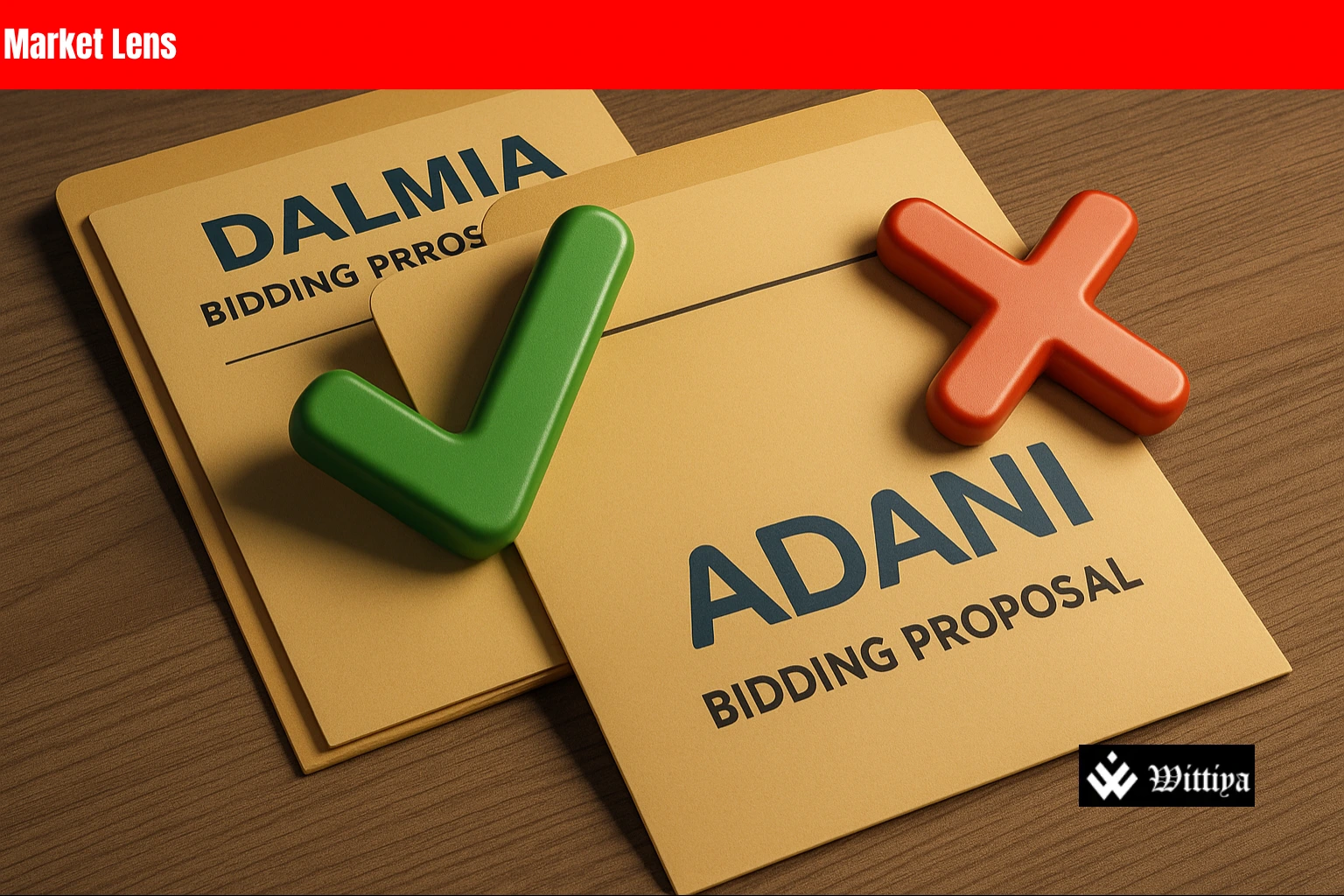
Adani Group’s ₹12,600 crore unconditional bid for Jaiprakash Associates outsmarts higher but conditional offers. With rival bids hinging on a disputed land parcel, Adani’s clean and executable offer may win the deal—proving that clarity can beat complexity in high-stakes acquisitions.
The Banks’ Dilemma
The lenders of Jaiprakash Associates, a flagship company of the embattled Jaypee Group, are now staring at a complex decision. In a high-stakes bidding scenario, they must choose between the highest bid with uncertainties and an assured, unconditional offer that guarantees speed and clarity.
On paper, Dalmia Bharat leads the race with a ₹14,600 crore bid. However, that number is far from absolute. The offer hinges on the successful resolution of a disputed land parcel whose legal status is mired in complications. Experts estimate that if the dispute remains unresolved, the effective value of Dalmia’s offer could shrink by nearly ₹2,000 crore, bringing it down to ₹12,600 crore — the exact amount offered by the Adani Group.
This is where Adani’s strategy becomes compelling. While others attached strings to their bids, Adani submitted a clean, no-conditions-attached ₹12,600 crore offer, forcing the lenders to ask a critical question: Do they prefer a higher number with legal risks or a guaranteed payout with zero ambiguity?
The Bidding Landscape: Five Offers, One Clear Contender
The insolvency process for Dalmia Bharat attracted five suitors:
- Dalmia Bharat – ₹14,600 crore (conditional on land dispute resolution)
- Adani Group – ₹12,600 crore (unconditional)
- Jindal Power, Vedanta, and others – bids with multiple caveats and clauses
The Committee of Creditors (CoC) met on Monday to evaluate these bids. Dalmia’s bid led in raw numbers, but the presence of legal encumbrances around a major part of the valuation has tilted focus toward Adani’s bid, which offers certainty of closure.
For the lenders, especially in the context of India’s Insolvency and Bankruptcy Code (IBC), speed and legal clarity are often more critical than headline figures. With mounting NPAs and regulatory pressure to resolve cases swiftly, an unconditional bid like Adani’s can feel like a lifeline.
The Genius of Adani’s Bid: Turning Certainty into Strategy
This isn’t just another corporate acquisition attempt; it’s a case study in strategic bidding. Adani Enterprises has effectively demonstrated how to price in risk, position for advantage, and still emerge on top.
Here’s why:
- Speed Wins: Adani’s offer allows the CoC and NCLT to fast-track resolution. Time-sensitive cases are better served by unconditional terms that bypass litigation and revaluation.
- Risk Pricing Mastery: By assuming the land dispute will delay or devalue other bids, Adani accurately placed its bid to match the “realistic” valuation of the top competitor.
- Legal Hygiene: In IBC proceedings, any condition attached to a bid is a potential minefield. Adani avoided this entirely.
It’s not that Dalmia Bharat didn’t bid aggressively; rather, Adani understood that agility and certainty often outweigh volume in such processes. With the CoC prioritizing resolution speed, Adani’s bid becomes the most actionable one on the table.
The Land Dispute: A ₹2,000 Crore Question Mark
The disputed land parcel in question could contribute significantly to the overall enterprise value of Jaiprakash Associates. However, its unclear legal status makes it a double-edged sword.
Dalmia Bharat’s bid counts on this parcel being awarded or cleared without litigation. But if the parcel remains disputed or is eventually ruled out of the resolution asset pool, Dalmia’s headline bid takes a direct hit — reducing it by as much as ₹2,000 crore.
This variable dramatically flattens the gap between the top two bids and puts Adani back on par with Dalmia. But with one critical edge: Adani’s bid is executable “Today”.
Why This Move Is a Masterclass in Corporate Strategy
This move is not just a financial calculation; it’s a demonstration of corporate chess at its finest.
- Positioning Over Price: Adani sidestepped the noise and went straight for lender psychology — offering certainty instead of maximum value.
- Smart Use of IBC Flexibility: Under the IBC, the CoC is not bound to accept the highest bid; viability and executability matter more.
- Market Signal: The Adani Group is signaling confidence in Jaiprakash Associates’ long-term value, even minus the disputed asset.
Other bidders may still come forward with revised offers, but Adani has already changed the dynamics of the bidding war.
Adani’s Clarity Could Beat Dalmia’s Complexity
In high-stakes corporate acquisitions, particularly under insolvency, the real win often lies not in outbidding others but in outthinking them. Adani’s unconditional bid for Jaiprakash Associates is a shining example of using strategic clarity to trump conditional promises.
By submitting a bid that offers banks speed, certainty, and legal cleanliness, the Adani Group has effectively shifted the narrative from “highest bid wins” to “best bid wins.”
Sometimes, the smartest move on the board is the one that looks the simplest—and Adani just made it.