


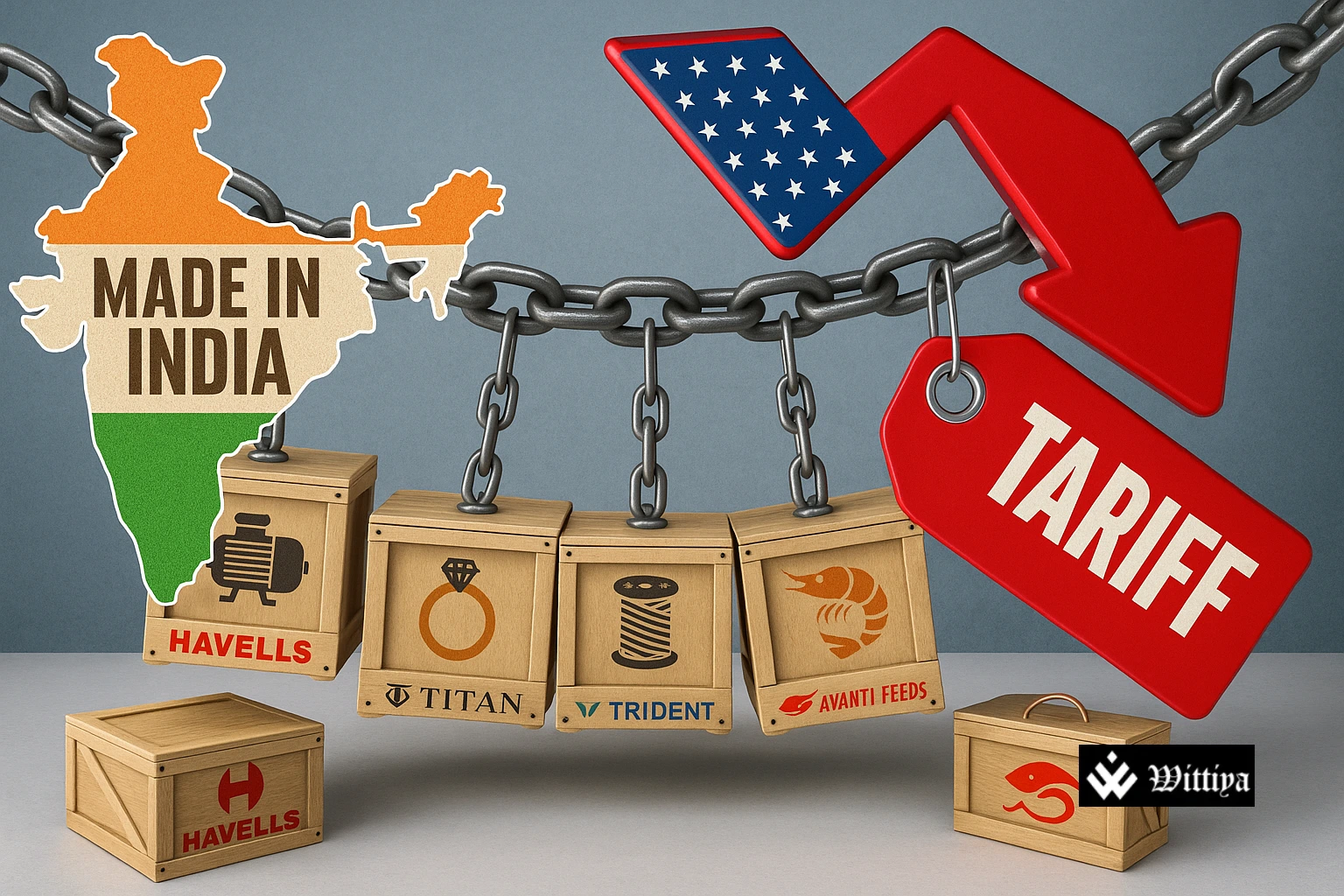
Indian export sectors are facing heightened pressure after the United States reinstated and expanded tariffs up to 25% on select Indian goods. With the U.S. being India’s largest export market, industries across machinery, jewelry, chemicals, and textiles are evaluating revenue and margin risks amid fears of volume contraction and order diversions.
With the U.S. reinstating and expanding tariffs on select imports from India, several export-driven sectors are bracing for impact. India and the United States share a strong trading relationship, with the U.S. being India’s largest export destination. In 2024, India’s exports to the U.S. reached $81 billion, accounting for nearly 17.7% of the country’s total exports. Now, with tariffs climbing as high as 25% under Trump’s renewed trade agenda, this relationship is entering uncertain terrain. Here’s a sector-wise breakdown of who stands to lose the most.
Electrical Machinery & Equipment ($14 Billion)
This is the largest export segment from India to the U.S., covering components like transformers, switchboards, motors, and semiconductors. Indian firms have gained substantial outsourcing and OEM contracts from American manufacturers and green energy firms.
- Tariff Threat: A 25% hike will erode price competitiveness, particularly affecting mid-sized exporters who can’t absorb the additional costs or reroute supply.
- Impact: Expect short-term order cancellations and a potential shift of U.S. buyers toward Southeast Asian suppliers.
Precious Metals & Jewelry ($11.6 Billion)
India exports a large volume of cut and polished diamonds, gold jewelry, and silver ornaments to the U.S., making it one of the most visible sectors in bilateral trade.
- Tariff Threat: This sector is highly sensitive to price fluctuations. Even a 5–10% hike makes Indian jewelry significantly more expensive in the American market.
- Impact: Exporters like Titan, Rajesh Exports, and Kalyan Jewellers could witness margin pressure and volume declines.
Also Read: Markets Defy Tariff Tensions with a Stunning 500-Point Rally
Nuclear Reactors, Boilers & Industrial Equipment ($6.8 Billion)
This niche but valuable sector includes boilers, reactors, turbines, and other capital goods used by U.S. industries in power, aviation, and manufacturing.
- Tariff Threat: Large project-based orders may face renegotiations, delays, or reallocation to other low-tariff countries.
- Impact: Engineering conglomerates such as L&T and BHEL could face headwinds in their U.S. contract pipelines.
Organic Chemicals ($3.5 Billion)
India is a significant supplier of intermediates, dyes, and specialty chemicals to U.S.-based pharmaceutical and manufacturing firms.
- Tariff Threat: This could lead to higher landed costs for buyers, prompting them to either pass costs downstream or shift sourcing to China or Vietnam.
- Impact: Mid-cap chemical firms like Aarti Industries, Deepak Nitrite, and SRF are at risk of volume loss and margin compression.
Auto and Auto Ancillaries
The U.S. is a key export market for auto components, castings, and engine parts made by Indian companies. Major clients include General Motors, Ford, and Tesla.
- Tariff Threat: Component makers operating on thin margins could be hit hard. Tier-2 suppliers will find it difficult to renegotiate contracts.
- Impact: Stocks like Bharat Forge, Motherson Sumi, and Sundaram Fasteners may face demand volatility and order cuts in FY26.
Chemical Sector
Besides organic chemicals, the broader chemical industry—including agrochemicals and industrial solvents—has major U.S. exposure.
- Tariff Threat: The sector has already been battling high raw material costs and environmental scrutiny. Additional tariffs further stress supply chains.
- Impact: Export-oriented firms could lose market share in the U.S., slowing growth and affecting earnings projections.
Textiles
India exports cotton, synthetic garments, home furnishings, and more to the U.S., with retail giants like Walmart and Target being major buyers.
- Tariff Threat: The labor-intensive nature of this sector leaves little room to absorb cost hikes. U.S. buyers may switch to Bangladesh or Vietnam.
- Impact: Expect significant stress on companies like Arvind, Welspun, and Trident, especially in home textile and apparel exports.
Also Read: The Billion-Dollar Battle: Andhra’s Shrimp vs. U.S. Tariffs
Seafood Sector
The U.S. is a major destination for Indian shrimp and frozen seafood exports, especially from coastal states like Andhra Pradesh and Kerala.
- Tariff Threat: Indian seafood already faces quality scrutiny and FDA regulations. Tariffs will compound cost disadvantages vs Latin American suppliers.
- Impact: Major listed players like Avanti Feeds and Apex Frozen Foods are vulnerable to shipment delays, cancellations, and price renegotiations.
Consumer Goods Companies
Several Indian FMCG and packaged food companies are now exporting to diaspora-heavy U.S. markets—spices, ready meals, and beauty products.
- Tariff Threat: Though not the largest contributors by value, these categories are price sensitive and may suffer shelf displacement in mainstream retail.
- Impact: Firms like Dabur, HUL (Ayurvedic brands), and Marico could see revenue decline in North America-focused SKUs.
Energy Sector – Oil & Gas Companies
Though India doesn’t directly export oil or gas to the U.S., energy companies with global operations may be impacted by geopolitical tensions.
Russian Crude Factor: India imports over 35–40% of its oil from Russia, often at a $3/barrel discount. The U.S. has threatened to penalize countries that continue these purchases.
Impact:
- Reliance Industries could face global compliance and shipping risks.
- HPCL, BPCL, IOCL may see margins narrow due to reduced discounts.
- ONGC may see valuation impact from weaker upstream profits.
EBITDA Impact Estimate: Analysts project a 3–10% EBITDA decline if discounts from Russia are reduced under U.S. pressure.
Conclusion
The U.S.-India trade relationship is at a critical juncture. While India has diversified its export destinations in recent years, the U.S. still remains its most lucrative market. Any long-term trade barriers could dent India’s export momentum, erode sectoral profitability, and dampen investor confidence.
Going forward, exporters will need to:
- Explore alternative markets like Europe, Southeast Asia, and the Middle East.
- Localize production through global manufacturing partnerships.
Lobby for preferential trade agreements or dispute resolution under WTO frameworks.
READ MORE ON