






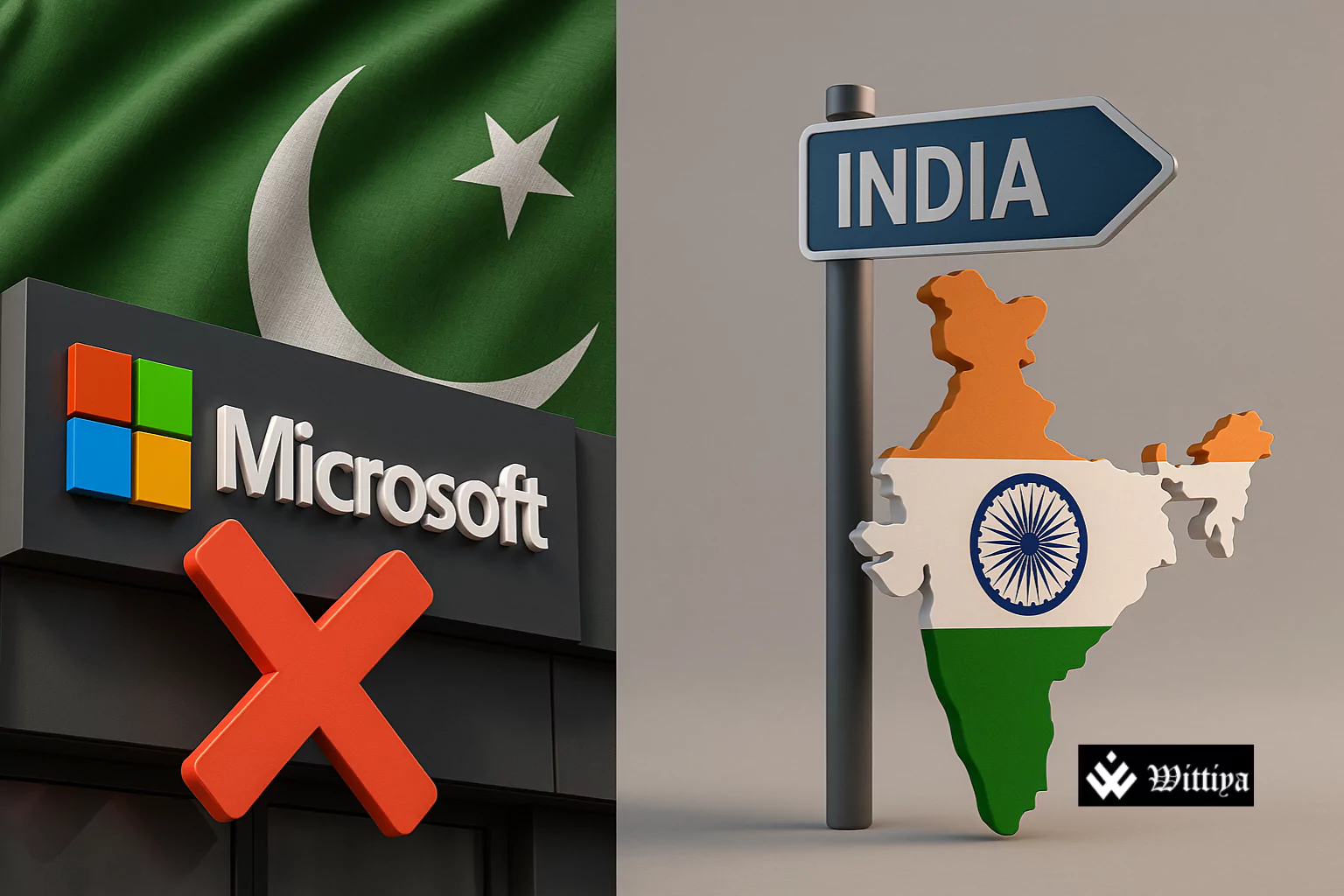
Microsoft officially shut down its Islamabad operations in July 2025, marking a complete exit from Pakistan. The move reflects deep-rooted concerns over Pakistan’s political instability, economic mismanagement, regulatory unpredictability, and growing religious intolerance. In sharp contrast, Microsoft is expanding in India, where governance, infrastructure, and investor confidence are proving to be long-term growth enablers.
Introduction: A Departure That Speaks Volumes
In July 2025, Microsoft officially shut down its Islamabad operations, marking the tech giant’s complete exit from Pakistan. While the closure seemed sudden, the signs had long been evident. Microsoft’s departure is more than a corporate decision—it’s a scathing commentary on Pakistan’s broken administrative machinery, unpredictable political climate, and its continued inability to present itself as a viable hub for global technology investment. In stark contrast, India has not only held the door open for global tech giants but built a digital superhighway to welcome them.
1. Political Instability and Administrative Paralysis in Pakistan
Pakistan’s governance framework has long struggled with chronic instability. Since 2018, the country has witnessed a carousel of leadership changes, with four different prime ministers assuming office amidst a backdrop of civil-military tensions. This political churn is not just cosmetic—it actively disrupts economic planning and business continuity. Multinationals like Microsoft are not interested in short-term chaos; they seek long-term strategic stability, something Pakistan has consistently failed to provide. The bureaucracy, meanwhile, remains mired in red tape, inefficiency, and opacity. Regulatory enforcement is unpredictable at best, and outright contradictory at worst.
The tech ecosystem has suffered greatly under these conditions. For instance, PayPal pulled out of talks to launch in Pakistan in 2023. The decision wasn’t about technology—it was rooted in the country’s lack of operational guarantees and the rigidity of its financial regulators, which refused to allow flexibility in data localization and cross-border transfers. Microsoft, like PayPal, struggled with delays in policy approvals, unpredictable tax frameworks, and compliance bottlenecks.
2. Economic Mismanagement and Forex Crisis
These structural weaknesses are compounded by economic mismanagement. Pakistan’s ongoing foreign exchange crisis has prompted the State Bank to impose harsh capital controls, effectively trapping foreign earnings within the country. In 2024, Procter & Gamble—a major global player in consumer goods—scaled back its expansion in Pakistan after facing nearly a year of delays in repatriating its profits. Microsoft too, according to insiders, faced hurdles when trying to move funds or import hardware for its Azure and enterprise products. Such conditions are unsustainable for any serious global operation.
3. Geopolitical Tensions and Isolation
Geopolitics only adds fuel to the fire. Pakistan’s persistent hostility with India, its unpredictable stance toward Western alliances, and closer alignment with China have made it less attractive to U.S.-based corporations. In 2024, Amazon launched its pilot drone delivery program in India, despite having had extensive discussions with Pakistani logistics providers. The reason? India’s better security assurances, logistics infrastructure, and long-term market reliability.
4. Rising Global Confidence in India
Contrast this with India, where Microsoft is not just operating—but expanding. In 2024, the company opened new data centers in Hyderabad and Pune to support its growing Azure client base. Microsoft also partnered with Indian government agencies to upskill millions in AI and cloud computing, reinforcing India’s role as a digital innovation hub. Other tech giants are following suit. Apple launched flagship stores in Mumbai and Delhi and announced that one-fourth of its global iPhone production would now be based in India. Google pledged $10 billion through its India Digitization Fund to enhance internet access, cloud infrastructure, and AI research. Tesla, too, has announced a new software R&D center in Bengaluru.
5. Institutional Strength and Regulatory Clarity
This divergence between India and Pakistan isn’t just about investment numbers—it’s about perception. India is viewed as a place where innovation meets governance, where institutions like the Reserve Bank of India (RBI) and Securities and Exchange Board of India (SEBI) offer clarity and confidence. When Visa and Mastercard needed local data storage compliance cleared, Indian regulators acted swiftly, allowing both firms to scale operations without fear of sudden policy reversals.
6. The Startup Divide: Unicorns vs Shutdowns
Meanwhile, Pakistan’s startup ecosystem is deteriorating. Once-promising ventures are shutting down due to lack of investor confidence. Airlift, which had once raised tens of millions in capital and promised to revolutionize urban transport in Pakistan, shuttered in 2022 after failing to secure follow-on funding. In contrast, India has seen unicorns like Zepto and Cred cross the $1 billion valuation mark by 2024, with robust backing from both domestic and international VCs.
7. Religious Extremism and Regressive Social Climate
Another critical yet often under-discussed factor driving away global corporations is Pakistan’s increasingly regressive religious and social climate. In recent years, there has been a noticeable rise in religiously motivated vigilantism, blasphemy-related arrests, and growing intolerance toward minority communities. For global corporations that prioritize diversity, inclusion, and employee safety, such an environment is a red flag.
Multinationals prefer countries where their workforce—regardless of background, gender, religion, or belief—can operate freely and safely. Pakistan’s poor track record on religious freedom has been noted in multiple U.S. State Department reports, which have also influenced foreign investor confidence. In contrast, India, while not without its challenges, presents a far more progressive and pluralistic space for companies to function. Major global firms have initiated DEI (Diversity, Equity, Inclusion) programs from their Indian offices, highlighting a more open and globally-aligned culture.
Writing on The Wall
Microsoft’s exit from Pakistan is not just about numbers—it is a damning verdict on a system that has failed to evolve. It’s a warning to all emerging markets: political noise, regulatory chaos, economic mismanagement, and an intolerant social climate drive global players away. At the same time, India is proof that if you build strong institutions, promote transparency, embrace diversity, and align with global standards, investment will follow.
The world is watching. And increasingly, it is looking towards India.
Also Read: Microsoft Exit Reflects Pakistan’s Economic Struggles