


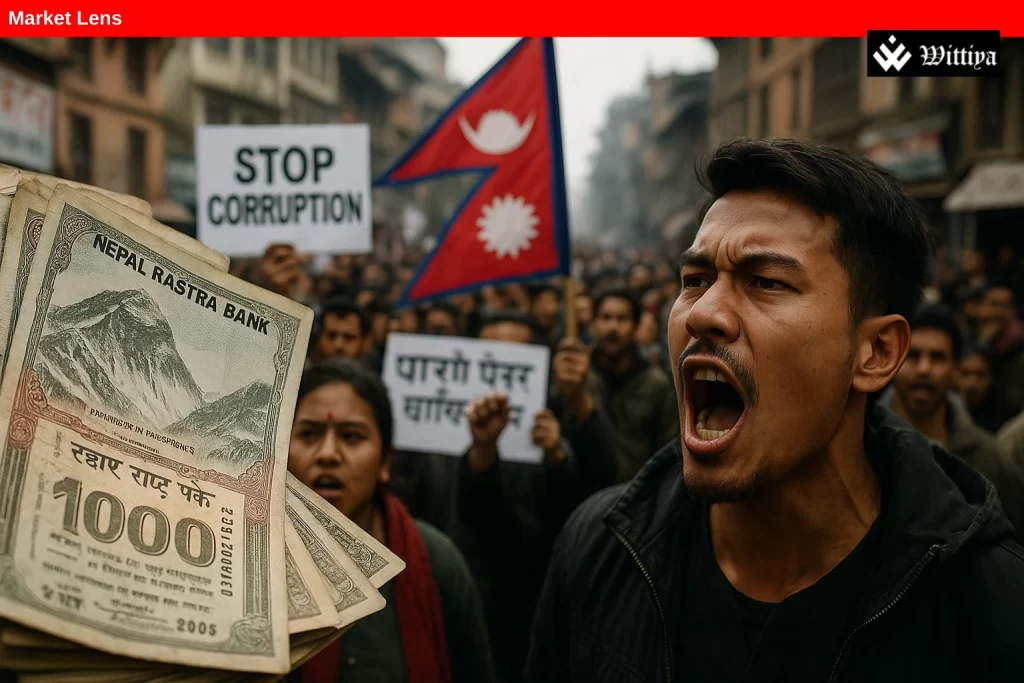
Nepal’s recent protests reveal that money, mismanaged and flaunted by elites while withheld from citizens, is at the heart of the nation’s unrest and economic collapse.
The streets of Kathmandu are restless again. From Durbar Square to Pokhara’s lakeside roads, chants and banners fill the air. For many, it may look like yet another chapter in Nepal’s long history of instability. But dig beneath the noise, and a clearer truth emerges. This uprising isn’t rooted only in politics or ideology. It is rooted in economics. It is about money — how it disappeared, how it was misused, and how it was flaunted in the faces of those who had none. In Nepal’s story of unrest, money is the common thread that explains its fall.
When the Pandemic Emptied the Nation’s Wallets
Covid-19 turned Nepal’s fragile economy into quicksand. Tourism, the country’s lifeline, collapsed overnight. Trekkers who once filled tea houses in the Himalayas vanished. Hotels, restaurants, and guides saw bookings evaporate. Taxi drivers waited hours for customers who never arrived. Entire mountain communities, which had learned to survive on seasonal tourist dollars, were left without income.
At the same time, remittances — which account for nearly a quarter of Nepal’s GDP — slowed as Nepali workers abroad faced layoffs and pay cuts. Families back home who relied on that money found themselves trapped. Essentials like rice, cooking oil, and fuel grew costlier, but wages disappeared. Money became not just scarce but impossible. For many, survival itself turned into a daily negotiation with debt.
Corruption as the New Currency of Leadership
In times of crisis, governments are expected to step up. In Nepal, the opposite happened. Aid packages, relief funds, and international loans meant to stabilize the economy rarely reached the people who needed them most. Instead, they were siphoned into the pockets of those in power. Contracts for hospitals and infrastructure were awarded to cronies, not to those most capable. Medical supplies were hoarded or resold at inflated prices.
For ordinary citizens, this was not just incompetence but betrayal. They watched leaders enrich themselves while the poor scrambled for food and oxygen cylinders. Corruption became so routine that bribery was seen as the only way to secure jobs, licenses, or government help. In Nepal, money wasn’t just a measure of wealth — it had become the only language the state understood. And for the people, that language was cruel.
A Generation Without Paychecks
Nepal’s greatest resource has always been its youth. But today, that resource feels abandoned. After the pandemic, joblessness became the norm rather than the exception. Thousands of graduates with degrees discovered that their qualifications meant little in this situation.
For many, the only way out was to leave. Recruitment agencies charged huge fees to send workers to India, Gulf countries Or East Asia, pushing families into debt just for the chance at foreign wages. Those who stayed behind felt trapped in a cycle of unemployment and underemployment. The frustration was more than economic — it was personal. A generation that should have been building Nepal’s future instead watched its dreams sold for cash. When money controls opportunity, anger is inevitable.
The Outrage of Golden Shoes and Diamond Watches
Nothing fueled resentment more than the images that spread on social media with multiple trends. Ministers’ children, shielded by privilege, flaunted designer watches, limited-edition sneakers, and luxury cars. Screenshots of Instagram posts went viral, with ordinary Nepalis calculating the cost of these items against their own monthly earnings. One viral example showed the price of a politician’s son’s shoes — more than what a rural farmer earned in an entire year.
The symbolism was sharp. These images weren’t just displays of wealth; they were public taunts. For families forced to skip meals or take on crushing loans, the spectacle of elites living like global celebrities was intolerable. Money became a weapon of humiliation. Inequality wasn’t just visible — it was flaunted. And in a country struggling to feed its own, that sight was unforgivable.
Silencing Voices, Strangling Livelihoods
The government’s decision to ban social media poured fuel on the fire. For many Nepalis, social media wasn’t just entertainment — they were business tools. Small entrepreneurs promoted handicrafts, restaurants marketed menus, trekking guides connected with tourists, and youth carved out digital livelihoods through content creation.
When those platforms were blocked, it wasn’t only dissent that was silenced. Entire businesses collapsed overnight. A trekking lodge in Pokhara that had shifted to online bookings saw reservations vanish. A young designer selling clothes via Instagram lost her only customer base. By cutting off social media, the state severed income streams for thousands. Once again, the story circled back to money: it was withheld from the people and weaponized by those in power.
Decades of Boiling Anger Spill Over
Nepal has lived through many transitions — monarchy to democracy, civil conflict to fragile peace. Each phase came with promises of renewal, yet each left behind the same frustration: money never seemed to reach where it was needed most. Roads remained broken, schools underfunded, hospitals short of medicine. Yet politicians grew wealthier, their children educated abroad, their families shielded from the struggles of ordinary people.
This imbalance brewed anger for decades. The current protests are not just spontaneous outrage; they are the boiling over of years of disappointment. The young march not simply for ideology but because they are tired of seeing money dictate who succeeds and who suffers. They rise not only against leaders but against a system where money is the only true power.
Writing on the Wall: When Money Breaks a Nation
Nepal’s fall was not the work of a single party or a single leader. It was the cumulative result of money mishandled at every level — hoarded by the elite, stolen by politicians, flaunted by their children, and denied to the millions who needed it most.
The protests filling the streets are not abstract political slogans. They are economic cries. People are demanding more than change of government; they are demanding a change in the way money works in their country. They want survival without bribes, jobs without corruption, dignity without inequality.
In the end, Nepal didn’t fall because of ideology. Nepal fell because money, in the wrong hands, became more powerful than justice, fairness, or hope. And when money breaks a nation, it is always the people who pay the price.
READ MORE ON