


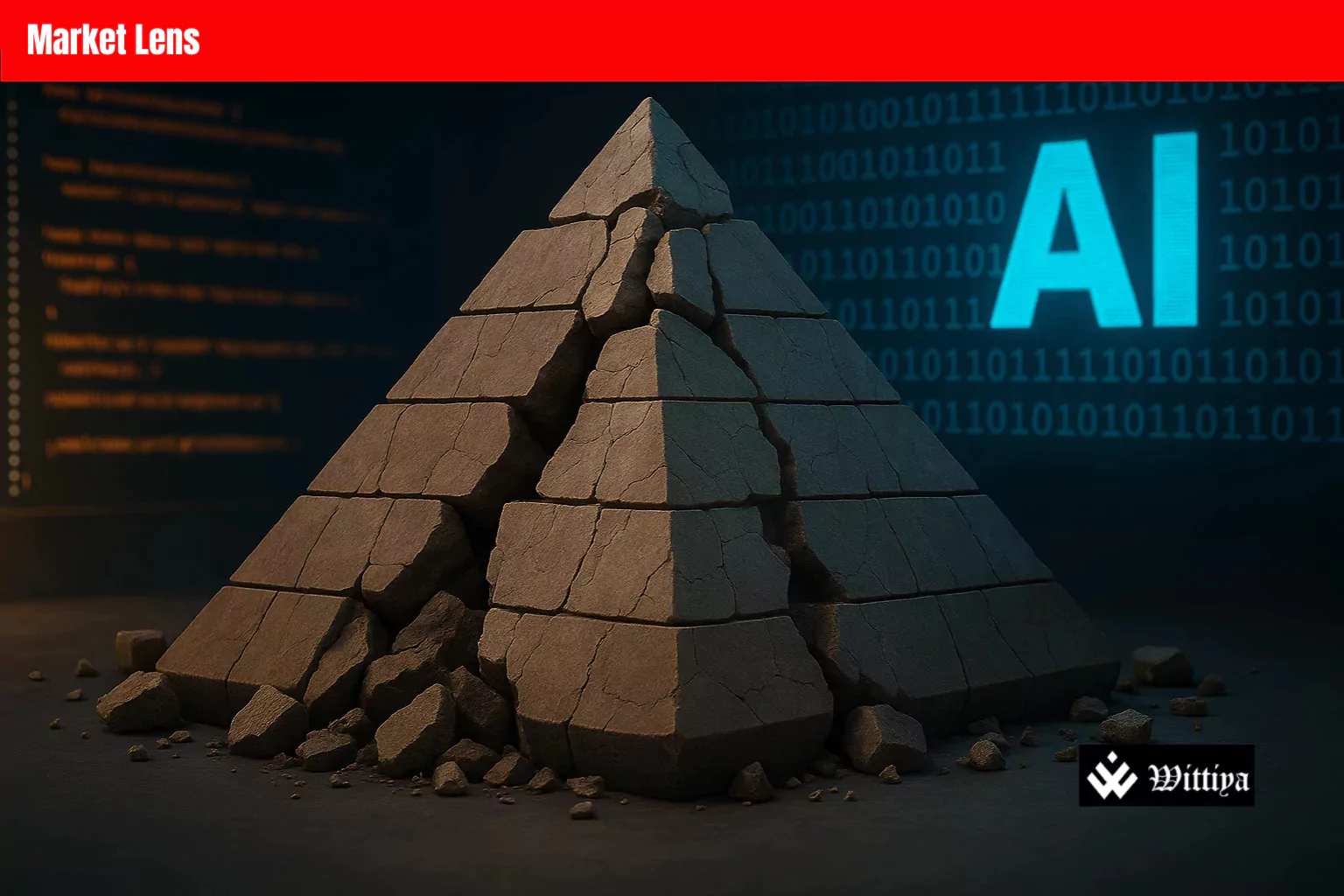
India’s IT services industry, long built on mass hiring of freshers and an offshore-driven pyramid model, is facing a turning point as Generative AI transforms client expectations and workforce strategies. With the pyramid’s foundation beginning to crumble, major firms in Karnataka and beyond are shifting toward AI-ready talent and away from volume-based hiring.
Cracks in the Foundation
For decades, the Indian IT services sector has flourished on the strength of a well-oiled pyramid model: hire thousands of freshers annually, train them cheaply, and deploy them at scale for global clients. This model brought consistency, cost-efficiency, and offshore dominance. But with the rapid rise of Generative AI (GenAI), that foundational pyramid is showing visible cracks.
GenAI tools like GitHub Copilot, ChatGPT, and Google’s Gemini are increasingly capable of writing code, automating testing, generating documentation, and more. As clients begin to demand AI-augmented delivery, Indian IT companies are re-evaluating whether large pools of junior engineers are still necessary in the same volume. What once was a badge of scalability may soon become a sign of inefficiency.
The Old Engine of the IT Pyramid
Historically, the strength of India’s IT pyramid came from its bottom layer—fresh graduates.
IT services companies recruited en masse from engineering colleges across disciplines, including Mechanical, Civil, Electronics, and EnTC—regardless of whether students had a background in software. Packages hovered between ₹3–4 LPA, and have barely changed in over a decade.
The selection criteria were simple but strict: candidates needed a first-class academic record and the ability to clear an aptitude test. This ensured that recruits had a baseline of logical reasoning and mathematical skill, even if they lacked coding experience. Within 3–6 months, companies would train them internally through standardized programs, equipping them with the skills needed for entry-level development or testing roles.
This mass hiring model allowed firms to scale rapidly, promise clients affordable delivery, and maintain a steady pipeline of deployable resources—especially attractive to clients looking to outsource large-scale maintenance or development projects.
Bench Strength: A Strategic Advantage Turned Liability?
Indian IT firms also used a concept called “bench strength” to their advantage. This referred to the practice of keeping thousands of employees on standby—officially employed but not assigned to a client project. These employees would undergo training or remain idle while awaiting deployment.
Major Indian IT firms showcased their bench strength to win contracts quickly. This was their USP: they could kick off projects instantly with already-trained, salaried personnel—something Western IT competitors couldn’t match due to tighter labor laws, minimum wage requirements, healthcare costs, and cultural resistance to hire-and-fire practices.
Foreign competitors eventually adapted to this model by establishing massive India operations. Here’s a snapshot of global IT firms and their current headcount:
| Foreign IT Company | India Employee Count | Global Employee Count |
| Accenture | 300,000+ | 742,000 |
| IBM | 140,000+ | 288,000 |
| Capgemini | 185,000+ | 340,000 |
| Cognizant | 250,000+ | 345,000 |
| DXC Technology | 40,000+ | 130,000 |
These firms initially struggled with scale, but once they replicated the Indian model locally, they quickly became major players, often outcompeting Indian firms on process maturity, digital expertise, or consulting-led delivery.
A Shift from Volume to Value
The age of hiring in bulk to bill by the hour is fading. Several top-tier Indian IT firms have already signaled a moderation in fresher hiring. Instead, they’re aggressively reskilling mid-level employees and investing in domain-specific GenAI integration.
Leaders from these major IT firms have acknowledged that revenue growth is increasingly decoupled from headcount growth.
This underscores a deeper shift: companies don’t need more coders—they need smarter, multi-skilled AI-capable talent. As a result, legacy roles like manual testers, L1 support staff, and entry-level coders are under existential threat.
Indian engineering colleges, which once functioned as feeder pipelines to IT giants, are also beginning to feel the pinch. Campus placements have become more selective and skill-oriented, with less emphasis on bulk hiring drives and more on certifications, AI readiness, and project portfolios.
Flattening the Pyramid
The pyramid’s flattening is visible in hiring data. Entry-level intake across the top 5 IT companies has dropped by over 30% compared to pre-pandemic levels. Many firms are delaying onboarding of 2023 graduates into 2025, further straining the confidence of fresh tech talent entering the workforce.
As GenAI models improve, tasks previously assigned to junior developers—like writing boilerplate code, unit testing, or fixing bugs—are being automated or significantly accelerated. While this increases delivery speed and efficiency, it also reduces the need for traditional manpower layering.
Companies are also reducing their reliance on legacy service lines. Areas such as infrastructure support, quality assurance, and business process outsourcing (BPO)—once the strongholds of mass employment—are being deprioritized in favor of platform engineering, AI transformation services, and cloud-native architecture.
Upskilling or Obsolescence
Major firms are launching internal GenAI certifications, coding bootcamps, and AI-led service training to pivot their workforce.
Startups and IT consulting firms are also jumping in, offering specialized GenAI services that traditional IT players are still catching up with. Hiring has moved away from “just” Java or Python developers—it now looks for “AI-ready engineers” who understand data pipelines, prompt engineering, model tuning, and API integration. Those unwilling or unable to reskill risk rapid obsolescence.
As firms look to shrink middle management layers and automate repetitive reporting and ticketing systems, the question arises: will India’s IT workforce shrink before it transforms?”
Rethinking the Pyramid, Rebuilding the Future
Indian IT firms that recognize this shift and evolve will not only survive but lead. The real question isn’t whether the pyramid will collapse. It’s whether India can redesign it with stronger, smarter blocks at every level.
For the young engineer, the message is clear: learn fast, think beyond code, and embrace AI—or risk being left behind. For the industry, this is not just evolution—it’s a fork in the road between transformation and extinction.