






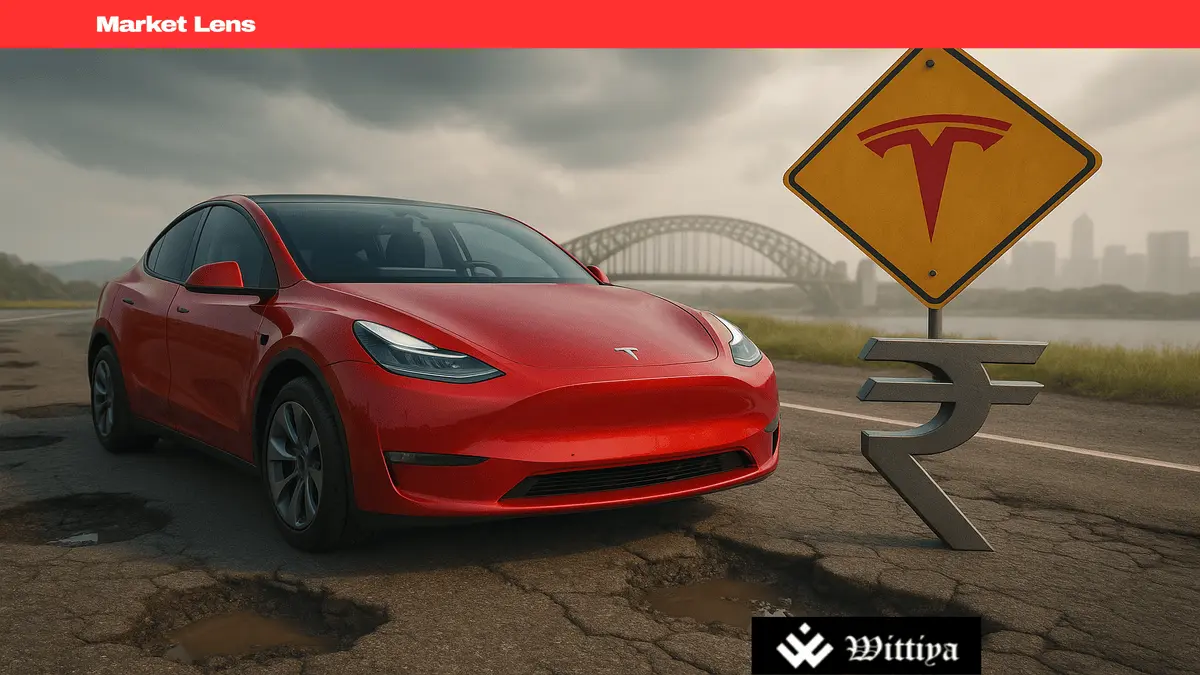
Tesla has finally entered the Indian market with its premium Model Y after a decade of delays, lobbying, and regulatory negotiations. Launched amid global challenges—including falling margins in China, political setbacks in Europe, and slowing EV demand in the U.S.—Tesla faces a tough road in India. This article explores the brand’s high-stakes entry, pricing hurdles due to import duties, poor charging infrastructure, and rising competition from BMW, Mercedes, Volvo, and Tata. Without local manufacturing or policy incentives, Tesla’s luxury-first approach may struggle to gain ground in a value-driven Indian EV market.
A Decade in the Making: Diplomacy, Delays & the Luxury Test Launch
The road to Tesla‘s India debut stretches back a decade, marked by negotiations with not just trade officials but multiple layers of government—from the Ministry of Heavy Industries to state energy departments. Tesla’s persistence in lobbying for reduced tariffs, supportive EV policies, and infrastructure support culminated in July 2025 with the launch of the Chinese-assembled Model Y. At ₹60–68 lakh, the vehicle caters to affluent elites, fulfilling Tesla’s ambition of establishing a luxury brand presence while the broader ecosystem matures.
Tesla’s entry was announced with high-octane fanfare—including marketing tie-ups with luxury malls and elite brand activations—signaling that the intent was more than sales volume: it was about planting the brand flag in India’s evolving EV market.
Global Headwinds Turning South: A Market-Wide Bellwether
Tesla’s pivot toward India isn’t happening in a vacuum—it’s unfolding amidst intensifying global headwinds that are putting pressure on the company’s most mature markets. Once the undisputed leader in the electric vehicle (EV) revolution, Tesla is now finding itself caught between political controversies, economic slowdowns, and rising competitive heat across continents.
- China: Demand Softens, Margins Squeezed
In China, Tesla’s largest international market, the company has been forced to slash prices multiple times over the last 18 months. These aggressive cuts, especially on the Model 3 and Model Y, were an attempt to defend market share against BYD, Nio, and Xpeng—Chinese automakers that now offer high-tech, feature-rich EVs at competitive prices. But the price cuts came at a cost—gross margins for Tesla have dipped, worrying investors about the long-term profitability of its volume strategy.
China’s slowing economy and evolving buyer preferences—toward smaller, software-rich EVs with local flavor—have made it a tougher market for Tesla’s minimalist aesthetic and premium pricing. Meanwhile, BYD has overtaken Tesla in global EV unit sales in some quarters, a symbolic moment for the shifting balance in EV leadership.
- Europe: Political Missteps and Growing Skepticism
In Europe, Tesla’s market share has shown signs of erosion, despite the opening of its Gigafactory in Berlin. Beyond competition from legacy players like Volkswagen and Renault, Tesla has been embroiled in political and public perception controversies.
CEO Elon Musk’s open support of right-wing parties during the 2024 German elections—including controversial statements on immigration—has alienated large swathes of the European public. Combined with his affiliations with conservative politics in the U.S., including his ties to Donald Trump, this has tarnished the brand image in liberal-leaning European markets. What was once seen as a progressive, eco-conscious brand is now viewed by some as politically polarizing.
Additionally, labor union challenges in Germany and Sweden, and growing pressure to improve worker conditions and sustainability disclosures, have added to Tesla’s operational headaches.
- U.S.: Growth Fatigue, Investor Anxiety
Back home in the U.S., Tesla is still dominant—but not without growing scrutiny. EV demand has plateaued, inventories have piled up at dealerships, and interest rate hikes have dampened auto financing. Musk’s pivot toward AI and robotics, while promising in the long term, has drawn criticism for distracting from core EV operations.
Moreover, rivals like Ford (with the Mustang Mach-E), General Motors (with the Cadillac Lyriq and Chevy Blazer EV), and even startups like Rivian and Lucid are steadily nibbling away at Tesla’s first-mover advantage. Add to that Musk’s volatile social media behavior and abrupt policy changes on X (formerly Twitter), and the result is a growing perception of unpredictability—something both investors and consumers are increasingly wary of.
India-Specific Barriers Under the Microscope
- Sparse Charging Infrastructure
India has just 1 public EV charger per 235 EVs—a ratio that demands exponential growth. Tesla aims to fast-track adoption via its Supercharger network, but broader expansion hinges on partnerships with utility companies and private developers. - Tariff vs. Localization Incentives
India’s SPMEPCI scheme grants 15% import duty for EV companies investing ₹4,150 crore and producing cars locally. So far, Tesla has not committed, likely waiting to see how quickly infrastructure evolves and whether the cost-benefit of investment justifies long-term factory inclusion. - Climate & Terrain Constraints
Monsoons, potholes, rural terrain, and 45+°C heat are not just challenges—they’re tests for Tesla’s suspension, battery thermal management, and ADAS sensors. Localizing MiTAC or Bosch-like upgrades could be necessary to match Indian conditions. - Service Network & Closed Ecosystems
Maintenance could be a tipping point for long-term customer satisfaction. Tesla’s presence isn’t dependent solely on brand appeal—it hinges on ecosystem readiness, including aftermarket support, crash repair timeliness, and software patches attuned to Indian road variability.
India’s EV Market: Tesla’s Tough Fit
India may be the world’s third-largest car market, but it’s a uniquely frugal and infrastructure-starved terrain for electric vehicles. While Tesla has long symbolized the gold standard in EVs globally, the Indian EV landscape operates on an entirely different equation—one where value, utility, and pricing dominate over brand prestige and autopilot buzzwords.
Tesla’s entry with Model Y, priced well north of ₹60 lakh due to hefty import duties, throws it into an ultra-premium bracket that only a fraction of Indian consumers can consider.
Unlike in the U.S. or China, where charging infrastructure is relatively mature and luxury EVs enjoy broader appeal, Indian EV buyers still lean toward practical, affordable options. Tata Motors, MG, and Hyundai have captured mindshare with models priced between ₹10–30 lakh—making Tesla a misfit in the value pyramid.
India’s charging network remains patchy and heavily urban-centric, with limited penetration outside Tier-1 cities. And for a car like the Model Y—built for long-range, high-speed highway use—the lack of high-capacity chargers and Tesla’s own supercharger ecosystem makes the Indian infrastructure woefully underprepared to support a premium EV experience.
While Tesla could consider partnerships or even install its own charging network, these are capital-intensive moves that don’t scale easily without robust policy backing.
Furthermore, government subsidies and incentives in India are skewed toward lower-cost EVs. The FAME II scheme, for instance, primarily benefits two-wheelers and commercial EVs—not premium imports. In contrast, companies like Tata and Mahindra qualify for these subsidies, helping them maintain cost leadership. Without local manufacturing or assembly, Tesla remains locked out of these advantages.
Even the psychology of Indian car buyers makes Tesla’s entry a complex puzzle. SUVs dominate Indian preferences—but mostly in the ₹10–25 lakh segment. The idea of paying 3–5x that price for a premium, battery-powered SUV—when ICE options like Fortuner or XUV700 deliver comfort, range, and resale value—is still a stretch for many Indian consumers.
And this challenge gets tougher when you look at premium EVs already in India. BMW’s iX1, Volvo’s XC40 Recharge, and Mercedes EQB offer localized assembly, better service accessibility, and pricing incentives, making Tesla’s import-only approach appear detached from market realities.
In a market where “value per rupee” trumps “brand allure,” Tesla’s current strategy feels more like a halo experiment than a serious push to gain share. The question remains: Will Tesla localize, or will it continue playing the long game?
Fuel Mix Snapshot 2025: India’s Road Ahead
| Fuel Type | Share in PV Sales |
| Petrol | 57.5 % |
| Diesel | 18.0 % |
| CNG | 19.4 % |
| EVs | 2.7 % |
| Hybrids | ~2.4 % |
EVs and hybrids together cross 5% of registrations, but the remaining 94% still rely heavily on petrol, diesel, and increasingly, CNG. Tesla must establish policy-adoption advantage (subsidies, belts) to become competitive.
Competitive Heat: Audi, BMW, Mercedes & The Premium EV Turf
Tesla’s Model Y isn’t entering a vacuum—it’s stepping into a battlefield already charted by German giants and new-age disruptors. And unlike Tesla, many of these brands have either started local assembly or have plans underway, which gives them a significant pricing and availability advantage.
- BMW: Legacy Precision, Local Assembly
BMW has been pushing hard with models like the iX1, i4, and i7, priced between ₹66 lakh to ₹2 crore. The iX1, its entry-level electric SUV, is locally assembled at its Chennai plant, significantly reducing costs. It combines traditional German luxury with high efficiency and smart interiors tailored for Indian driving preferences.
- Audi: Performance-Focused, Brand-Pulled
Audi offers the e-tron SUV, Q8 e-tron, and e-tron GT. Starting from ₹1.10 crore, these cars are positioned as aspirational yet functional vehicles for India’s elite. Though completely built units (CBUs), Audi’s brand recall and robust dealer-service network give it a premium edge.
- Mercedes-Benz: Tech Sophistication with an EV Edge
Mercedes-Benz’s EQB, EQE, and the flagship EQS 580 (locally assembled in Pune) offer a tech-rich experience with a legacy of after-sales excellence. The EQS is one of the most luxurious EVs locally produced, and priced at ₹1.55 crore, it directly targets premium buyers Tesla also seeks.
- Jaguar I-PACE: British Elegance, Indian Familiarity
Launched earlier, the Jaguar I-PACE at ₹1.2 crore, though aged in software capability compared to Tesla, enjoys a strong positioning among SUV lovers and urban buyers.
- Volvo XC40 Recharge: Compact and Practical
The XC40 Recharge, priced around ₹56 lakh, hits the sweet spot of luxury + practicality. Now assembled locally, it undercuts Tesla by offering a strong VFM (value-for-money) proposition with decent service access.
The Price Wall: Why Tesla’s Import Strategy Is a Double-Edged Sword
Tesla’s Model Y comes to India as a completely built-up (CBU) import. Here’s why this matters:
- 100–110% import duty on CBUs makes the car ₹20–25 lakh more expensive than it could be if locally assembled.
- Logistics and transit costs raise prices and delay availability.
- Lack of production-linked incentives (PLI) that local players like Tata or foreign rivals with Indian facilities benefit from.
In contrast, BMW, Mercedes, and Volvo are actively localizing production to tap into lower taxation (as low as 15% under some schemes) and faster delivery timelines—making their EVs more accessible and competitively priced.
Tesla vs Premium EVs in India — At a Glance
| Brand | Key EV Models | Starting Price (INR) | Local Assembly | Notable Feature |
| Tesla | Model Y | ₹60–68 lakh | ❌ | OTA software, Autopilot, range |
| BMW | iX1, i4, i7 | ₹66 lakh – ₹2 crore | ✅ | Driving dynamics, widespread service |
| Mercedes-Benz | EQB, EQE, EQS 580 | ₹77 lakh – ₹1.55 crore | ✅ | Advanced luxury, top-shelf interiors |
| Audi | e-tron, Q8 e-tron, e-tron GT | ₹1.1 crore+ | ❌ | Sleek design, performance branding |
| Volvo | XC40 Recharge, C40 | ₹56–65 lakh | ✅ | Scandinavian design, VFM |
| Jaguar | I-PACE | ₹1.2 crore | ❌ | Urban presence, Jaguar heritage |
The Long Drive Ahead
Tesla’s renewed interest in India appears less like a confident expansion and more like a strategic hedge. With traditional strongholds showing signs of fatigue or hostility, India’s growing middle class and EV ambitions seem like a natural pivot.
But as outlined in the previous sections, India isn’t an easy market to crack—especially with a premium-first, import-based strategy.
In essence, Tesla is playing a defensive hand globally while attempting to test offensive waters in India—but without local manufacturing or serious investment, the India bet risks becoming another expensive detour rather than a growth engine.