


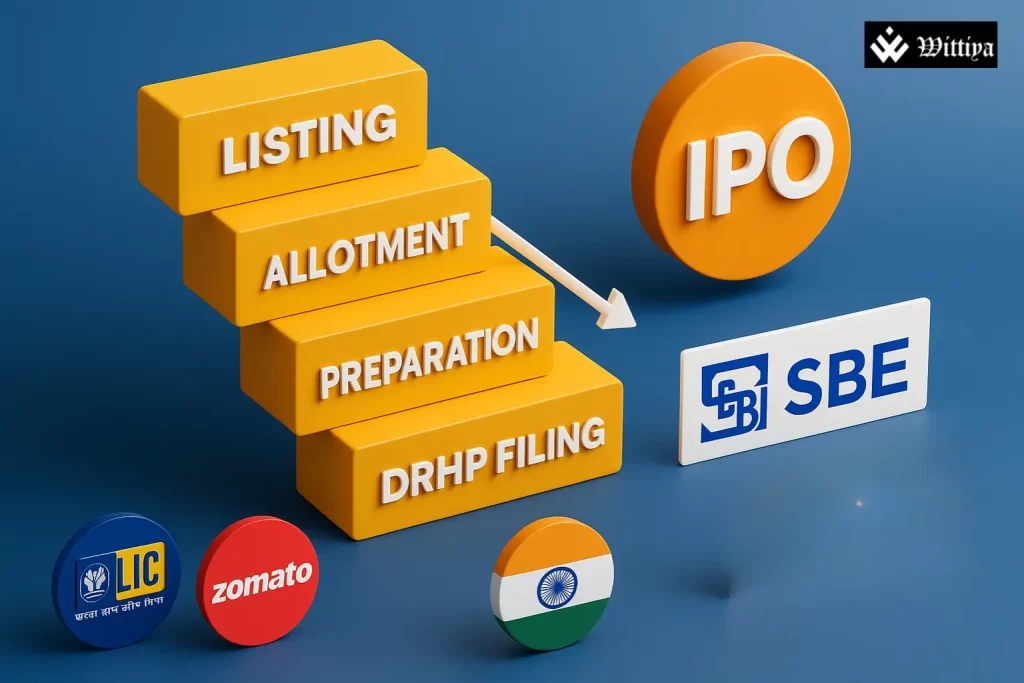
India’s IPO lifecycle is the process that takes a company from being privately owned to being publicly listed. The importance of each stage, from DRHP filing to listing day, cannot be underestimated for investors, regulators, and businesses as it determines the pace of growth and the level of transparency.
How Companies Go Public in India
“Going public” in India means the company will go through a metamorphosis. The IPO lifecycle acts as a blueprint that guarantees transparency, adherence to rules, and investor’s safety. In India, the Securities and Exchange Board of India (SEBI) is in charge, hence the whole system can be considered one of the most organized IPO structures in the world.
Both Zomato and LIC’s examples have demonstrated how the achievement of an IPO relies heavily on the planning and the following of the regulations. Besides solving the problem of the needed capital, an IPO allows the public to take part in a company’s advancement.
Step 1: Pre-IPO Preparations – Laying the Foundation
Without completing their own internal preparation, no company would ever dare file for an IPO.
- Financial Audits and Reporting:
According to SEBI, at least three years of audited financial statements are mandatory. Besides providing the essential financial figures, these documents also show how the company is making money and what is its level of indebtedness. For example, in the case of LIC’s IPO, for the sake of investors’ understanding, five years of audited financials were included.
- Board Approvals and IPO Planning:
Among others, the board gets to approve the following: issue size, pricing strategy, and capital utilization. Ensuring harmony with the business’s long-term objectives is to be expected here.
- Appointment of Merchant Bankers and Advisors:
Chartered bankers as Kotak Mahindra Capital or ICICI Securities are the ones responsible for managing the entire IPO program. They execute the due diligence, prepare the prospectus, and sort out the legality of it all.
- Internal Restructuring and Compliance:
The operations of a company might have been overhauled, governance structures updated, and prepared disclosures for investors might have been done in order to meet the SEBI requirements.
Step 2: Filing the DRHP with SEBI – The First Step
The Draft Red Herring Prospectus (DRHP) is actually the first way for the company to communicate with SEBI. Information here includes:
- Business Overview: Products, services, revenue model, and market positioning
- Financials: Revenue, profits, and past performance
- Promoter Details: Background and shareholding pattern
- Risk Factors: Operational, market, and regulatory risks
Example: As part of its DRHP, Zomato detailed its losses against growth metrics; thus, it showed a transparent view to prospective investors.
Why it matters: The DRHP leads to the protection of investors’ rights by showing the company’s financial and operational health in totality.
Also Read: Studio LSD IPO: Subscription Status, Price Band, and Listing Forecast
Step 3: SEBI Review and Red Herring Prospectus (RHP)
The DRHP is initially submitted to the Securities and Exchange Board of India (SEBI) for a thorough check for accuracy, completeness, and consistency with the regulations. The company may have to provide clarifications to multiple queries and also amend the prospectus.
The RHP is then submitted to SEBI and the stock exchanges. It includes:
- Final price band for bidding
- Number of shares to be offered
- Details about the issue date and issue closure date
Fact: SEBI’s review process ensures that the investors are protected from the fraudulent disclosures and also, they get to know the prices and the operations in a transparent way.
Step 4: Marketing – The IPO Roadshow
One of the ways the corporations get the investors to be interested in their proposals is by carrying the roadshows out:
- Domestic Roadshows: Meetings with institutional investors held in India’s financial centers like Mumbai and Bengaluru
- International Roadshows: Looking for foreign institutional investors (FIIs) targeted for large IPOs
- Investor Education: Teaching about the product, the ways of making money, and the expansion strategy
Example: Zomato’s roadshow highlighted its growth plan and prospering food delivery industry to draw institutional investors.
Also Read: GNG Electronics IPO Opens Soon – ₹225–₹237 Price Band Confirmed!
Step 5: Book-Building and Price Discovery
India is inclined to use the book-building method while implementing IPOs. The major stages include:
- Defining a price band (minimum and maximum price)
- Aggregating bids from institutional and individual investors
- Setting the final issue price depending on demand
Example: LIC IPO encountered a retail oversubscription of nearly 3x, pointing out substantial public interest.
Fact: Book-building gives a possibility of the fair market price to be found thus, demand and supply become balanced and consequently the risks of underpricing or overpricing will be diminished.
Step 6: Share Allotment and Refunds
Once the IPO has come to a close:
- Securities are allotted to successful applicants
- Money is refunded to the investors who did not receive the shares
- Shares are credited to demat accounts, which is a transparent process
Example: In Zomato’s IPO, retail investors got the shares in the proportion to their bids, with oversubscription causing the fractional allotment.
Step 7: Listing Day – The Public Debut
Listing day is opposite the end of the IPO process, the time when the shares begin trade on NSE and BSE.
- Price Movements: Driven by demand, market sentiment, and sector trends
- Market Perception: The strong listing raises investor confidence; the weak one can mean the caution
Examples:
- Zomato listed a little bit higher than its IPO price, early investors got a reward
- LIC shares listed at a price that was 8-9% higher than the IPO, showing the strong interest of retail and institutional investors
Fact: Listing day is very important for the market credibility and future capital-raising potential.
Step 8: Post-IPO Compliance
At the moment public, companies bear a big burden of ongoing compliance:
- Quarterly Financial Reporting: Publishing of revenue, profit, and cash flow
- Shareholding Disclosure: Frequent updates on promoters and institutional holdings
- Corporate Governance: Applying regulations of SEBI and stock exchanges
Example: HDFC Bank together with Infosys uphold investor presentations coupled with quarterly reporting as part of their shareholders’ trust program.
Key Facts About IPOs in India
- The IPO market in India is among the largest in Asia and has more than 70 IPOs in 2024.
- Book-building is the technique that guarantees fair pricing both for retail and institutional investors.
- Investors are allowed to participate in three types of categories: retail, institutional, and high-net-worth.
- IPOs turn out to be a capital source for companies to invest in their growth, repay their debts, or take over other companies.
- After the IPO, companies become more visible in the market and gain credibility.
The IPO lifespan in India is a multi-step, regulated process that is characterized by transparency, investor protection, and market efficiency. The filing of DRHP to the listing day is just as important as any other stage of it. Knowing this cycle will not only help investors make the right decisions but will also be a guide for companies when they go through a successful transition from being privately owned to a public entity.
FAQ’s
What is SEBI?
SEBI is an acronym for the Securities and Exchange Board of India, which is a regulator for the securities and capital markets of India.
When was SEBI created?
The formation of SEBI was done in the year 1988 and it became a statutory body in 1992.
What are the main functions of SEBI?
Among the main functions are: the organizations of stock markets, the registration and the control over the activities of intermediaries, the protection of investors, and the promotion of investor education are some of the major functions of SEBI.
READ MORE ON