


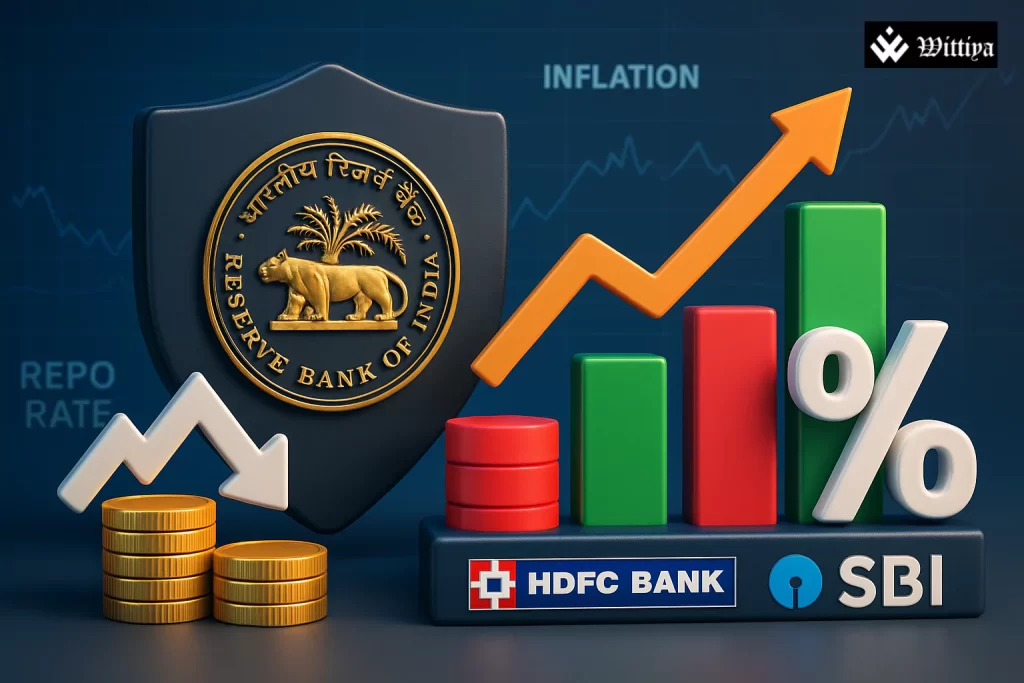
In India, RBI decision-making affects the stock market trends and the performance of your investments. The article explains the link between your portfolio and the repo rate, CRR, and inflation control.
Introduction: India’s RBI and Your Money
In India, the Reserve Bank of India (RBI) is not just a regulator—it is the central bank of the financial system. Every policy decision, be it a repo rate change or a CRR adjustment, impacts your investments directly. It is very important to know that RBI policies will have an impact on your investments. This applies to both new and seasoned investors who are used to fluctuating markets.
How Repo Rate Influences Your Investments
Repo rate refers to the interest rate at which the central bank of the country (RBI) lends money to commercial banks. When the RBI increases the repo rate, the cost of borrowing goes high and as a result people tend to borrow less thereby shrinking the economic growth. On the other hand, a lower repo rate induces people to borrow money and the market will start to heat up.
Impact on Investors:
- Fixed Income Investments: The return you get from bonds and fixed deposits can be higher in a high-rate environment.
- Equity Market: The increase in interest rates can make the stock market slow down as the companies might face the problem of having to pay more for their borrowed money.
- Borrowers: Interest on loans will be on the rise making the real estate and consumer finance sectors to suffer.
In fact, Indian banks such as HDFC Bank and State Bank of India regularly change deposit and loan interest rates in accordance with the repo rate shifts.
CRR (Cash Reserve Ratio) and Its Effect
CRR is the amount of money out of the total deposits of a bank that has to be kept with the RBI. Excessive CRR removes the money from the market tightening liquidity while a lower CRR raises lending capacity.
Investor Implications:
- Liquidity: High CRR can discourage banks from lending which in turn may lead to lower economic growth.
- Stock Market: Firms that rely on debt for their working capital needs may face difficulties during hikes.
- Interest Rates: The raising of CRR can make long-term lending rates to rise thus, companies will have fewer profits to issue stocks.
Also Read: RBI’s Rate Cuts May Be Too Late to Save India’s Urban Economy
Inflation Control: Protecting Your Investments
What money does it take to buy goods and services when the same amount is more than in the past? That is inflation. The RBI controls inflation by deploying instruments like repo rate changes, which stabilizes the economy.
Why It Matters to Investors:
- Equity Markets: Needless to say, the corporate profits that come from inflation of moderate nature become the coins of the realm; however, are not able to survive when market confidence takes a dive due to severe inflation.
- Fixed Income Investments: Inflation will always chip away at the real returns of fixed deposits and bonds.
- Portfolio Strategy: Knowing RBI’s stance on inflation gives the investor the resources advised to act in his own fairness by allocating his assets in diversified ways.
Also Read: SBI vs. RBI: Who’s Right About India’s Economic Future?
Historical Perspective: India’s RBI Actions
In the last 10 years, India’s RBI had to overcome various obstacles like global economic deceleration, high inflation, and major economic reforms. Some of the most important things are:
| Year | RBI Action | Market Impact |
| 2013 | Repo Rate Hike | Equity dip, fixed deposits rise |
| 2019 | Repo Rate Cut | Market boost, lower loan rates |
| 2023 | Inflation Control Measures | Stabilized equity growth, managed borrowing costs |
These cases are examples of how it is beneficial to you to keep an eye on the changing RBI policies to know when to take action and how to manage risk.
Practical Tips for Indian Investors
- Be it mandatory, you should be an active reader of the news advertisements by RBI. Watch repo rate and cash reserve ratio changes to predict what the future interest rates will be.
- Don’t Put All Your Eggs in One Basket: Apart from stocks also own fixed income products and commodities to be a problem solver for risks associated with RBI policy changes.
- Short-Term vs Long-Term Perspective: Rate hikes and other RBI tightening measures may create panic in the short term but deep fundamentals will always matter more in the long term.
- Take Advantage of Professional Opinion: Learn the different points of view of the Indian financial organizations to synchronize your investment decisions with their predictions of the policy.
Expert Advise:
Financial experts in India continuously stress the importance of knowing the RBI policies as a key factor for a healthy portfolio. While risk-takers may be able to use the situation for profit when interest rates are low, conservative players usually prefer to keep their money safe in fixed-income assets during the tightening periods.
Key Insight:
Friendly measures taken by the RBI widen the avenues of easy borrowing inviting new investors to enter the market. In return for a lighter liquidity squeeze the market and investors are encouraged by RBI signaling and tend to behave in a certain way. Fully understanding of how RBI policies affect your investments is it what takes informed decision-making.
The Reserve Bank of India’s monetary policy decisions—repo rate, CRR, and inflation control—are always directly visible to investments. As an investor in stocks, bonds, or fixed deposits, knowing how RBI policies affect your investments is the one thing that keeps you as a smart, risk-managed player.
FAQ’s
What are the main functions of the RBI?
The Reserve Bank of India (RBI) oversees money supply through currency issuance, keeps inflation under control, regulates and supervises banks to ensure the safety of the banking system, provides the state with the means for managing its financial operations and acts as the banker and debt manager of the government.
How does RBI control inflation in India?
To control inflation, the RBI adjusts the liquidity in the market through instruments such as the repo rate, the reverse repo rate, and the cash reserve ratio, which directly affect the money supply in the economy.
What is the repo rate?
Repo rate is the interest rate at which the central bank of the country, i.e. the Reserve Bank of India (RBI), provides loans to the commercial banks in India for their short term requirement.
READ MORE ON