


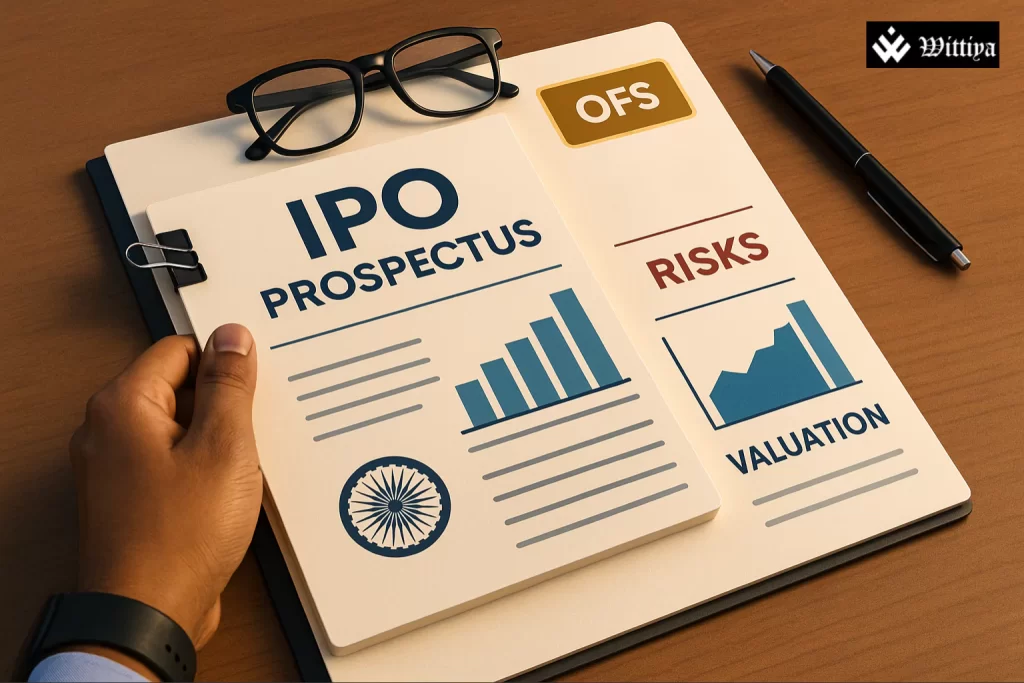
A layman step wise explanation for Indian investors to grasp IPO basics, fresh issue vs OFS, financials, risks, and valuation before investing.
How to Read an IPO Prospectus: A Beginner’s Guide
One of the most exciting events in the stock market is a decision by a private company to go public through an IPO (Initial Public Offering). A company can use an IPO to sell its shares to the public for the first time, and after that, it could utilize the money to grow the business, pay off loans, or increase the company’s scope of operations. IPOs are like a once-in-a-lifetime chance for investors to get their hands on a piece of the firm and possibly make a profit when it grows further.
If there is only one document that you need above all others, then it is the IPO prospectus (known as Draft Red Herring Prospectus, or DRHP, in India). It is essentially a file that contains a summary of the company, the IPO, and all the potential risks.
We can try to break it down using simple everyday language.
Also Read: SEBI Approves IPO Proposals of 13 Companies
1. Understanding IPO Types: Fresh Issue vs Offer for Sale (OFS)
An IPO could be either a Fresh Issue, an OFS, or a mixture of both.
| Type of IPO | What It Means | Who Benefits | Example |
| Fresh Issue | Company issues new shares to raise capital | Company | Infosys issuing new shares to fund growth |
| OFS | Existing shareholders sell their shares | Shareholders, not company | Promoters of a startup selling shares to the public |
Significance: By having this knowledge, investors would be able to comprehend if their money is employed to support company expansion (fresh issue) or it is in possession of the existing shareholders (OFS).
2. IPO Price, Lot Size, and Valuation
The prospectus outlines:
- Price Band: The share application price range.
- Lot Size: Least number of shares for application.
- Valuation Metrics: How much the company’s value is compared with its peers.
| Metric | What to Check |
| Price Band | Is it reasonable compared to profits and peers? |
| Lot Size | Can you afford the minimum shares? |
| Valuation | Compare with industry competitors |
Advice: A company with a solid brand and expansion could claim a higher valuation, whereas smaller companies might offer a cheaper entry point.
3. Reading Financial Statements
Financials are the company’s tale of the past. Main points:
| Section | What to Look For | Why It Matters |
| Revenue & Profit | Trends over 3–5 years | Growth consistency |
| Debt Levels | Loans and liabilities | Higher debt = higher risk |
| Cash Flow | Cash inflow vs outflow | Operational efficiency |
Chart Suggestion: An illustration of revenue and profit trends over five years enables readers to visually identify growth.
4. Understanding Risk Factors
Any plan considers risks, which in India might be:
- Change of regulation
- Dependence on a few customers or suppliers
- The economy in a bad condition
- Competition in the market
Advice: Don’t overlook the risks—they offer a balanced perspective of possible obstacles. You can also make a risk heat map that visually categorizes high, medium, and low risks.
5. Management and Promoters
The question of who is in control is very important.
- Study the directors and promoters’ credentials.
- Normally, experienced teams equate to better management.
Case: Tata Consultancy Services is one of the companies with the highest management experience to gain faith in investors.
Chart Suggestion: A list of premier promoters and their qualifications can help the newbies quickly assess the management.
6. Use of Proceeds
The document for a fresh issue lays out the plan of use of the raised money as follows:
| Use | Purpose |
| Expansion | New plants, technology, hiring |
| Debt Repayment | Reduce interest burden |
| Research & Development | Improve products/services |
By doing this, you are making sure that your money is going towards projects that bring growth and that in the long-term, will bring value.
7. Step-by-Step Tips to Read an IPO Prospectus
- First, get familiar with the IPO basics: look at the type, price, and lot size.
- Financial statements should be scrutinized thoroughly; the major areas are revenue, profits, debts, and cash flow.
- Get to know the risk factors and see if they match up with your tolerance.
- Reliability and experience can be checked by management and promoters.
- Find out if the money will be used for growth or not.
- Look at valuation and compare with industry peers.
Visual Suggestion: The presentation of steps for analyzing an IPO prospectus by using a flowchart can make it easy for beginners.
Also Read: Groww IPO Gets SEBI Nod for $1 Billion
Making the Prospectus Work for You
Reading a prospectus is not solely based on the recollection of numbers—it is more about linking the information together. By comprehending OFS vs fresh issue, financials, risks, management, and use of proceeds, investors can decide logically rather than just following the market craze.
Always supplement prospectus data with financial news, stock market trends, and analyst reports. In India, SEBI readies regulatory updates, whereas big banks like HDFC Bank and ICICI Bank are the ones to provide research reports.
Investors who are knowledgeable about the IPO prospectus will be able to spot the best opportunities, anticipate less surprises, and make their investment decisions wisely in the Indian stock market, which is very dynamic.
FAQ’s
What are the possible ways to invest in Indian stock market?
If you have a Demat account and a trading account with a valid broker, you can go for investing. After the procedure is completed, you will be able to buy and sell shares.
What are the major stock indices in India?
The major indices are the BSE Sensex and NSE Nifty 50, which track the performance of top companies in India.
Can foreigners invest in India?
Yes, foreign investors can invest through Foreign Portfolio Investment (FPI) or by purchasing shares through Indian brokers following RBI guidelines.
READ MORE ON